Fine-Tuning Is a Knife, Not a Hammer
Fine-tuning has a reputation problem.
Some people treat it like magic: “Just fine-tune, and the model will understand our domain.” Others treat it like a sin: “Never touch weights, it’s all prompt engineering now.”
Both are wrong.
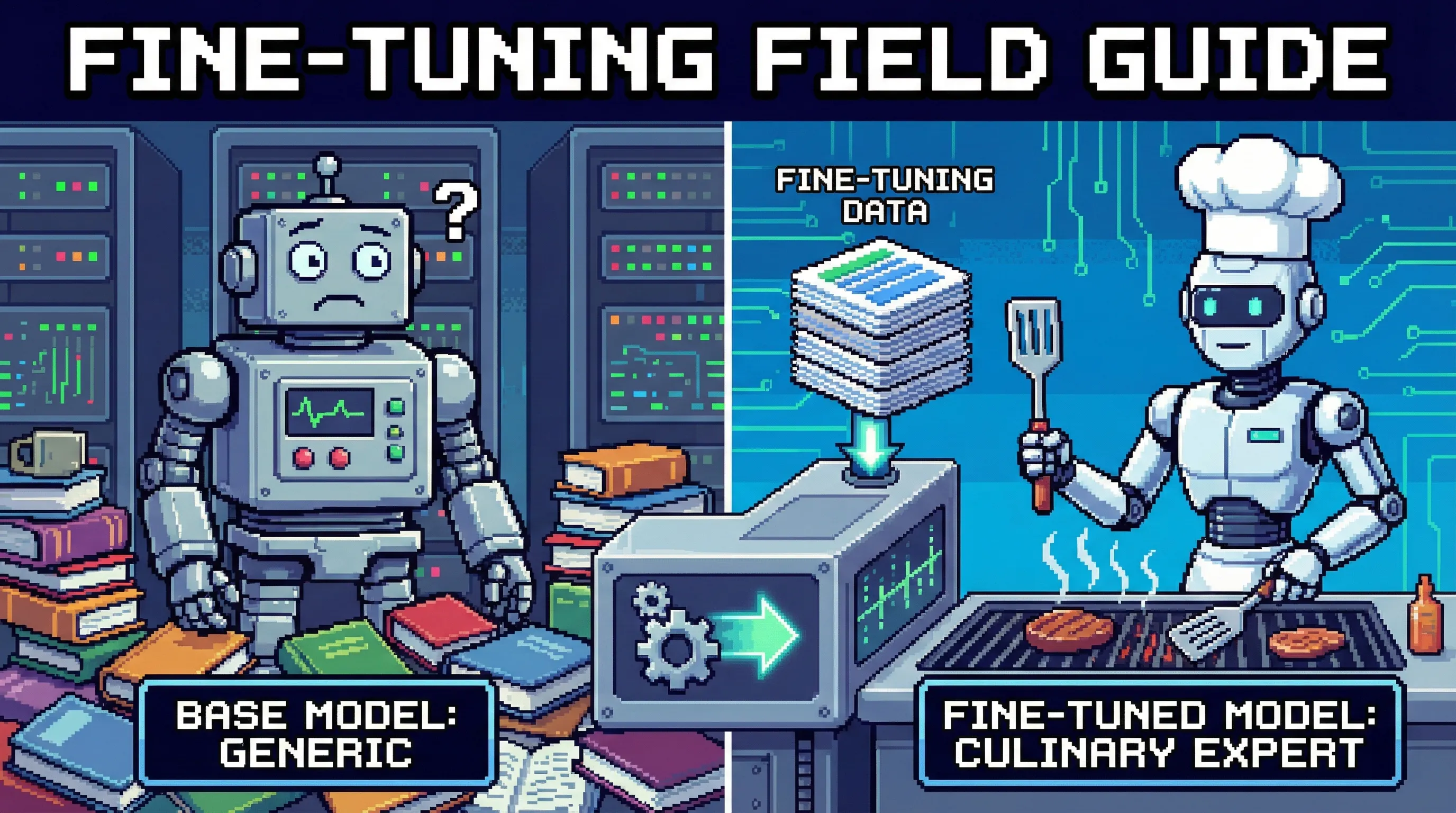
Fine-tuning is a precision tool. Used well, it turns a generic model into a specialist. Used badly, it burns GPU budgets, bakes in bias, and ships a model that performs worse than the base.
This is a field guide: what types of fine-tuning exist, what they cost, how to run them, and the traps that quietly ruin outcomes.
1) The Real Taxonomy of Fine-Tuning
There are multiple ways to classify fine-tuning. The cleanest is: what changes, what signal you train on, and what model type you’re adapting.
1.1 By training scope: Full FT vs PEFT
Full fine-tuning (Full FT)
Definition: update all model weights so the model fully adapts to the new task.
Traits:
- Maximum flexibility, maximum cost
- Requires strong data quality and careful regularization
- Risk: catastrophic forgetting (the model “forgets” general abilities)
When it makes sense:
- You have a stable task and a solid dataset (usually 10k–100k+ high-quality samples)
- You can afford experiments and regression testing
- You need deeper behavioral change than PEFT can deliver
Parameter-Efficient Fine-Tuning (PEFT)
Definition: freeze most weights and train small, targeted parameters.
You get most of the gains with a fraction of the cost.
PEFT subtypes you’ll actually see in production:
(A) Adapters
Insert small modules inside transformer blocks; train only those adapter weights. Typically, a few percent of the total parameters.
(B) Prompt tuning (soft prompts/prefix tuning)
Train learnable “prompt vectors” (or a prefix) that steer behaviour.
- Soft prompts: continuous vectors
- Hard prompts: discrete tokens (rarely “trained” in the same way)
(C) LoRA (Low-Rank Adaptation)
LoRA is the workhorse. It decomposes weight updates into low-rank matrices:
$$ n Delta W = BA, quad B in mathbb{R}^{d times r},; A in mathbb{R}^{r times k},; r ll min(d,k) n $$
Why it wins:
- You store only Delta W (small)
- Easy to swap adapters per task
- Strong performance per compute
(D) QLoRA
QLoRA runs LoRA on a quantised base model (often 4-bit), slashing VRAM requirements and making “big-ish” fine-tuning viable on consumer GPUs.
1.2 By learning signal: SFT, RLHF, contrastive (and friends)
Supervised Fine-Tuning (SFT)
Train on labelled input-output pairs. This is the default for:
- classification
- extraction
- instruction following (instruction tuning)
- style/tone adaptation
Preference optimisation (RLHF / DPO / variants)
Classic RLHF pipeline: SFT → reward model → policy optimisation (e.g., PPO). In practice, many teams now use direct preference optimisation (DPO)-style training because it’s simpler operationally, but the concept is the same: align the model to preferences.
Contrastive fine-tuning
Useful when you care about representations (retrieval, similarity, embedding quality), less common for everyday text generation.
1.3 By modality: language, vision, multimodal
- NLP: BERT/GPT/T5-style models; instruction tuning and chain-of-thought-style supervision are common
- Vision: ResNet/ViT; progressive unfreezing and strong augmentation matter
- Multimodal: CLIP/BLIP/Flamingo-like; biggest challenge is aligning representations across modalities
2) When Fine-Tuning Actually Pays Off
Fine-tuning shines in three situations:
2.1 Your domain language is not optional
Example: finance risk text. If the base model misreads terms like “short”, “subprime”, “haircut”, it will miss signals no matter how clever the prompt is.
2.2 Your task needs consistent behaviour, not one-off brilliance
A model that produces “sometimes great” answers is a nightmare in production. Fine-tuning can stabilise behaviour and reduce prompt complexity.
2.3 Your deployment requires control
On-prem constraints, latency budgets, data residency: self-hosted models + PEFT are often the only workable path.
3) When You Should NOT Fine-Tune
Here are the expensive mistakes:
- <100 labelled samples: you’ll overfit or learn noise
- task changes weekly: your fine-tune becomes technical debt
- you can solve it with retrieval: if the problem is “missing knowledge,” do RAG first
- you can’t evaluate properly: if you can’t measure, don’t train
4) The Fine-Tuning Workflow That Survives Production
Forget “train.py and vibes.” A real pipeline has repeatable stages.
4.1 Environment
Core stack:
- PyTorch
- Transformers + Datasets
- Accelerate
- PEFT
- Experiment tracking (Weights & Biases or MLflow)
4.2 Data
This is where most projects win or lose.
Minimum checklist:
- label consistency (do two annotators agree?)
- balanced distribution (avoid 10:1 class collapse unless you correct for it)
- no leakage (train/val split must be clean)
4.3 Model config
- pick base model
- pick tuning method (LoRA vs QLoRA vs full)
- decide what gets trained, what stays frozen
4.4 Training loop
- forward → loss → backward
- gradient clipping
- mixed precision when appropriate
- periodic eval
4.5 Evaluation + export
- validate on held-out set
- measure robustness and regression
- export artefacts (base + adapter weights)
5) Practical Code: SFT + LoRA (PEFT) with Transformers
Below is a slightly tweaked version of the standard Hugging Face flow, tuned for clarity and real-world guardrails.
# pip install transformers datasets accelerate peft evaluate
from datasets import load_dataset
from transformers import AutoTokenizer, AutoModelForSequenceClassification, TrainingArguments, Trainer
from peft import LoraConfig, get_peft_model
import evaluate
import numpy as np
dataset = load_dataset("imdb")
tokenizer = AutoTokenizer.from_pretrained("bert-base-uncased")
def preprocess(batch):
return tokenizer(batch["text"], truncation=True, padding="max_length", max_length=384)
tokenised = dataset.map(preprocess, batched=True)
tokenised = tokenised.remove_columns(["text"]).rename_column("label", "labels")
tokenised.set_format("torch")
base = AutoModelForSequenceClassification.from_pretrained("bert-base-uncased", num_labels=2)
lora_cfg = LoraConfig(
r=16,
lora_alpha=32,
lora_dropout=0.05,
target_modules=["query", "value"], # tweak per model architecture
bias="none",
task_type="SEQ_CLS",
)
model = get_peft_model(base, lora_cfg)
metric = evaluate.load("accuracy")
def compute_metrics(eval_pred):
logits, labels = eval_pred
preds = np.argmax(logits, axis=-1)
return metric.compute(predictions=preds, references=labels)
args = TrainingArguments(
output_dir="./ft_out",
learning_rate=2e-5,
per_device_train_batch_size=16,
per_device_eval_batch_size=32,
num_train_epochs=2,
weight_decay=0.01,
evaluation_strategy="epoch",
save_strategy="epoch",
load_best_model_at_end=True,
metric_for_best_model="accuracy",
logging_steps=100,
fp16=True,
)
trainer = Trainer(
model=model,
args=args,
train_dataset=tokenised["train"],
eval_dataset=tokenised["test"],
compute_metrics=compute_metrics,
)
trainer.train()
trainer.evaluate()
model.save_pretrained("./ft_out/lora_adapter")
What’s different (and why it matters):
- max_length trimmed to 384 to reduce waste
- LoRA targets are explicit (you should verify for your model)
- fp16 enabled, batch sizes set for typical GPUs
6) QLoRA in Practice: When VRAM Is Your Bottleneck
QLoRA is the “I don’t have an A100” option.
Use it when:
- your model is too big to fine-tune in full precision
- you want LoRA-level results with drastically less memory
- you accept slightly more complexity in setup
Operational note: QLoRA is sensitive to:
- quantisation config
- optimizer choice
- batch size/gradient accumulation
7) Hardware Planning (The Boring Part That Saves You £££)
A simple rule-of-thumb table (very rough, but directionally useful):
| Model size | Practical approach | GPU class | Why |
|—-|—-|—-|—-|
| 10B | QLoRA or multi-GPU | 80GB+ (multi-card) | Memory + throughput |
If your goal is a production system, plan for:
- checkpoints (storage balloons fast)
- inference latency testing (p50/p95/p99)
- versioning (base + adapters + configs)
8) Monitoring: How to Detect Failure Early
Track:
- train vs val loss divergence (overfitting)
- task metric (F1/AUC/accuracy) over time
- gradient norms (explosions or vanishing)
- GPU utilisation + VRAM (to catch bottlenecks)
Early stopping is not optional in small-data regimes.
9) The Pitfalls That Kill Fine-Tuning Projects
9.1 Data leakage
Validation looks amazing, test collapses.
Fix:
- group-aware splits
- time-based splits for temporal data
- deduplicate aggressively
9.2 Class imbalance
Model learns the majority class.
Fix:
- weighting
- resampling
- metric choice (F1 > accuracy in many cases)
9.3 “Bigger model = better”
On small data, bigger models can overfit harder.
Fix:
- match model size to data
- prefer PEFT
- regularise
9.4 Ignoring deployment constraints
A model that hits 0.96 AUC but misses latency and memory budgets is a demo, not a product.
Fix:
- benchmark early
- export-friendly formats (ONNX/TensorRT) if needed
- distil if latency matters
10) A Decision Cheat Sheet
Use this quick chooser:
- Data < 100 → prompt + retrieval + synthetic data
- 100–1,000 → LoRA / adapters
- 1,000–10,000 → LoRA or full FT (small LR)
- 10,000+ → full FT can make sense (if eval + regression are solid)
- VRAM tight → QLoRA
- Need preference alignment → DPO/RLHF-style preference training
- Task changes often → avoid weight updates, design workflows instead
Final Take
Successful fine-tuning isn’t “a training run.”
It’s a loop: data → training → evaluation → deployment constraints → monitoring → back to data.
If you treat it as an engineering system (not a one-off experiment), PEFT methods like LoRA/QLoRA give you the best tradeoff curve in 2026: strong gains, manageable cost, and deployable artefacts.
And that’s what you want: not a model that’s “smart in a notebook,” but a model that’s reliable in production.