
You sent $10,000 worth of Bitcoin through a “zero-fee” swap. You received $9,720 on the other end. Where did $280 go? Nobody charged you a fee. At least, not one you could see.
That’s not a glitch. That’s the business model.
The crypto swap fee comparison most traders do stops at the headline rate — the 0% or 0.1% splashed across a platform’s landing page. But analysis of over $1 million in aggregate volume across 25+ platforms, published by crypto.news in early 2026, found that advertised fees account for just 30–50% of what traders actually pay. The rest disappears into spread markups, inflated withdrawal charges, and conversion padding — costs that don’t appear on any pricing page.
This piece breaks down exactly how hidden crypto exchange fees work, what the real cost of a crypto swap looks like across leading platforms, and why fee transparency has become the defining differentiator in the instant swap market.
The Anatomy of a “Zero-Fee” Swap
“Free” crypto swaps are never free — platforms advertising zero fees earn revenue through spread markups, typically 1–3% per transaction.
A spread markup is the hidden fee an exchange adds by widening the gap between buy and sell prices. When Bitcoin’s mid-market price sits at $50,000, and a platform quotes you $50,750 to buy it, that $750 difference isn’t volatility — it’s revenue. You paid a 1.5% fee. It just wasn’t labeled as one.
Platforms like Coinbase and eToro built their beginner-facing interfaces around this mechanic. Coinbase’s simple buy interface typically embeds a 0.5–2% spread on top of whatever trading fee it charges — meaning a $10,000 trade can quietly cost $100–$200 more than the advertised rate. PayPal’s crypto service, per analysis from industry observers, routinely imposes spreads of 1.5–2.3% above actual market rates.
The spread is just the most obvious layer. There are four more:
- Withdrawal fee inflation: A Bitcoin withdrawal that costs $5 in actual network fees gets billed at $15–25 on many platforms. That markup is pure platform revenue.
- Fiat conversion markup: Exchange rates offered on fiat-to-crypto conversions are typically 2–4% worse than mid-market, a difference the platform pockets.
- Slippage on thin liquidity: On exchanges with shallow order books, market orders execute at worse prices than quoted — a cost that shows up after the fact, not before.
- Inactivity fees: Some platforms quietly drain dormant accounts at $5–10/month after a set period, a charge buried in terms of service.
Stack these together on a single $10,000 swap, and the advertised 0.1% fee can compound to 3–5% in actual cost. That’s not a rounding error — on regular volume, it’s the difference between a profitable year and an average one.
What Does a Crypto Swap Actually Cost? Platform Comparison
The lowest transaction fee crypto exchange is the one with the lowest total cost — not the lowest headline rate.
The formula that matters: Total Cost = Trading Fee + Spread + Network Fee Markup + Slippage + Conversion Fee
The table below applies this formula to a representative $5,000 ETH → BTC swap across six platforms, using publicly documented fee structures and observed spread ranges.
Estimates based on publicly documented fee structures and published analyses. Actual costs vary by pair, volume, and market conditions.
Two things stand out. First, “included in rate” is not the same as “no fee” — it means the platform fee is embedded in the quoted exchange rate, which is standard practice for instant swap services. The question is how much is embedded. Second, the platforms with the lowest spread markup consistently end up cheaper in total cost, even if their stated fee looks higher.
How Spread Manipulation Works in Practice
Spread manipulation is most aggressive during volatile markets, exactly when traders are most likely to swap quickly and least likely to compare rates.
Consider a real-world scenario: You hold 2 ETH and want to swap to BTC during a fast market move. You pull up three platforms simultaneously and get these quotes: n
- Platform A (advertises “0% fee”): Shows 0.0621 BTC per ETH. Mid-market rate: 0.0638 BTC. That’s a 2.7% spread embedded in what’s being called a free swap.
- Platform B (advertises “0.1% fee”): Shows 0.0632 BTC per ETH. 0.1% fee plus ~0.8% spread. Total cost: ~0.9%.
- Platform C (transparent instant swap): Shows 0.0629 BTC per ETH. All-in cost documented at ~0.8%.
Platform A’s “free” swap is 3.3x more expensive than Platform C’s. The 0% fee label is technically accurate — there’s no trading commission. The spread just charges you more than a commission ever would.
This isn’t speculation. Research published by crypto.news found that zero-commission platforms consistently widened spreads by 1–3% during volatile periods — compared to competitors with transparent 0.2% fees that delivered execution within 0.5% of market rates. 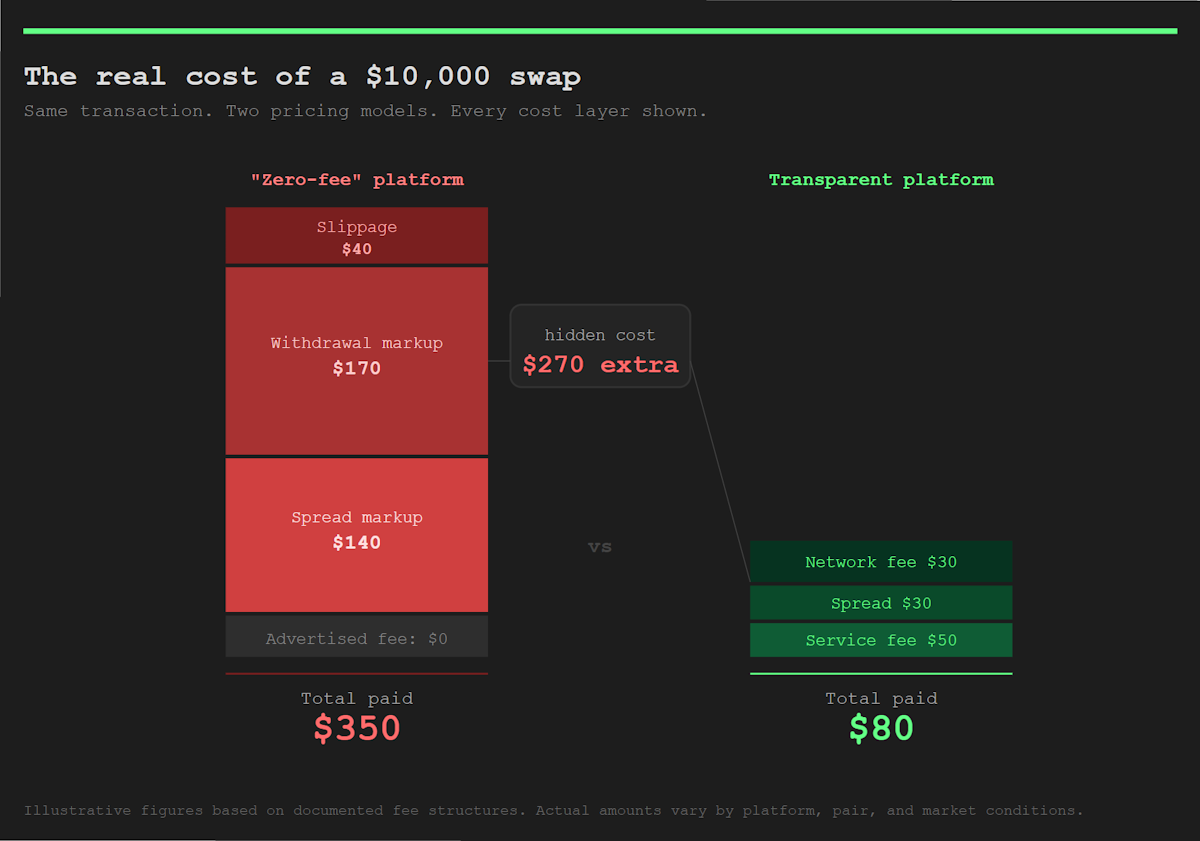
Why Non-Custodial Instant Swaps Have a Fee Advantage
Non-custodial instant swap platforms have a structurally lower cost base than custodial exchanges because they carry none of the overhead — no account infrastructure, no internal ledger reconciliation, no regulatory burden from holding customer funds.
That cost difference gets passed through in the rate. Godex.io is a non-custodial instant crypto exchange operating since 2018 that requires no KYC, no registration, and no personal data — it supports 937+ cryptocurrencies with both fixed and floating rate options and no upper limits on swap volume. Its fee model — approximately 0.5% service fee plus a ~0.3% transparent spread, with network fees passed through at actual cost — produces an all-in cost of around 0.8% on standard pairs. That’s not the advertised number on a landing page; it’s the math when you compare what goes in versus what comes out.
At $50,000 monthly swap volume, the difference between 0.8% and 2% total cost is $600/month — $7,200 annually. That’s not a fee preference, it’s a position size.
What “Lowest Fee” Actually Means Depends on Your Use Case
The cheapest crypto swap platform for a $500 casual swap is not necessarily the cheapest for a $25,000 privacy-sensitive swap — different cost structures serve different use cases.
Three profiles, three different answers:
Privacy-first traders need to account for more than fees. Platforms that require KYC at certain thresholds — some of them implement risk-based verification that can trigger at higher volumes — introduce friction that defeats the purpose of a non-custodial swap. For this profile, the relevant metric is the lowest fee without identity disclosure at any volume. Godex’s no-KYC model applies regardless of swap size, which is why it appears alongside StealthEX in guides specifically targeting privacy coin use cases, including Monero ecosystem resources.
High-volume swappers should run the total cost formula on every platform rather than trusting category labels. At scale, a 0.3% spread difference compounds meaningfully. Fixed-rate options, available on Godex.io and others, eliminate slippage risk on larger swaps by locking the quoted rate at initiation. This matters when you’re moving five figures, and a 1% adverse price move during processing is a four-figure loss.
Cautious newcomers often get the worst deal because they gravitate toward brand-familiar platforms — Coinbase, Crypto.com, PayPal — that happen to be the most expensive in total cost. The core lesson: familiarity is not transparency. Check the spread on your first swap by comparing the quoted price to the mid-market on CoinGecko or CoinMarketCap. If the difference is more than 0.5%, you’re paying a hidden crypto exchange spread.
How to Audit Any Platform’s Real Cost Before You Swap
You can calculate a platform’s hidden fee in under two minutes before committing any funds. 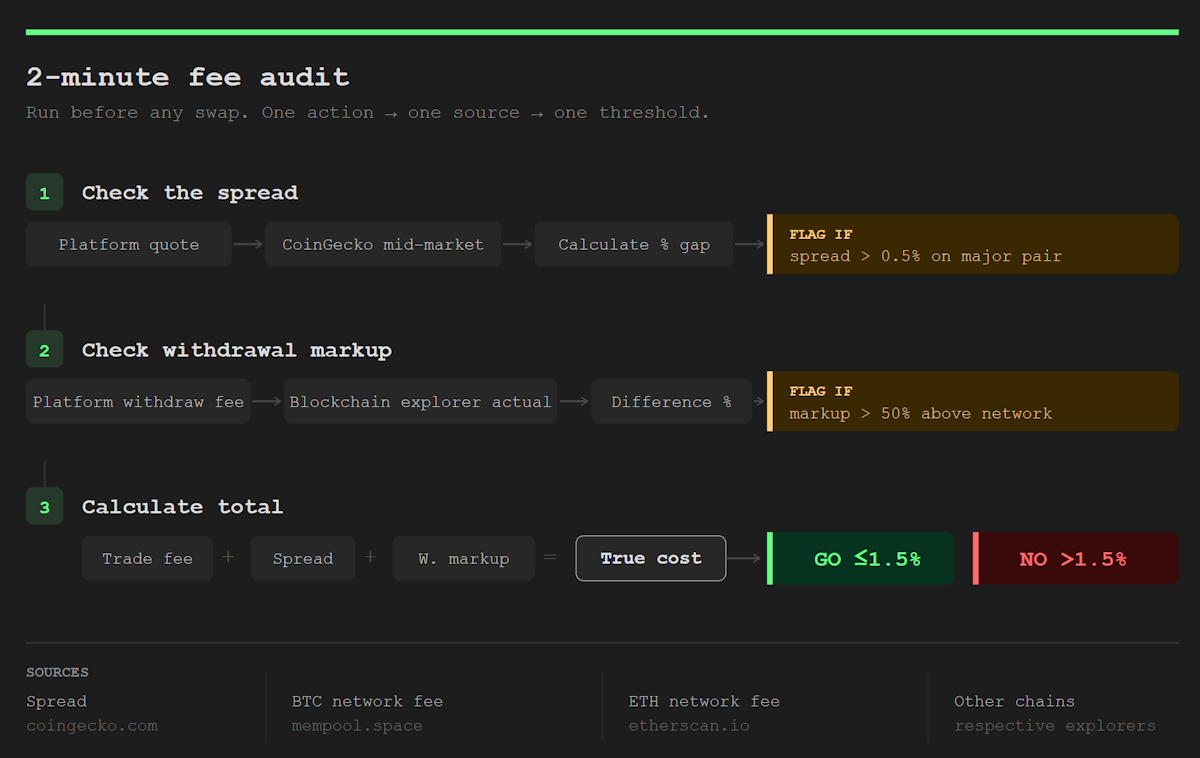
Three-step audit process:
- Check the spread: Pull up the platform’s swap quote, then open CoinGecko or CoinMarketCap for the same pair at the same moment. The percentage difference between the platform’s rate and the mid-market rate is the embedded spread. Anything above 0.5% on a major pair is a markup worth factoring.
- Check withdrawal fees: For the coin you’re receiving, look up the current network fee on a blockchain explorer (Etherscan for ERC-20, Mempool.space for Bitcoin). Compare it to the platform’s stated withdrawal charge. A 300–500% markup — documented as common in published research — is a sign the platform profits on outbound transfers.
- Calculate total cost: Add trading fee + spread + withdrawal markup. Apply this to your actual swap amount. If the result exceeds 1.5% on a standard pair, look for a lower-fee crypto exchange before proceeding.
The Bottom Line on Hidden Crypto Swap Fees
Platforms that lead with “0% fees” and platforms that lead with “0.5% transparent fees” are not in the same conversation. The second category often ends up cheaper.
Fee transparency in the instant swap market has improved since 2023, but the gap between what’s advertised and what traders pay remains large enough to meaningfully affect returns. The platforms closing that gap fastest — publishing all-in rates, passing network fees at cost, and eliminating withdrawal markups — are setting the new standard for what “lowest fee” should actually mean.
Disclaimer: This article is for informational purposes only and does not constitute financial or investment advice.