I had been waiting for the 2026 edition of Zoom Communications Inc.‘s Perspectives, its recently held annual get-together for industry analysts, because I find Zoom to be the most interesting vendor in the communications business today.
Though it has many competitors, its product roadmap has been markedly different. Other unified-communications-as-a-service and contact-center-as-a-service providers have been focused on going deeper in those stacks, but Zoom has complemented those efforts by expanding into many adjacent areas, such as e-mail, docs, sheets, notes and other productivity tools. In addition, the company offers frontline worker tools with Workvivo, small-business apps through Bonsai, and much more.
This has many industry watchers raising their eyebrows and wondering why Zoom would want to go head-to-head with Google LLC and Microsoft Corp. in their core areas of strength. At Perspectives, I was looking forward to gaining a better understanding of Zoom’s master plan for its next act.
The timing for the event was ideal, as business and information technology leaders have moved beyond thinking about video, chat,and calls and are focusing more on artificial intelligence companions, digital workers and a relentless focus on business outcomes. Here are my key takeaways from Zoom Perspectives 2026:
Zoom is disrupting work, not communications
Zoom is repositioning itself as a “system of action” that moves beyond simple communications to fundamentally disrupt how work is done. By integrating its broad suite of tools — including meetings, phone, team chat, docs, sheets and the new personal note-taker, Zoom My Notes — into a unified platform, Zoom looks to bridge the gap from “conversation to completion.”
This strategy focuses on eliminating the “friction tax” of switching between disparate applications by enabling AI to reason over unstructured conversation data and trigger automated workflows. Rather than merely competing on feature sets with legacy giants like Microsoft and Google, Zoom is betting on a federated AI approach that delivers a seamless, “disposable” user interface tailored to the specific task at hand.
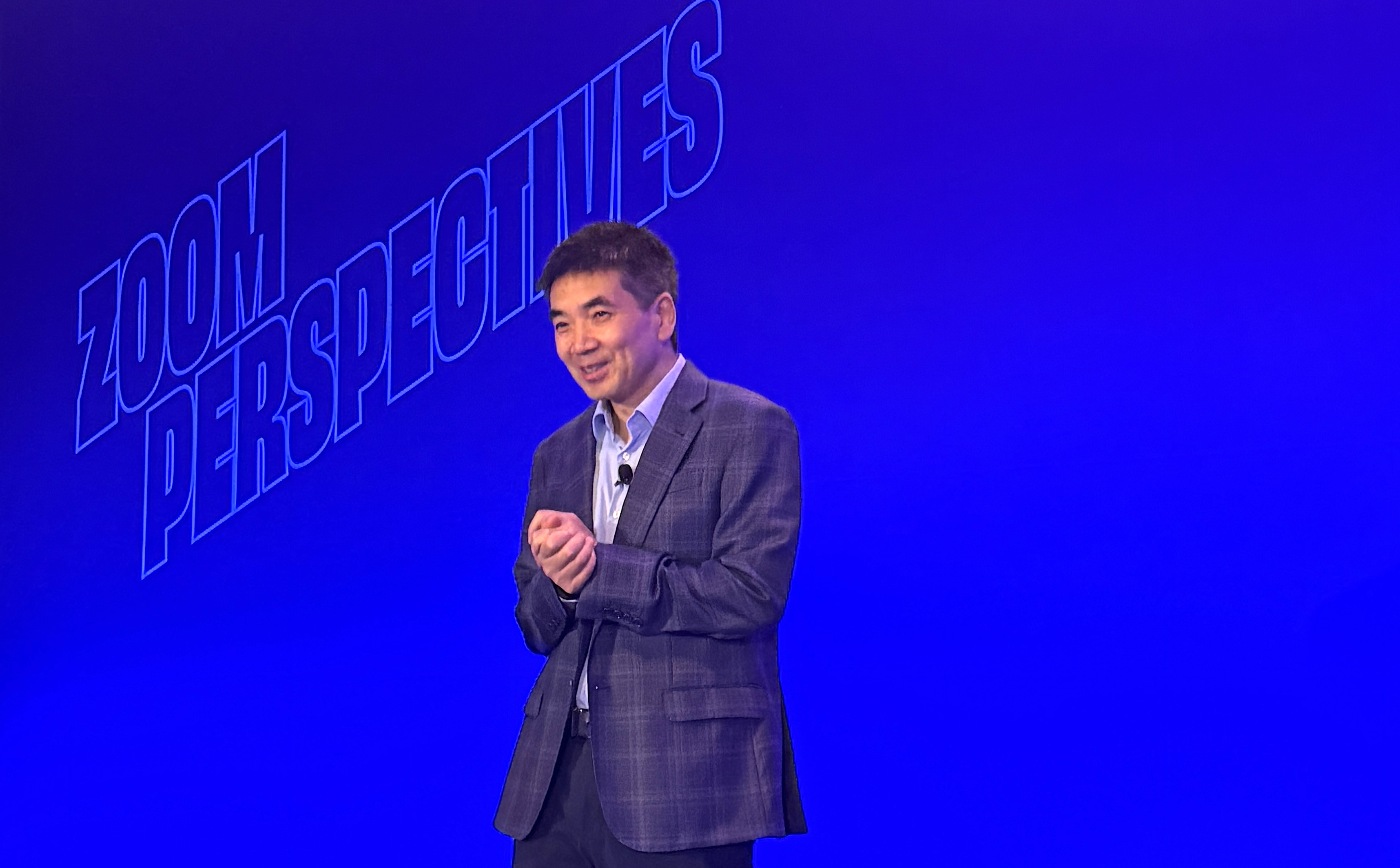
As Chief Executive Eric Yuan (pictured) explained during the event: “Over the past many years, we’ve focused only on the first step: rich communication. Now, we are aiming to embrace completion as well. Essentially, offer the customer a seamless experience to get a task done. It used to be two steps; now it’s just one step with AI.”
From passive information to active orchestration
While many platforms focus on organizing data, Zoom is repositioning its interface as a reasoning engine that actively guides the next steps of a project. By serving as a “semantic layer” between the user and their tools, the platform uses AI to identify commitments made during a conversation and translate them into coordinated actions across third-party systems such as Jira or Salesforce. This shifts Zoom’s role from a simple information display to an active orchestrator of business processes.
As Chief Marketing Officer Kim Storen noted, “We recognize that there’s an opportunity to add value across the lifecycle of conversations, from preparation to meetings and all the way through to completion of work, with the understanding and context that come with embedded AI.”
From synchronous utility evolves to persistent platform
A recurring theme among large-scale enterprise customers is the move toward platform consolidation — not merely a cost-saving exercise, but a strategy for information persistence.
The “utility phase” of the pandemic era was about keeping the lights on. The current phase is about eliminating the human latency caused by handoffs between global teams. My research shows that workers spend 40% of their time managing their work rather than doing their jobs.
For today’s chief information officers, the value proposition has shifted from video stream quality to capturing value from the data being generated. By leveraging persistent whiteboards, documents, and AI-generated context, organizations can seamlessly bridge time zones. When a development team in one hemisphere wraps up, the team in the next can resume work immediately, guided by an AI-curated “state of play” rather than a grueling four-hour status meeting.
AI as the new accountability partner
Enterprise AI discussions have shifted from “What can AI do?” to “How does AI change our social contract of work?” For many IT leaders, the Zoom AI Companion is much more than a meeting summary; it is becoming an accountability mechanism. When transcription and action-item tracking are enabled by default, the “social contract” of a meeting shifts.
The typical post-meeting ambiguity gives way to a digital record of commitments. If a stakeholder agrees to a deliverable, it is captured, assigned and tracked. This shift transforms AI from a passive assistant into a persistent partner that drives project velocity and ensures that “administrative drift” no longer stalls mission-critical workflows. These handoffs are what cause large enterprises to lose their nimbleness leading to falling behind smaller competitors.
What this means for the CIO
For the CIO, Zoom’s evolution marks a shift in the “center of gravity” of enterprise data.
- Reducing tool fatigue: By consolidating fragmented tools into a single AI-enabled ecosystem, CIOs can reduce employees’ cognitive load and IT’s integration burden.
- Data liquidity: The agentic approach means data no longer lives in silos. If the AI can track a project from a phone call to a whiteboard session to a final document, the CIO is no longer managing disparate apps; they are managing a continuous flow of corporate intelligence.
- ROI of “found time”: The primary metric is shifting to “time to context.” The faster a worker can understand a project’s current state without human intervention, the higher the organizational throughput.
Implications for Zoom
As Zoom pivots toward this agentic future, the company faces several strategic imperatives:
- The identity challenge: Zoom must continue to combat the “video-only” perception. Its success depends on the market viewing it as a “work operating system” rather than a meeting tool.
- Platform interoperability: To be truly “agentic,” Zoom’s AI will need to integrate seamlessly with third-party ecosystems (Salesforce, ServiceNow, Jira). The more “open” their agentic framework is, the more indispensable Zoom becomes.
- Security and trust: As AI evolves from summarizing meetings to “holding people accountable” and managing workflows, the privacy and security of that data will face intense scrutiny. Zoom’s “AI-first” architecture must remain “Trust-first” to maintain its foothold in the regulated enterprise.
Ultimately, Perspectives signaled that Zoom is no longer content to be merely a venue for discussing work; it intends to be the engine through which work is done. It’s certainly a departure from where the industry has been, but Zoom has never been afraid to do things differently. The platform is ready, and products are rolling out at a torrid pace.
Can Zoom change the way people work? Only time will tell, but with companies making heavy AI investments, Zoom will certainly have an opportunity.
Zeus Kerravala is a principal analyst at ZK Research, a division of Kerravala Consulting. He wrote this article for News.
Photo: Zeus Kerravala
Support our mission to keep content open and free by engaging with theCUBE community. Join theCUBE’s Alumni Trust Network, where technology leaders connect, share intelligence and create opportunities.
- 15M+ viewers of theCUBE videos, powering conversations across AI, cloud, cybersecurity and more
- 11.4k+ theCUBE alumni — Connect with more than 11,400 tech and business leaders shaping the future through a unique trusted-based network.
About News Media
Founded by tech visionaries John Furrier and Dave Vellante, News Media has built a dynamic ecosystem of industry-leading digital media brands that reach 15+ million elite tech professionals. Our new proprietary theCUBE AI Video Cloud is breaking ground in audience interaction, leveraging theCUBEai.com neural network to help technology companies make data-driven decisions and stay at the forefront of industry conversations.