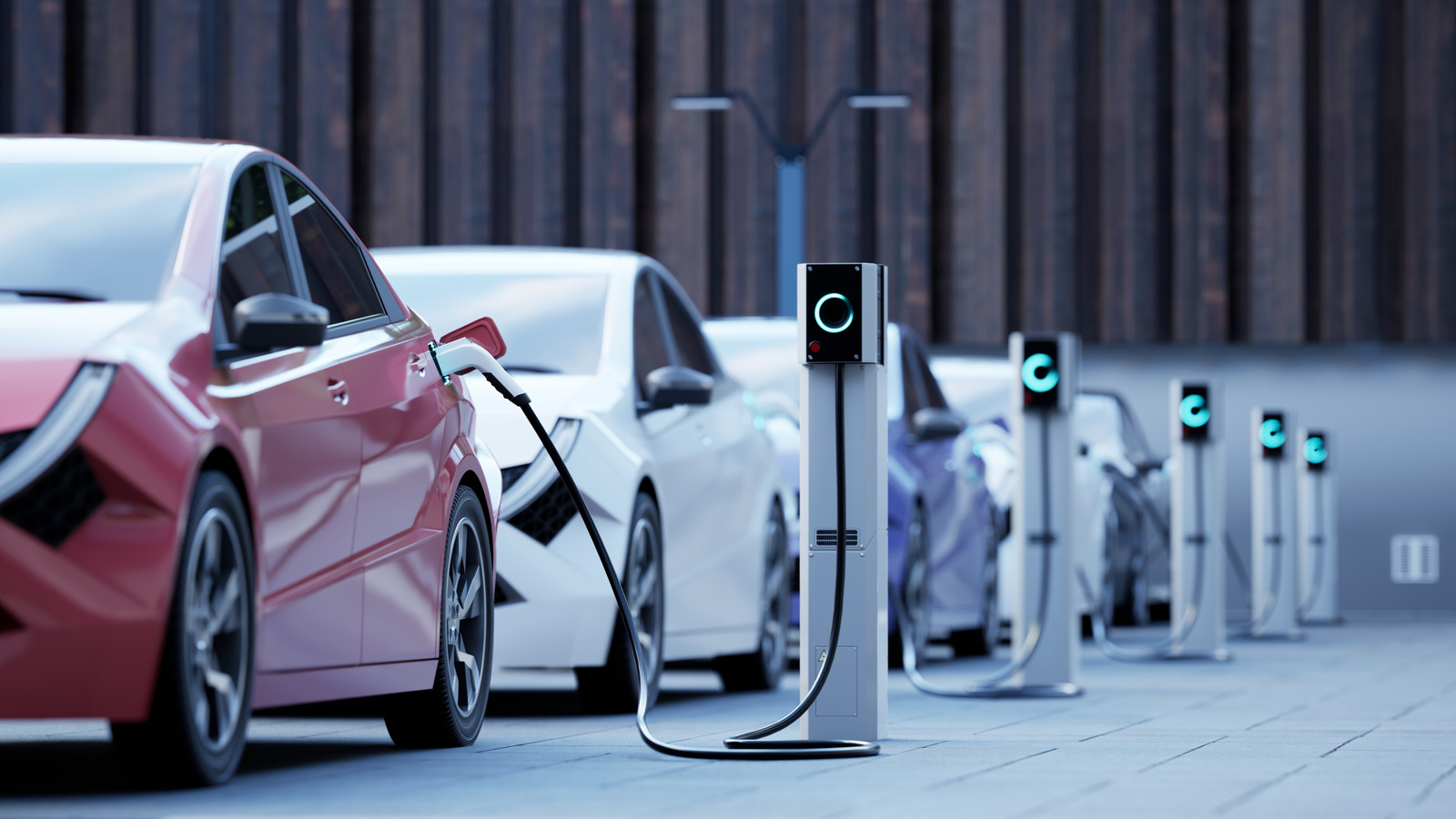
The biggest culprit when it comes to reducing your EV’s range isn’t a feature of the car at all; it’s the person behind the wheel. Whether it’s a full electric or even a plug-in hybrid, you’re unlikely to achieve the stated mileage unless you adjust your driving habits and learn the subtleties of EV efficiency. When gas is cheap and plentiful, it’s easy to ignore fuel efficiency (EVs are still cheaper to fill up, though). But if you’re not even sure if you’ll make it to the next charging station, you may need to face some harsh truths (unless you’ve travelled to the future and got one of them shiny new 3,000-mile range electric cars, that is). Aggressive and high-speed driving are the worst offenders that will drain your battery and obliterate range.
Here’s a quick tip: If your EV has an Eco mode button, consider it a cheat code to instantly improve your driving habits and range. Eco mode will optimize the drive train and reduce throttle sensitivity. Make a new habit of turning it on every time you get in your car, while also minding the following features and issues that can contribute to your EV’s battery drain.
Speed
Up to a certain point, the slower you travel, the more efficiently the motor will run, and the more range you’ll get — around 20 mph is best. This is mainly due to aerodynamic drag getting exponentially worse the faster you drive — and why a roof box will quickly obliterate your range at high speeds. But of course, fellow drivers frown upon going everywhere at 20 mph, so we need to be practical as well. 50 to 60 mph feels like the sweet spot for EV driving on the highway, while range drops significantly at 70 mph and above. One Ioniq5 driver on the r/electricvehicles subreddit measured this, and their range halved when they went from 45 to 70 mph. That’s roughly 10% less range for every additional 5 mph.
If you find your speed creeping up, turn on cruise control. This also helps avoid small surges of acceleration as you unconsciously tap the pedal. It’s not just a lower overall speed that matters; it’s consistency.
Carrying unnecessary weight
This is probably an obvious one, but when you’re battling range anxiety, every pound counts. We’re not saying kick your child out and make them walk (although, it turns out kids might be a lot more physically capable than you think), nor should you strip your car interior to the basics to shave off a few pounds. It’s not the biggest factor on the list, either, but if you forgot to empty that emergency stash of water bottles or animal feed from your trunk, it’ll make a small difference. Towing the weight of a trailer is also a huge range killer, so if you’re in the habit of bringing a trailer along just in case you find a sale on 2×4 wood planks, it’s worth planning a little more with an EV.
This is also why slapping a solar panel or wind turbine on your roof isn’t an infinite energy glitch; the energy required to move that much additional weight (and the detrimental effect it will have on aerodynamics) is far more than the energy it would generate.
Heavy-handed use of the brake pedal
Physical braking is a mechanical action that purely wastes energy. Regenerative braking is a type of engine braking where the engine itself absorbs the excess energy and slows down the car. On an EV, this means the power flow in the engine is reversed into becoming a generator, allowing the motion of the car to recharge the battery.
All electric cars have regenerative braking, and some allow you to adjust how strong it is via the use of paddles on either side of the steering wheel. Regenerative braking is the primary way that a hybrid car charges if you never plug it in. Depending on your car, this braking mechanism may or may not be linked to the brake pedal, so it’s worth checking your manual. In some EVs, a light touch on the brake pedal will engage regenerative braking, while increased pressure uses the physical brakes. In others, any touch on the brake pedal is only linked to the physical brakes, and you should learn what’s called the “one pedal technique” — only driving with the accelerator, allowing the regenerative braking to slow you down, with your actual brake pedal reserved for emergencies.
What’s still in debate is whether or not you’re better off using regenerative braking at high speeds, or if you should turn it off and allow the car to cruise. Since regenerative braking and one-pedal driving affect stopping distance, my preference is to leave it at max all the time for consistency and safety.
Rapid acceleration
The biggest avoidable power loss in any electric car is rapid acceleration. Once you’re up to speed, it takes the same amount of power to maintain that speed, but how you get there is the key difference. Yes, electric cars are really good at delivering torque, which can be fun, but just because you can doesn’t mean you should. It takes a disproportionate amount of energy to accelerate quickly than it does to get up to your intended speed at a more moderate pace (but it’s inefficient at very slow speeds, too). Other factors on this list, like weight, will also compound the energy wasted to rapid acceleration. This is more of an issue in city driving because of the frequency which you’ll be accelerating and braking. Accelerate slowly, leave enough stopping distance, and use regenerative braking to slow down rather than the brake pedal.
However, while rapid acceleration will reduce range, a study published on Nature suggests occasional use may be good for battery longevity. The study looked at the difference between dynamic cycling of cell charges — that is, a mix of quick and slow usage — compared to traditional testing procedures that evaluate battery life with only low or high frequency cycles. While the experiment set out to explain real-world reports that EV batteries were lasting longer than expected, it also suggests that only using slow charging and gentle driving may actually be counterproductive for longevity (even if they are better for range).
A/C vs windows down
Ahh, another great debate, one which even sparked a MythBusters episode: Is it more efficient to use air conditioning or wind down the windows, given the aerodynamic drag of an open window? In an on-road test, YouTuber Bjørn Nyland found that, in a Tesla Model X, windows down resulted in greater range than turning on the A/C at any legal speed. But speed is only half the equation, as opening the window will only ever get you a warm breeze and closer to the ambient temperature.
How hot it is outside also makes a significant difference to the range loss. A Recurrent study of around 30,000 EVs found that using the A/C at 90 degrees Fahrenheit accounted for 5% of battery usage, while at temperatures of 100 degrees Fahrenheit, it was closer to 20%.
While evidence is mixed, we can confidently say that above speeds of 40 mph, the difference in range is so negligible that you may as well use A/C for comfort, especially when the alternative is roasting.
Heating and pre-drive climate control
Some EVs let you warm up the car before your journey even starts. Heating of any kind is a massive drain on energy, so it should go without saying that this is going to reduce your range significantly. The only time you might consider pre-warming is if the car is still plugged in on your driveway, so it can draw power directly from the incoming socket rather than the battery. But away from home, it’s best to leave this particular luxury comfort feature off.
However, if you absolutely must use some kind of heating because it’s just too cold, use individual seat warmers rather than trying to heat the whole cabin. According to GridServe, the impact of general heating through the climate control is a loss of 5.7 miles of range per hour of travel, compared to 0.3 miles for heated seats or 0.1 miles for a heated steering wheel. These are huge savings, especially if you’re travelling alone.
Cold weather
It sounds silly, but batteries just don’t like the cold. The chemistry slows down, and they drain faster in winter. Range can drop by around 15 to 20% when temperatures nudge closer to freezing. There’s nothing you can do to counter this, but it’s something you should keep in mind if you’ve been expecting a certain range all year round, or have favorite charging points planned en route that you’ve perfectly timed to reach when you’ve got 10% remaining. You won’t make it as far between charges in winter, so plan your route accordingly to make additional stops and allow extra travel time.
Cold weather also compounds losses and slower gains from other issues and features. You’re more likely to want some heating. The charging rate slows, and regenerative braking doesn’t work as well. The battery itself will need energy to get warmed up initially. All told, you might only get half the range you normally would. Winter is the ultimate nemesis of electric vehicles!
Tire pressure
It takes more effort to move a car when your tire pressure is low. Underinflated tires increase the surface area in contact with the road; there’s more frictional resistance, and the engine has to work harder. This is especially important with EVs, as they tend to be heavier than equivalent internal combustion engine cars (which is why EVs have special tires). It also has a knock-on effect of making your tires wear down faster — a 20% underinflated tire can expect 25% extra wear. Nokian Tyres recommends a more aggressive schedule for rotating your EV tires — swapping front to back every 4,000 miles to ensure they wear evenly.
The lesson here is: Don’t ignore that low tire pressure warning message on the dashboard. If you don’t have a tire pressure sensor, manually check tire pressures at least once a month. Keeping them at the recommended pressures is a basic check you should be doing before any long journey, anyway.
Terrain
While driving through those scenic mountains and hillsides can be enjoyable, electric vehicles work best on flat roads. You’ll recover some energy with regenerative braking while traveling downhill, but not as much as you need to get back up the next hill — there’s always a loss of efficiency when converting from one form of energy to another. 60 to 70% energy recovery from regenerative braking is typical, but it means that overall, you’d use significantly less to cover the same distance on a flat road. You’re also more likely to encounter gravelly roads on the more rural routes, which need more power to traverse and result in less range.
Google Maps offers some basic enhanced route planning for electric vehicles. Once you’ve requested directions, click the “Settings” button (which looks like three faders), select “Prefer fuel-efficient routes,” and tap on “Vehicles” to add your car. A Better Route Planner is a comparatively better service (pun intended) and has more robust settings for how you’d like your electric drive to be, such as getting there as quickly as possible, multiple short stops, or fewer — but longer — stops.
Rapid charging
Completely charging your EV battery in 10 minutes before you’ve even finished your coffee is certainly convenient, but it can be bad for the battery — emphasis on “can.” While all cars vary, a study by Recurrent showed no significant difference in battery degradation over a five-year period for Tesla owners who used rapid DC charging 70% of the time versus those who only used it 30% of the time. That sounds pretty conclusive, right? Sort of.
Rapid charging is bad for battery chemistry if it’s really hot or really cold, or if a battery is completely drained or over 80% full. Most cars have a BMS (battery management system) that will mitigate these effects for you. It’ll pre-cool a hot battery if your destination is set as a fast charging station and limit the charging rate beyond 80% (you might be better off switching chargers for the last bit). You can also warm up the battery by just driving around before charging if it’s extremely cold.
For most people, rapid charging probably won’t make a difference a majority of the time. If anything, given what we now know about dynamic charging cycles being better for battery longevity, occasional use of rapid charging may actually be beneficial.
Comfort over range
While some of the factors that negatively affect range are mitigated with basic maintenance — such as checking tire pressures — others are a question of comfort. Unless you’re trying to squeeze every last mile out of your EV, they’re best weighed against your own enjoyment of the journey.
Personally, I’m going to take the scenic route every time, even if the motorway is faster, flatter, and more efficient for the battery. I’m not in a hurry; if anything, a long drive is an escape from the hustle and bustle of daily life, and a great chance to engross myself in an audiobook. I’m happy to drive slower if it gets the best efficiency, and in the UK, I can live without A/C; it never truly gets intolerably hot or cold. Nothing that a seat warmer or cracking open a window can’t deal with, anyway.
If one piece of advice encapsulated as many of these factors as possible, it would be: Don’t be in a hurry.