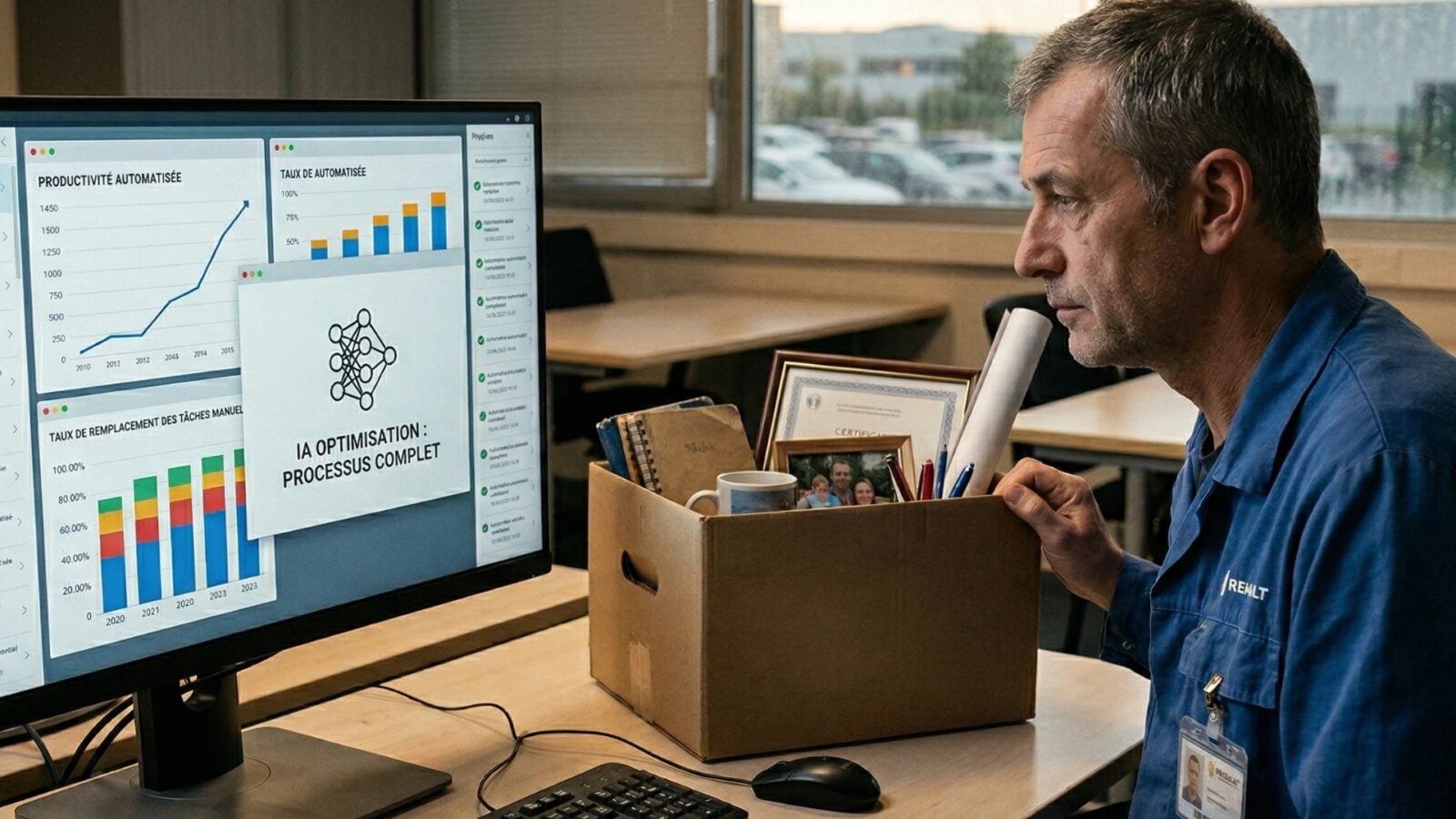
One in six jobs. This is the figure just given by the insurer Coface and the Observatory of Threatened and Emerging Jobs (OEM) in a study published yesterday, revealed by The World. Within two to five years, 16.3% of French employees would be exposed to a direct threat linked to artificial intelligence, or nearly 5 million people. A threshold which contrasts with the usual caution of economic studies on the subject.
What is new here is less the figure itself than the methodology. Where most projections remain theoretical, the Coface/OEM study combines sectoral data and the level of automatability of tasks to measure concrete exposure, profession by profession. The result is clear since today, 3.8% of French jobs are already weakened by generative AI. Tomorrow it will be more than four times as much.
Agentic AI will change everything
This projected jump is largely explained by an ongoing technological breakthrough: the rise of agentic AI. Unlike current chatbots, these systems are capable of carrying out complex tasks autonomously, without human supervision at each step. French companies are still mostly at the stage of supervised experimentation, only 7% of employees used generative AI daily at work in 2025. But the dynamic is there, and it is accelerating.
The study also points out that one job in eight would already see more than 30% of its tasks affected by possible automation. These are not positions that will disappear overnight, but their content will fundamentally change.
White-collar workers caught in a vice
The profile of the professions exposed breaks with the intuitions of previous technological waves. It’s not the execution jobs or the assembly lines that are in the sights this time. AI tackles cognitive tasks: reasoning, writing, analysis, information processing. Are thus identified as high-risk sectors architecture, engineering, IT and mathematics, administrative support, legal, and creative professions (design, media, arts and entertainment).
This reversal is historic, because previous industrial revolutions had rather eliminated intermediate and repetitive jobs, preserving professions with high intellectual content. Generative AI reverses this gradient, and the best paid are no longer the best protected.
Young people constitute another particularly exposed category. While some companies freeze their recruitment to automate upstream, interns and work-study students find themselves on the front line because their role is often precisely to manage the low-value-added tasks that AI is starting to absorb.
An insufficient political response
Faced with these projections, the government’s reaction remains timid. The “Dare to AI” initiative, launched to train 15 million professionals in the uses of AI by 2030, is considered clearly insufficient by Axelle Arquié, economist and co-founder of the OEM. She has publicly pleaded for political leaders to take up the subject with the same urgency as the economists who model it.
Less alarmist voices exist. Grégory Verdugo, professor at Cergy-Paris University and associated researcher at the OFCE, puts things into perspective by saying that the catastrophist speeches are partly driven by the promoters of the technologies themselves, who need to demonstrate the short-term profitability of their massive investments. The argument has weight. Each major technological revolution, robotization, Internet, digital platforms, has generated its prophecies of collapse which have not all materialized, or not within the announced deadlines.
Except that this time, there is no shortage of concrete signals. Independent graphic designers, translators, lawyers responsible for documentary research, several professions are already experiencing the partial disintegration of their activity. The Coface study does not predict a catastrophe, it documents a transformation that is already underway and it is not quite the same.
🟣 To not miss any news on the WorldOfSoftware, follow us on Google and on our WhatsApp channel. And if you love us, .