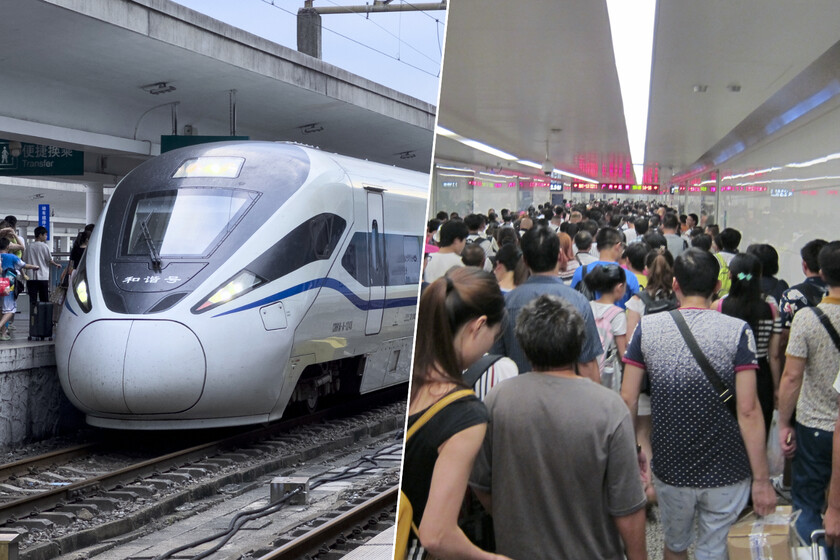
China is preparing for the largest migration of people in the world. And behind it there is no famine, war or racial persecution. In fact, there is not even a crossing of borders. China, the world’s second most populous country with more than 1.4 billion people, faces a new test.
And today, February 17, the Lunar New Year. This time we are facing the Year of the Fire Horse, a good year for those who embrace this element because they are cold (born in autumn/winter) and for the industries that depend on it. On the contrary, complications are expected for relations that are already tense and with prospects of greater probability of suffering natural disasters related to heat and fire, points out Thierry Chow, Feng Shui consultant to CNN.
Those first tense relationships have already been seen in the movements of these days, says Lucas de la Cal in an interesting chronicle in The World. He explains that the most coveted thing these days are train tickets that are packed. No wonder, there are those who have trips of more than 30 hours ahead of them, with the aim of covering the more than 2,000 kilometers that separate them from their hometown.
And the Lunar New Year is a celebration in which there is a massive migration from the city to the countryside, to the origins. Traditionally, the Chinese employee has returned home for this Spring Festival, a period that lasts for 15 days.
However, the massive movement of people means that trips accumulate in a total of 40 days in which, this year, around 9.5 billion trips are expected to occur. A tradition that, explained in CNAis undergoing some changes since, although anecdotal at the moment, it is beginning to be common to see parents traveling to the city where their child works.
The train as the axis on which everything rotates
They point out the Cal in The Worldthat your trip starts from Shanghai and is destined for Longkou. Normally, he says, they would have taken a plane but this means of transportation has tripled in Price. The solution, like that of millions of Chinese travelers, is on the train tracks.
Shanghai represents well the investment effort what the State has done in this means of transportation. The city’s south station is the first in the world with an entirely circular design and 15 million people are expected to pass through it each year. Nothing compared to the city’s main station, where an estimated 60 million people pass through each year, with access to the busiest metro service in the world.
Nor to Guangzhou South Station. This space was, until 2024, the busiest in the country. According to the Chinese media, 170 million people passed through the station every year and on average 600 trains passed through it every day. On average, it is estimated that almost half a million people pass through the station.

It was until this year, the most renowned station in China. However, a few months ago the largest train station in the world opened in Chongqing. Is five times larger than Grand Central Station from New York and has been moving 16,000 passengers an hour. Its potential is yet to be discovered because, as is the case with metro stops in the country, it was born in an open field where buildings have begun to grow around it.
These are just some data that speak of the consolidation of the train as the means of transportation capable of transporting the greatest number of people in the shortest possible time in a gigantic country. In the early 2000s, high-speed rail was completely unknown in China. Today they have by far the most extensive network in the world.

And not only that. In their trains travel robots that act as hostesses, the carriages have become the preferred space compared to the plane because in them you can work with an enviable data connection and they have, by far, the fastest trains in the world while they do not stop breaking speed records in new tests to continue putting bites on the stopwatch.
The country is experiencing an effervescence in the sector that has turned it into the true reference. Óscar Puente, Minister of Transport in Spain, gave the example of Chinese trains as the technological vanguard and the key to being able to operate a Madrid-Barcelona train at 350 km/h. For now, they have reached a position unattainable by any other country in the world.
Not even Japan, who was the absolute king of the bullet train, can now at least come close.
Photo | Kuruman y Team Wu
In WorldOfSoftware | China urgently needed a train station, so it was built in nine hours with 1,500 workers and 23 excavators.