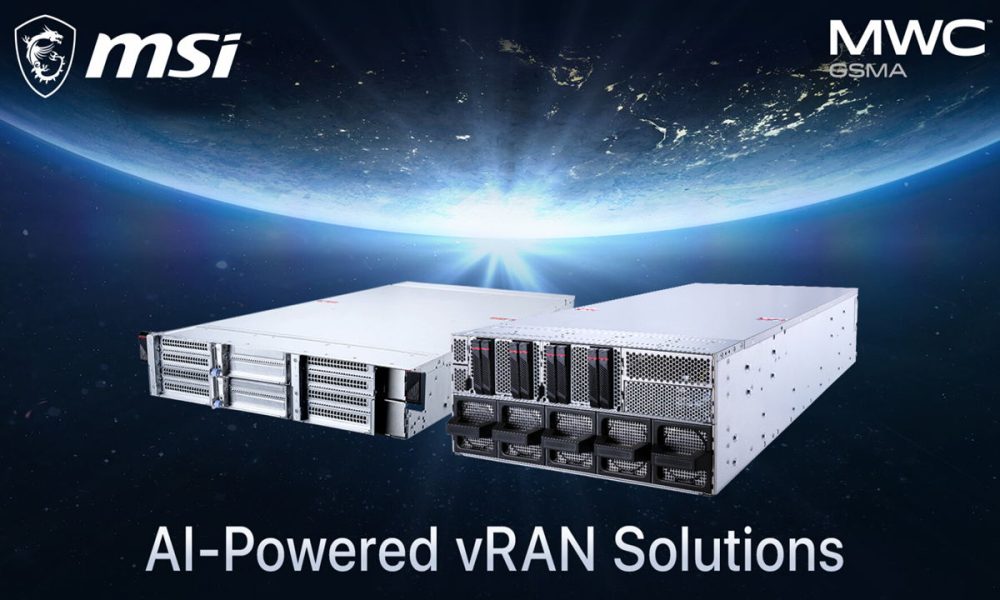
MSI has presented its latest AI-vRAN solutions at MWC 2026 to address the changing needs of next generation telecommunications networks. MSI’s AI-vRAN stack, integrated with GPU server solutions, is designed to integrate AI capabilities into the core of network operations, supporting growing telecom workloads and accelerating the transition to AI-based mobile networks.
“AI is rapidly transforming the telecom landscape, and MSI is focused on helping operators build scalable network architectures that support diverse applications, such as voice, data, video streaming, and AI workloads, through a unified infrastructure.”said Danny Hsu, General Manager of Enterprise Platform Solutions at MSI. “This AI-powered vRAN architecture offers greater flexibility for future 5G and 6G deployments, while accelerating the time to market of new services.”.
To support AI-based telecom networks, MSI offers a AI-vRAN Unified Platformdesigned to simplify deployment in O-RAN, private 5G, and virtual RAN environments. This unified architecture enables operators to adopt AI-based network functions, maintaining consistency across distributed and centralized network infrastructures.
At MWC 2026, MSI presented its platforms CG480-S6053 y CG290-S3063designed specifically to address various IA-vRAN deployment requirements. The CG480-S6053 is designed to support dense GPU configurations for resource-intensive AI acceleration and inference workloads. On the other hand, the CG290-S3063 is optimized for space- and power-saving deployments in a 2U chassis, making it ideal for distributed and perimeter network environments. Both platforms offer flexible GPU, NIC, DPU and storage configurations to help operators optimize performance, scalability and profitability on a consistent infrastructure.
Along with these systems, the plataforma 2U CX271-S4056 (HE SKU) is designed to support balanced data processing for AI workloads, addressing scenarios where computational efficiency and system balance are critical.
The Taiwanese company offers a Scalable range of GPU-accelerated server configurations, from 2 to 8 GPUsto meet various deployment needs in wireless access, metropolitan edge, core network, and centralized cloud environments. This flexibility allows telecom operators to tailor system configurations to specific workload demands, while optimizing performance and operational efficiency.
Based on the NVIDIA MGX architecture, MSI is extending this proven architectural approach to the telecommunications sector, applying data center-class computing principles to meet the changing performance, scalability and efficiency needs of next-generation mobile networks.