Since Apollo 17, no human being has traveled to lunar orbit again. More than five decades have passed since that last manned flight to the satellite, and the return has not been exactly quick or easy. The Artemis program is accumulating delays, technical reviews and schedule adjustments, and Artemis II itself has also recently had to stop due to a problem detected in the rocket’s helium system. Even so, there is an important novelty: after completing the repairs, NASA has already indicated a first launch opportunity for this mission that will once again take astronauts to the environment of the Moon.
The Date. Following a flight readiness review, the US space agency announced that it is working with April 1, 2026 as the first opportunity to launch Artemis II. That initial attempt is scheduled for 6:24 p.m. (Eastern time in the United States), which in mainland Spain is equivalent to 12:24 a.m. on April 2. This schedule comes after repairing a problem in the rocket’s helium system, an element that regulates the pressure of the fuel tanks and which forced the vehicle to be removed from the platform to replace a defective seal.
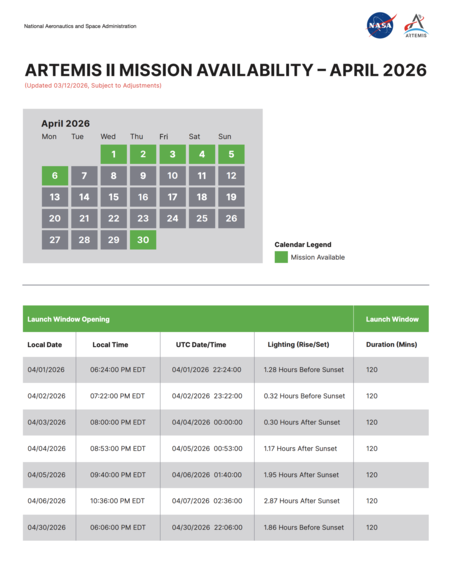
Artemis II launch window schedule for April 2026
How launch windows work. In space exploration we do not work with rigid dates, but with periods of opportunity. A launch window is the interval in which the rocket can take off to follow the planned trajectory and meet the mission objectives. That margin depends on very precise orbital calculations that take into account the position of the Earth, the destination and the energy necessary to complete the trip. If the vehicle cannot take off within that interval, the attempt is canceled and you must wait for the next available window.
Guaranteed launch? Although there is a calendar with concrete opportunities, each attempt still depends on several factors that must be aligned at the last moment. Technical teams continue to work on both the Kennedy Space Center assembly building and launch infrastructure, and the rocket itself must return to the pad before beginning the final sequence. During a press appearance, Lori Glaze, acting associate administrator of the Exploration Systems Mission Directorate, recalled that there is still work to complete and that the launch will depend on what the hardware itself indicates. Added to all this is the time, because in a mission like this you cannot operate with the risk of lightning, precipitation, hail or excessive winds.
Ground travel. The Space Launch System rocket must first return to the Kennedy Space Center pad from the assembly building. Once there, teams must prepare the vehicle and facilities for the takeoff attempt within the available window. This type of operation requires continuous reviews and coordination between different systems, so it is not always possible to attempt a launch the next day. In fact, Lori Glaze noted that, within the first six days of April, the agency anticipates around four real attempt opportunities.
The return. When it finally takes off, Artemis II will mark the return of a human crew to the Moon’s environment for the first time since 1972. The mission will take on board American astronauts Reid Wiseman, Victor Glover and Christina Koch, along with Canadian Jeremy Hansen, on a flight of about ten days around the satellite. The plan is for the Orion spacecraft to circle the far side of the Moon, the region we never see from Earth, before beginning the return journey. This flight will serve to check the operation of the systems in real conditions before the next steps of the Artemis program, which aims to take astronauts back to the lunar surface on subsequent missions.
Images | POT
In WorldOfSoftware | We already know what we will eat on the moon: Madrid stew. An American team manages to grow chickpeas in lunar regolith