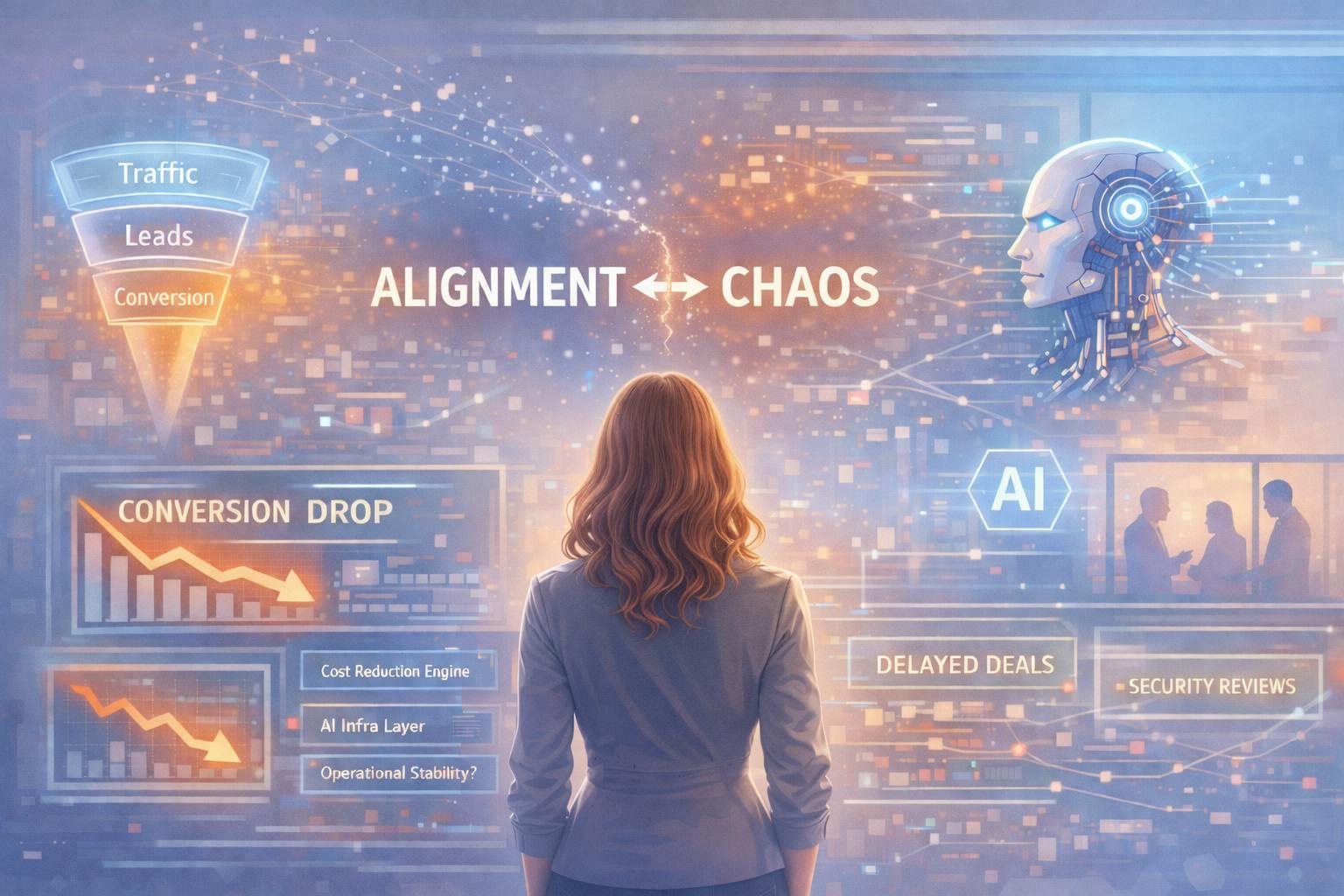
A Founder’s Framework for Going From Chaos to Clarity
In 2026, founders don’t lose deals only because their product is weak.
They lose deals because their company becomes hard to understand — internally and externally.
You can have traffic. Leads. A capable team.
And still, conversion quietly drops.
Sales cycles stretch. Prospects ask for “more materials” and disappear. Marketing publishes content that looks polished but doesn’t land. Product ships features, yet buyers struggle to clearly explain what the product solves.
This is not just market conditions.
This is not a sales problem.
This is alignment collapse, and it behaves like a hidden tax on conversion.
Broken internal alignment turns into broken external trust — and broken trust turns into lower conversion.
If that’s true, the founder’s job isn’t to “push sales harder.” n It’s to restore clarity at the system level.
Why This Is Getting Worse in 2026
The old growth model assumed relative stability:
Define strategy → execute → optimize funnel.
That model breaks when:
- Tech cycles compress from years to weeks
- Buyers research independently using AI
- Competitors replicate features rapidly
- Market narratives shift faster than roadmaps
In fast environments, companies don’t fail because they lack output. They fail because they can’t maintain coherence while adapting.
The market can handle change. n The market cannot handle confusion.
Alignment
Many teams think alignment means “agreement.”
That’s unrealistic. Different functions see different realities:
- Sales sees urgency.
- Product sees tradeoffs.
- Finance sees risk.
- Ops sees bottlenecks.
Alignment is not agreement. n Alignment iscoordinated action built on shared reality.
A company is aligned when:
- Everyone can explain the customer problem the same way.
- Everyone uses the same constraints and priorities.
- Everyone knows who decides what.
- Decisions become execution — not recurring debate.
- Learning closes the loop (we check results, update assumptions).
When these break, the company fragments into local truths.
And fragmentation is what kills conversion.
How Internal Fragmentation Leaks Into Revenue
Here are three predictable ways alignment collapse shows up in your funnel.
1) The message stops being one message
When teams hold different versions of “what we do,” your external footprint becomes inconsistent:
- homepage says one thing,
- sales deck says another,
- demo tells a third story,
- customer success promises a fourth.
Prospects don’t say “you’re misaligned.” They say:
- “Interesting, but not sure it’s a fit.”
- “We need to think.”
- “Send more info.”
That’s polite language for: I can’t trust what I can’t understand.
2) The product becomes feature-complete and outcome-unclear
Misalignment pushes product toward internal stakeholder satisfaction:
- “sales needs this feature,”
- “marketing needs this story,”
- “support needs this workaround.”
You get feature proof, not outcome proof.
Buyers don’t buy features. n They buy a clear promise with credible evidence.
3) The sales cycle becomes longer and more political
Confusion increases perceived risk, and perceived risk increases stakeholders.
That’s why unclear companies trigger:
- more calls,
- more security/legal review,
- more procurement friction,
- more “let’s wait.”
A fragmented company creates a fragmented buying process.
A Short Case: When Growth Hid Structural Drift
In early 2025, a B2B AI infrastructure company was growing fast.
ARR was increasing. Traffic was up.
The team had expanded from 18 to 54 people in under 10 months.
On paper, nothing was wrong.
But conversion dropped from 32% to 21% across enterprise deals.
Sales cycles extended by 26 days on average.
The founder assumed it was market hesitation.
It wasn’t.
When we mapped internal narratives, four different definitions of the company’s core value proposition surfaced:
- Sales described it as a “cost-reduction engine.”
- Product positioned it as a “data intelligence layer.”
- Marketing framed it as “AI transformation infrastructure.”
- Customer success sold it as an “operational stability platform.”
Each narrative made sense locally.
Collectively, they created cognitive friction.
Enterprise buyers began asking for additional demos, more documentation, more proof. Not because the product lacked value — but because the company lacked coherence.
Once the leadership team implemented:
- a weekly shared reality protocol,
- a single value narrative anchored in measurable outcomes,
- clarified decision ownership across product and GTM,
- conversion recovered to 29% within two quarters.
No new features were shipped.
No additional ad spend was deployed.
The system became understandable again.
And understanding converts.
The Founder Operating System: From Chaos to Coherence
The fix isn’t motivation. The fix is a lightweight operating system.
Move 1: Install a Shared Reality Protocol (weekly)
You need one stable reference point that sits above opinions.
Once a week, publish a short update (one page max):
- What is true right now (facts: customers, runway, constraints, metrics)
- What changed (since last week)
- Top priorities (this week)
- What we stopped (and why)
- Decisions needed (and the decider)
This reduces internal noise because it becomes the source of truth.
Rule: no strategy debate without shared reality.
Move 2: Clarify decision rights (one page map)
Most recurring conflict is not disagreement. It’s unclear ownership.
Write down 10–15 domains, assign one decider each:
- product direction,
- pricing/packaging,
- hiring bar,
- partnerships,
- brand narrative,
- compliance/security,
- customer success standards.
Many people contribute; one person decides.
Rule: speed is a function of clarity.
Move 3: Stabilize the cadence (rhythm beats intensity)
Chaos grows in randomness.
Minimal cadence is enough:
- Weekly leadership sync: constraints + decisions only
- Weekly metric pulse: one dashboard, same time
- Monthly strategy review: assumptions + resource shifts
- Quarterly reset: narrative + focus + “what we stop”
If the rhythm is stable, the organization becomes calmer even when the market is not.
Move 4: Close loops like an engineer
Most companies don’t “learn”; they just “move on.”
For major decisions:
- expected outcome,
- owner,
- check date,
- what data will confirm/disconfirm.
For recurring conflicts:
- convert drama into a rule (system design),
- so the same conflict doesn’t reappear every week.
Rule: no blame — only loop closure.
Two examples
Example A: “We have leads, but deals don’t close”
Symptoms:
- sales says “leads are low quality,”
- marketing says “sales can’t close,”
- product says “we need more features.”
Root cause is often clarity collapse:
- you don’t have one crisp “problem → promise → proof” narrative,
- teams optimize locally,
- nobody owns the one version of truth.
Fix using the framework:
- shared reality update includes one clear ICP + top 3 pains,
- decision rights assigns one owner for “core narrative,”
- monthly strategy review aligns packaging and proof assets,
- loop closure tracks conversion by segment and revises assumptions.
Outcome: n Less debate. Cleaner message. Faster cycles.
Example B: “We keep pivoting, and the team is exhausted”
Symptoms:
- priorities change weekly,
- founders jump into ops,
- people stop trusting plans.
Root cause:
- goals and strategies are mixed up. n Goals should be stable; strategies should be adaptive.
Fix:
- quarterly reset stabilizes long-term goals,
- weekly shared reality makes strategy changes explicit,
- decision rights prevents pivot-by-opinion,
- loop closure forces experiments to have end dates and success criteria.
Outcome: n Adaptation without chaos.
Where AI helps — and where it hurts
AI can accelerate clarity if it supports the operating loop:
- summarize customer feedback + CRM notes into shared reality,
- draft decision memos with options, assumptions, risks,
- detect drift (rework spikes, escalations, inconsistent messaging),
- track loop closures.
AI hurts when it becomes a substitute for accountability.
Simple rule: n AI proposes. Humans decide. The system learns.
The Headline Idea
When internal alignment breaks, your company becomes harder to understand.
Anything hard to understand converts worse.
The founder’s real leverage isn’t more hustle.
It’s installing a clarity operating system that keeps the organization coherent while the world changes fast.
That’s not management.
That’s architecture.
Valere Zimare, Founder & Human Systems Architect