
In the digital economy, trust is rarely earned through words alone. Users form judgments almost instantly based on interface behavior, often before reading mission statements or product descriptions. Research demonstrates that people form credibility impressions using visible site cues (including design and ease-of-use cues), often before engaging deeply with content (Fogg, 2003 1 ).
This distinction matters. Visual appeal can grab attention, but trust is what keeps people around. The brands that last aren’t always the ones that look the slickest. They are the ones whose user experiences quietly show authority through clear, consistent, and thoughtful design.
This article looks at how UX choices act as signals people can trust, how authority grows where psychology meets design, and why so many brands fail – not because they look bad, but because their interfaces make them seem less credible.
Trust Is Not a Visual Trait – It Is a Cognitive Outcome Trust in digital products can work like a shortcut: people use interface signals to decide whether a system feels predictable and ‘under control,’ especially when stakes are high. Users rely on observable interface cues to reduce uncertainty – especially when money, health, or sensitive data is involved. Clear system status and informative feedback are widely cited usability fundamentals for building confidence during interaction (Nielsen, 1994/updated 2; Shneiderman, n.d. 3 ).
Research in human–computer interaction and cognitive psychology consistently shows that users infer competence from structure before content. (Fogg et al., 2003 4 ) Navigation clarity, interaction predictability, and system feedback all inform whether a user believes a product is “in control.”
When interfaces feel unstable – inconsistent spacing, unclear hierarchies, delayed responses, ambiguous labels – users subconsciously question the organization behind the product. Even when content is accurate, these friction points erode perceived legitimacy.
UX is not a surface layer added after branding. UX functions as a behavioral language. That language shows a brand’s ability to think. It shows a brand’s ability to decide. It shows a brand’s ability to execute.
Cognitive Trust Signals in Interface Design
Certain UX patterns repeatedly correlate with higher levels of perceived trust. These patterns do not announce themselves as “trust features.” Their absence is felt immediately.
1. Predictability Over Novelty
Interfaces that work the way people expect make things easier to use. Trying new interaction ideas can be helpful, but too much novelty makes users relearn simple actions. That extra step often feels like the product is clumsy, not creative.
Predictable navigation, prominent actions placed where consumers expect them, and well-known interaction patterns allow users to concentrate on their goals rather than on how to achieve them. An interface shows authority when it respects users’ prior knowledge, reducing stress on the mind and improving user experience.
2. Hierarchical Clarity
A clear information hierarchy communicates decisiveness. When everything appears equally important, users infer that nothing has been prioritized. Strong typographic systems, spacing discipline, and intentional grouping signal that the brand understands its own message.
Hierarchy communicates priority; designers should structure content deliberately to reflect importance and guide user attention effectively.
3. Feedback and Responsiveness
Immediate, meaningful feedback – loading states, confirmations, and clear error explanations – helps users stay oriented. ‘Visibility of system status’ and ‘offer informative feedback’ are long-running usability principles for exactly this reason (Nielsen, 1994/updated 5 ; Shneiderman, n.d. 6 ).
Effective feedback explains system status, confirms actions, and reduces uncertainty – essential in high-stakes interfaces. The interface behaves like a competent collaborator rather than an opaque machine.
Where Branding Ends, and UX Authority Begins
Branding often establishes identity, while UX establishes credibility. The two are complementary, but they serve different psychological functions.
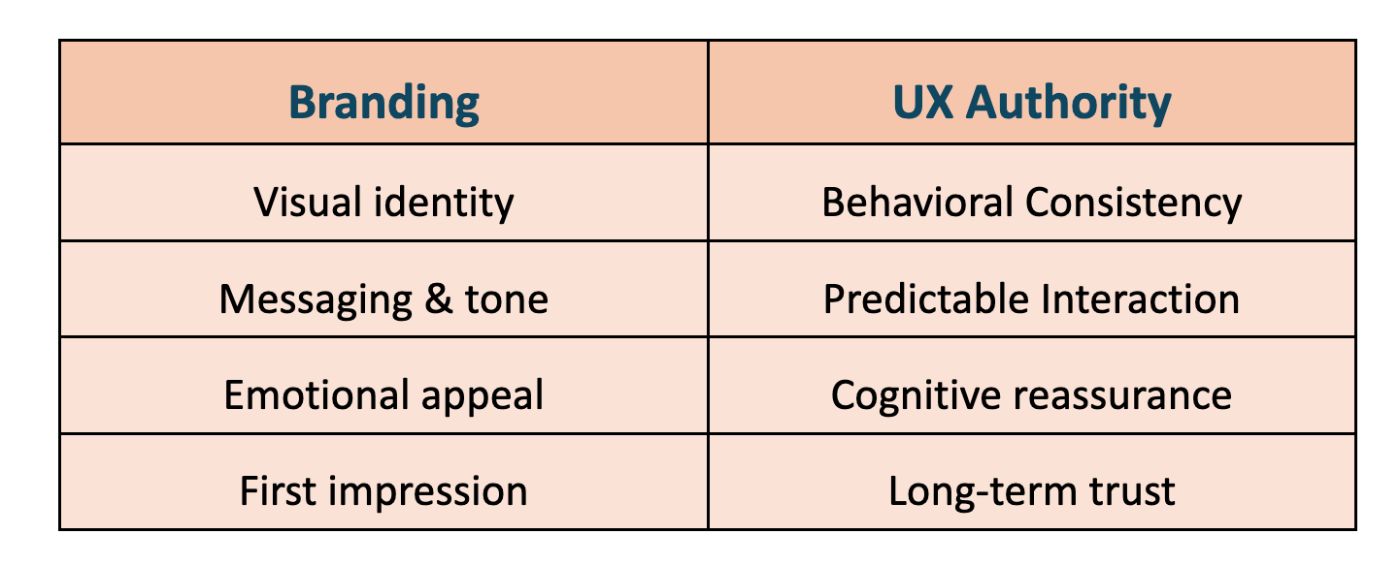
Branding answers: Who are you?
UX answers: Can you be trusted to deliver?
A common failure mode occurs when branding is treated as the primary trust lever. Logos are refined, color palettes perfected, and visual language elevated, while the underlying experience remains fragmented. Users may initially admire the brand, but they hesitate to commit.
UX authority emerges when brand values are embedded in behavior. For example:
- Brands emphasizing transparency should ensure pricing flows and data usage explanations are clear and accessible, reducing friction and building confidence.
- A brand that positions itself as premium must demonstrate restraint, not excess, in interaction and motion.
- A brand that emphasizes care must design for error recovery and user support, not just success states.
Authority is not claimed; it is enacted repeatedly through UX decisions.
Micro-Decisions That Increase Perceived Legitimacy
Legitimacy is rarely won through large gestures. It accumulates through micro-decisions that signal intentionality.
Copy Precision
Microcopy that anticipates user questions can reduce hesitation and mental effort. Clear, action-specific labels (for example, ‘Save changes’ instead of ‘OK’) help users understand outcomes faster (Nielsen Norman Group, 2024; Dykes et al., 2025).
Constraint as Confidence
Interfaces that limit choices with intention feel more confident than those that offer endless options. Constraint suggests expertise. The system has already considered what matters.
Consistency Across States
Visual and behavioral consistency across normal, loading, empty, and error states signals operational maturity. Inconsistencies suggest that edge cases were not considered, which undermines trust.
Motion With Purpose
Motion should explain causality, not decorate screens. When animation reinforces spatial relationships or action outcomes, it strengthens comprehension. Gratuitous motion, by contrast, can feel distracting or unserious.
These micro-decisions are rarely noticed individually, but together they form a pattern of reliability.
How Strong Interfaces Signal Trust Without Saying It
Highly regarded digital experiences rarely declare themselves trustworthy. Instead, they demonstrate trustworthiness through restraint and coherence.
Designers can evaluate their interfaces by auditing consistency, clarity of actions, and readability to ensure implicit trust signals are maintained.
Great digital experiences rarely announce ‘trust me.’ They show it, through clarity, restraint, and consistent behavior across screens. The following cues often signal that kind of trustworthiness in practice:
- Clear entry points and unambiguous primary actions
- Calm visual rhythm that prioritizes readability
- Systems that scale without visual degradation
- Language that favors explanation over persuasion
What distinguishes these experiences is not their trend alignment, but their internal consistency. Every design choice appears to serve a reason, even when the reason is invisible.
That coherence lets users sense the brand is thinking several steps ahead. Perceived authority depends on that feeling.
UX as Silent Persuasion
Persuasion in UX is often misunderstood as conversion optimization. A more effective form of persuasion shows up when users can complete tasks with confidence. Well-structured flows and explanatory feedback help each step feel justified and safe.
Legitimacy lowers friction without removing steps. A process can stay intact and still feel smooth. Each step feels reasonable. Each step feels worth it. Users invest time, data, or money more willingly when the interface shows care, foresight, and respect.
In this way, UX becomes a form of silent rhetoric. The experience makes the argument for competence. Claims do not carry the point. Interaction does. Each moment either reinforces the brand story or contradicts it.
Conclusion: Authority Is Designed, Not Styled
As digital products become more common, trust is what sets them apart. How something looks may catch the eye, but it is authority that keeps people engaged.
UX choices build legitimacy by showing intention. Users feel considered. Reliability becomes visible even when conditions are uncertain. Clarity matters. Consistency matters. Feedback matters. Each interaction can strengthen authority and trust.
Designers and teams who want a lasting impact should look beyond appearance. The real question is not whether an interface looks good. The real question is whether it behaves with authority.
In the end, users do not trust brands that only look confident. Users trust brands that act like they know what they are doing.
References
Fogg, B. J. (2003). Persuasive Technology: Using Computers to Change What We Think and Do. Morgan Kaufmann.
Nielsen Norman Group. (2018, June 3). Visibility of system status (Usability heuristic #1). https://www.nngroup.com/articles/visibility-system-status/
Shneiderman, B. (n.d.). The eight golden rules of interface design. University of Maryland. https://www.cs.umd.edu/users/ben/goldenrules.html
Fogg, B. J., Soohoo, C., Danielson, D. R., Marable, L., Stanford, J., & Tauber, E. R. (2003). How do users evaluate the credibility of Web sites? A study with over 2,500 participants. In Proceedings of the 2003 Conference on Designing for User Experiences (DUX ’03). Association for Computing Machinery. https://doi.org/10.1145/997078.997097
Nielsen Norman Group. (2024, May 8). UX writing: Study guide. https://www.nngroup.com/articles/ux-writing-study-guide/
Dykes, T., Moran, K., & Kaley, A. (2025, August 1). The 3 I’s of microcopy: Inform, influence, and interact. Nielsen Norman Group. https://www.nngroup.com/articles/3-is-of-microcopy/
n