
A team of American scientists, led by Giulia Brachi and Wil Srubar, has just demonstrated that it is possible to tame the light produced by living organisms. By focusing on a unicellular algae called Pyrocystis lunulaknown for its bluish flashes in the waves, they managed to transform an ephemeral defense reaction into a stable and controllable source of lighting. The study, published in May, details a method that could well change our relationship with artificial light.
How did scientists turn a flash into a long-lasting glow?
The secret does not lie in mechanical pressure, like that of waves, which only causes bursts of a few milliseconds. No. The team had another intuition: to play with chemistry. They discovered that by diving the algues bioluminescentes in a slightly acidic solution, with a pH of 4 (similar to tomato juice), the light reaction was triggered and, above all, maintained. A real chemical switch.
This phenomenon of bioluminescence (the production of light by a living organism) is caused by an enzyme, luciferase, which reacts with a compound called luciferin. Acidity triggers this reaction in a prolonged manner, providing an intense cyan glow for almost half an hour. This is the very first time that we manage to obtain such a long luminescence in this way.
What form does this new luminous material take?
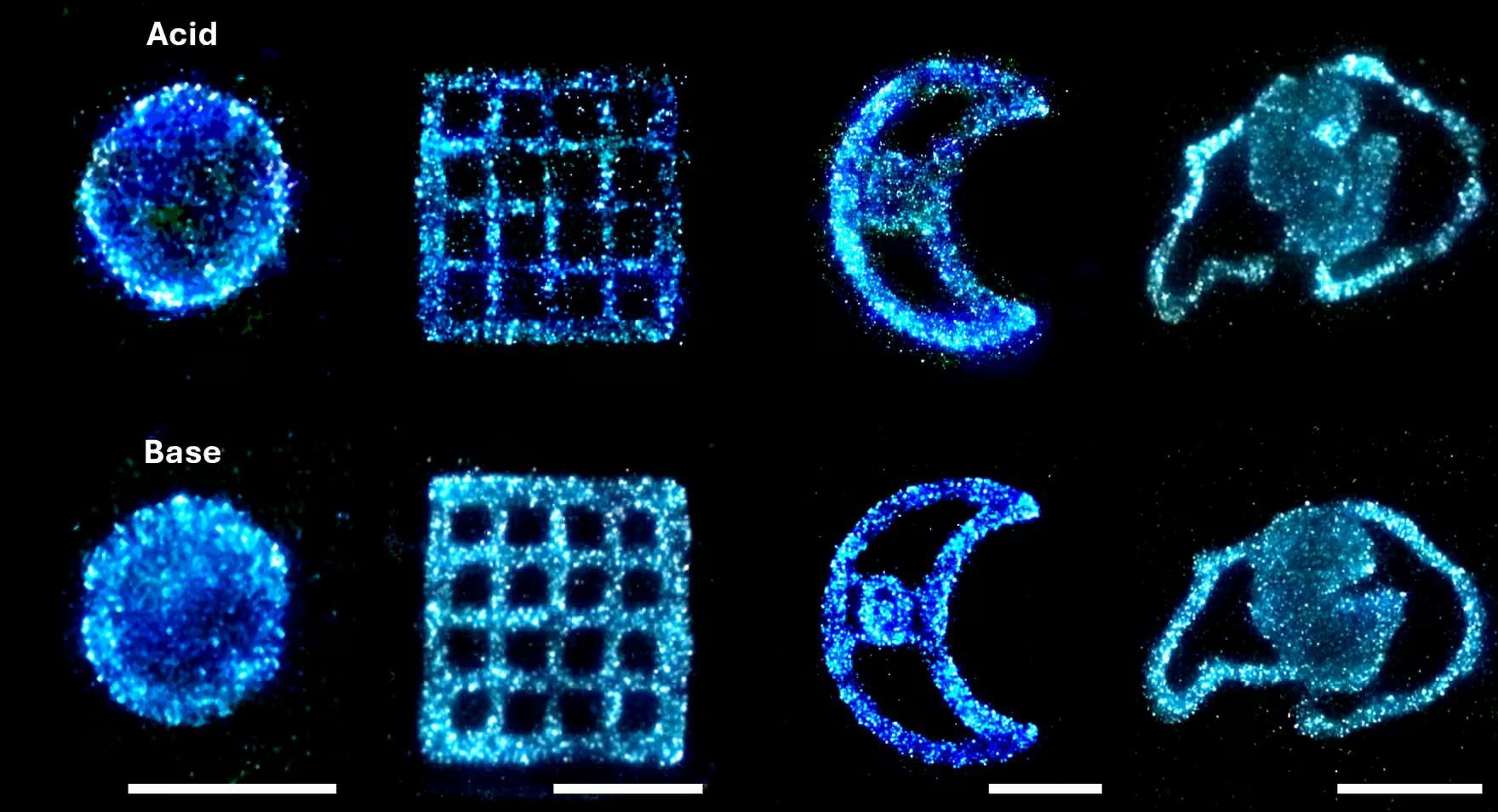
To make this discovery actionable, the researchers encapsulated the algae in a hydrogel, a gelatinous water-based substance. This biocompatible material serves as support and protection. This is where the magic ofimpression 3D comes into play, allowing this living gel to be sculpted into complex shapes, such as a crescent moon or logos. The result is a solid structure that shines from the inside out.
And the most amazing thing is that the algae survives this process. They remain alive and active for weeks inside their hydrogel matrix. The structures treated with the acid solution even retained 75% of their brightness initial after one month. It’s a giant step toward creating living, functional building materials.
Beyond gadgets, what are the concrete applications?
The team talks about a “moonshot”, a crazy idea. But the potential applications of this living light are dizzying. We can imagine autonomous robots exploring the seabed without heavy batteries, or biological sensors that light up to signal the presence of toxins in the water. The main advantage of these algae is their carbon footprint: they consume CO2 to live. We therefore produce light while storing carbon.
But let’s not get carried away: scaling up remains the main challenge, a well-known gulf between a laboratory bench and the real world. The conclusions of the study published in Science Advances are a fascinating first step, but there is still a long way to go before we see our cities illuminated by microorganisms.
Frequently Asked Questions (FAQ)
Does this technology consume energy?
No, and this is its major advantage. It produces light via a biochemical reaction without requiring electricity. Better yet, because algae are photosynthetic, the process is carbon negative: they absorb CO2 dissolved in seawater for their energy.
Do the algae survive for a long time in this acidic solution?
This is a point of vigilance. Some experts, not involved in the study, note that a pH of 4 is stressful for these organisms. However, the researchers showed that they remained viable and luminous for several weeks once encapsulated in the protective hydrogel.
When will we be able to buy algae lamps?
It’s much too early to tell. The technology is still at the basic research stage. The transition to a reliable and accessible commercial product will likely take many years and require overcoming significant engineering and production challenges.