You may have heard of Tesla’s home batteries that were introduced in 2015 under the name “Powerwall.” These powerful lithium-ion batteries can store energy from the grid — or even the sun — so you can use them when your power goes out or when the sun goes down. It’s no wonder that Tesla created a product like this, given the Powerwall battery technology is fundamentally no different from that found in Tesla cars.
So, why can’t the Tesla you plug into the wall at home act as a backup battery when the lights go out? Well, there’s no official reason. In fact, several electric cars afford you the ability to do just that. The feature is known as “bidirectional charging,” otherwise called V2G (Vehicle-to-Grid) or V2H (Vehicle-to-Home) charging. With this technology, your EV could power your home in the event of a power outage.
Depending on your EV’s battery capacity (and your power needs), it could provide anywhere between several hours to several days’ worth of power. Of course, since lithium batteries degrade with each charge cycle, you wouldn’t want to use your EV to charge things all the time. However, if you live somewhere with a shaky power grid or a violent storm season, using backup power from your vehicle could make a world of a difference in both your comfort and safety. If that sounds like something you’d want, then opt for an EV that offers bidirectional charging. We’ve put together some prime choices, and they aren’t all expensive luxury models, either!
Ford F-150 Lightning
While Tesla helped make EVs cool by marketing them as high-performance sports cars, Ford took a different approach to entering the EV market. Instead of pushing niche and expensive electric sports cars, the company took America’s best-selling truck and electrified it in the form of the F-150 Lightning. For this vehicle, strong performance is just one key consideration; anyone buying a truck like this would expect utility, in keeping with the F-150 tradition. Turning the car into an all-electric vehicle opens up new possibilities on that front.
For example, you have AC power outlets in the truck bed, which means you can power electric tools without carting a gas power generator around in your truck. The headline feature, however, is Ford’s Home Backup Power functionality. It might even be fair to say the F-150 Lightning has become the poster child for power-to-home EV technology. Ford even takes a jab the Tesla Powerwall on its Home Backup Power product page, stating that the F-150 Lightning model with extended battery can hold “as much energy as 7 Tesla Powerwalls” and power an average home for up to three days.
This is a brilliant way to make lemonade from the lemon that is powering a big, heavy truck using battery power; since the hefty Ford EV needs massive batteries to shift its bulk, Ford was smart to turn that into a selling point. Sadly, it seems that despite the vehicle being generally well-regarded, the data didn’t add up to justify its continued production. In late 2025, Ford announced it would discontinue the electric F-150. But with that, you can likely get a good deal on existing stock or easily find the car on the used market. It’s worth mentioning that this plucky truck did not feature on our list of the worst electric vehicles to buy used.
Hyundai Ioniq 5
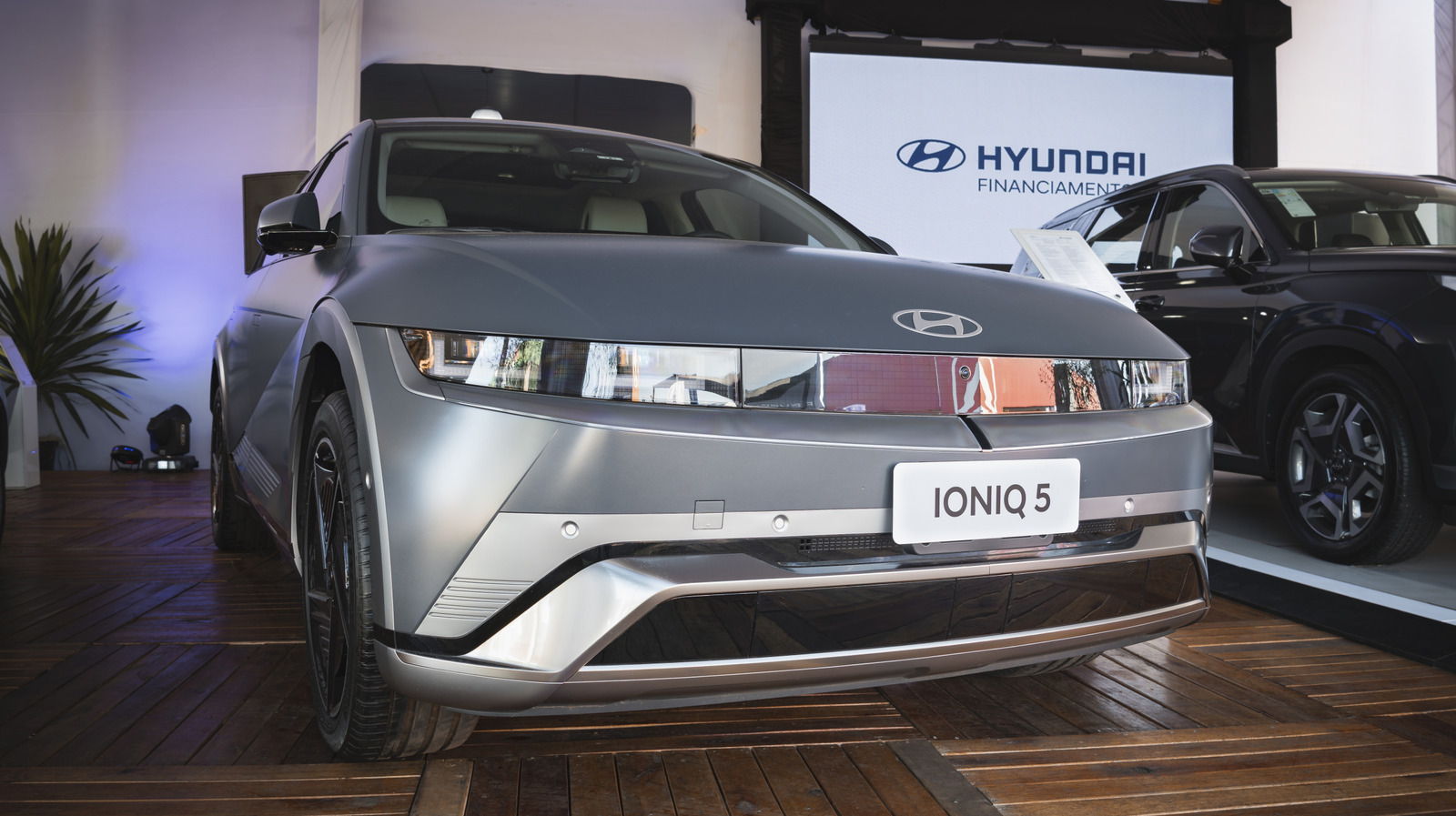
Hyundai’s Ioniq 5 is a record-breaking best seller in the U.S., with tens of thousands of Ioniqs having found garages to call home across the country. As a whole, the Ioniq series has really put the Korean car giant on the EV map, placing the automaker in considerable competition with EV giants like Tesla and other major industry players. Key to this is Hyundai’s proprietary E-GMP (Electric-Global Modular Platform), which gives a common core to a number of different EVs, both in Hyundai’s own stable and in the extended Kia EV family.
E-GMP offers bidirectional charging, which means you can use your Ioniq 5 to power household electrical devices in a pinch; you could even use it to power your whole home, if required, just like the F-150 Lightning can. That makes it suitable for emergency situations, but it’s also great for camping, which is one way Hyundai officially promotes it — as you can see above.
The Ioniq 5 can supply up to 3.6 kW of power and has two V2L (Vehicle-to-Load) ports. There’s one under the second row of seats, which only works when the vehicle is on, but there’s another port on the outside of the car, which works even when the vehicle is off. That’s the one you’re most likely to need when the lights go out. Whether you’re worried about food spoiling, or if you just want to keep your internet and entertainment going while you wait for your power to return, the vehicle’s exterior V2L port would help you keep things running. To better understand how the technology works, we recommend you watch Hyundai’s official V2L demo on YouTube.
Hyundai Ioniq 6
Remember how we mentioned that Kia and Hyundai use the same modular E-GMP for their EVs? Well, the Ioniq 6 is the perfect example of why that strategy is effective. Not everyone needs (or wants) a bulky SUV or a crossover vehicle, but for those attracted to E-GMP technology, Hyundai has adapted it for its sedans that boast all the trimmings buyers in the market would find appealing. As a sedan, the Ioniq 6 offers greater range at a lower price than its larger counterparts. But since it’s based on the same electric platform that powers vehicles like the EV9, you can expect the same platform-based features you’d get from other vehicles using the same technology.
Like the Ioniq 5, the Ioniq 6 can also output 3.6 kW of power to power appliances and other electronic devices. You’re unlikely to be taking out your Ioniq 6 on camping trips like you might do with an Ioniq 5, but you could certainly still plug your laptop’s AC power cord into the car’s under-seat outlet. You can also use the same V2L adapter on the exterior of the car. This just goes to show that an EV doesn’t have to look like a truck or an SUV to pack substantial power. After all, an emergency doesn’t care what type of car you drive.
Kia EV6
Moving on to the cousins of the Hyundai EVs, the Kia EV 6 was actually the first E-GMP car the public saw, and it was also Kia’s very first dedicated EV. It’s a compact crossover, so the market for the EV6 does overlap with the Ioniq 5, although the styling is — as usual — quite distinct between the two related brands. However, the EV6 is quite a bit more expensive than the Ioniq 5 is, and we suspect the latter vehicle’s aggressively affordable pricing is a big reason why it’s sold so well thus far.
What do you get for the more premium option, though? There are several key differences between the EV6 and the Ioniq 5, even if they are built on the same base. The EV6 is more performance-focused, so the fastest EV6 model is faster than the equivalent Ioniq 5 model in the stack. Between the two vehicles, range and economy are pretty similar, as are safety features and creature comfort options. The Ioniq 5 does, however, offer a smidge more storage space. Most importantly, though, the EV6 also supports V2L technology to give you emergency power when you need it.
Kia EV9
The Kia EV9 is the brand’s second E-GMP vehicle, and this one was based on a remarkable concept car that featured futuristic styling, including a cool rotating seating arrangement that allowed occupants to face one another. The production EV9 is far more conventional, but it does retain the futuristic exterior styling. Tragically, the vehicle’s second-row swivel seating feature is unavailable in the American market due to safety regulations.
While the EV6 is a compact crossover with a focus on performance, the EV9 is a mid-sized crossover SUV that can handle rougher terrain. It also offers more cabin space. While both the EV6 and the EV9 have the same V2L and V2H capabilities, Kia’s U.S. marketing for the EV9 focuses on V2H using the Wallbox Quasar 2. So, if you need a bigger, more practical, and higher-performing vehicle than the EV6 or a similar model, you can opt for the EV9 without having to give up bidirectional charging features.
Chevrolet Silverado EV
General Motors wanted to create a common EV platform that could be used across different vehicles within its many distinct brands, just like Hyundai Motor Group did. The result was the Ultium platform, which can be found in everything from Hummers to Cadillacs. The platform is also used in Honda and Acura EVs, since Ultium is the result of a joint venture with Honda.
The Chevrolet Silverado EV is a full-sized, Ultium-based EV that we assume is a response to the F-150 Lightning, but unlike the Lightning, there’s no current indication that the Silverado EV is going anywhere. As was done with the F-150, GM has leveraged the Silverado EV’s enormous battery capacity as a selling point, showing off its 9.6 kW of power delivery by using it to run a Beverly Hills mansion as a publicity stunt.
The message, we must assume, is that if you’re living in anything less than a big, fancy mansion, the Silverado will have no trouble getting you through a prolonged blackout.
Nissan Leaf
It’s incredible to think that the first-generation Nissan Leaf EVs launched all the way back in 2010, following their reveal only a year prior in 2009. The Leaf is one of the earliest EVs to support bidirectional charging. From 2013 onward, Leaf EVs using the CHAdeMO fast charging standard could support bidirectional charging, but you’d need a converter like the Wallbox Quasar to convert the Leaf’s DC power into AC power that your home would be able to use.
The problem? No bidirectional charger was officially approved for use on the Leaf in the U.S. until 2022, and when that happened, Nissan specifically okayed the Fermata Energy FE-15 charger. Only approved bidirectional chargers can be used with a Leaf without impacting the vehicle’s battery warranty. So, if you already have a Leaf — or if you’re considering buying one — you should double check whether the model in question will work with an approved charger system where you live. Getting that wrong could ultimately turn into an expensive mistake!
Tesla Cybertruck
Tesla’s Cybertruck has been controversial, to say the least. Setting aside public opinions on Elon Musk and the companies he owns, there are serious questions about whether the Tesla Cybertruck is actually reliable, and it doesn’t help that used Tesla Cybertrucks have plummeted in value compared to the high price tag on new ones.
While Tesla has been an EV pioneer, the company has been strangely reluctant to offer bidirectional power features. As of now, with a feature known as Powershare, the Cybertruck is the only Tesla model that allows you to pump electrons in two directions.
Powershare is a V2G (Vehicle-to-Grid) solution, and it also needs Powershare hardware to work. However, if you have a Cybertruck with electrical outlets in the bed, then you can still power key appliances without needing Powershare. One unique feature of the Cybertruck is that it can integrate with Tesla Powerwall systems, if you have them, to allow the truck and your Powerwall batteries to work together.
Polestar 3
At the time of writing, the Polestar 3 is the most recent EV to feature bidirectional charging. The company announced in late 2025 that it was working to enable V2H functionality in partnership with a third-party company called Dcbel.
Because Polestar’s V2H implementation is currently tied to Dcbel systems, the vehicle’s been targeted to residents in California where the infrastructure exists. In Australia, however, Polestar indicated it was “good to go” with V2G (Vehicle-to Grid) functionality. It therefore seems that owners of this EV will have to wait until the company gets around to activating bidirectional charging wherever they live.
As for V2L, which allows you to power appliances directly from an EV, we weren’t able to confirm it would be coming at all to the Polestar 3. Despite speculation by Polestar 3 owners, we couldn’t locate an official announcement. Of course, you don’t need to buy a whole EV just to have backup power. There are many high-quality, affordable portable power stations out there that can cover you when you need emergency power.