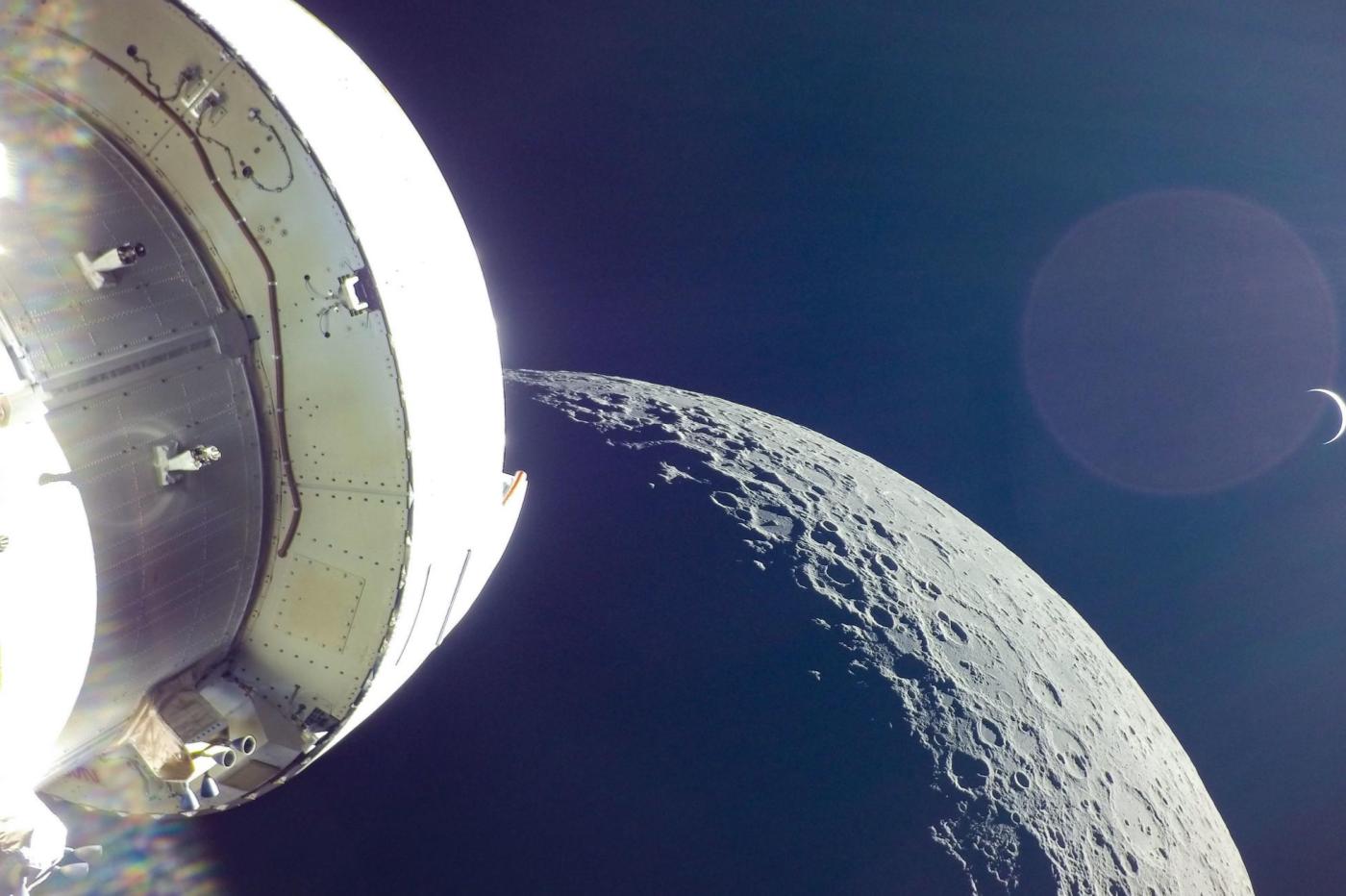
This evening at 8:45 p.m., four humans will fly over the Moon for the first time since 1972. At 6:42 a.m. this morning, the Orion Integrity spacecraft entered the “sphere of influence” of the Moon, where the gravitational attraction of the body takes over that of the Earth. The close observation phase begins in the evening and will last approximately seven hours. It is broadcast live on the NASA website, but also on YouTube, Amazon and Netflix. Needless to say, there’s no real excuse to miss this!
A flyover that shatters records
The four astronauts will surpass the historic milestone of Apollo 13 this evening, becoming the humans who have reached the greatest distance from Earth. Orion will reach its farthest point at 406,773 kilometers from Earth, surpassing the Apollo 13 record by more than 6,600 kilometers (around 8 p.m.), established in much less glorious circumstances in 1970.
The trajectory chosen by NASA also differs significantly from that of the Apollo missions. While the Apollo pioneers had passed at an altitude of around 110 kilometers from the lunar surface, those of Artemis II will be much further away, around 6,500 kilometers at the closest. Further, but paradoxically better view because due to their distance, they will benefit from a view of the complete disk of the star, including the pole region. The Moon will thus appear to them as large as a basketball held at arm’s length.
What the crew will do during these seven hours
The four astronauts, Reid Wiseman, Victor Glover, Christina Koch and Canadian Jeremy Hansen, are not there to passively admire the landscape. All were trained for more than two years to study geological formations and describe them. Their notes and photographs should make it possible to learn more about the geology and history of our natural satellite. They will see other portions of the Moon never seen directly by humans. Photos taken by robot orbiters exist, but as a science communicator from the Montreal Planetarium summarizes: “we have images, but none have the artistic capacity of humans“.
Around 12:47 a.m., Orion will pass behind the Moon and communications with Earth will be cut for approximately 40 minutes. A radio silence that the Houston ground teams will experience with the same tension as during the Apollo era. Then, towards the end of the flyby, something quite rare because the ship, the Moon and the Sun will align, making the Sun disappear for about 53 minutes. The astronauts will study the solar corona, this outer layer of the sun’s atmosphere which will appear to them as a luminous halo.
Subscribe to WorldOfSoftware
Why this flight really matters
Artemis II will not land on the Moon. This is a qualification flight of the Orion spacecraft, designed to verify that the systems hold up in the lunar environment before sending astronauts back there in 2028. This flyby will also be historic because it was accomplished for the first time by a woman, Christina Koch, and by a black astronaut, Victor Glover. Jeremy Hansen becomes the first non-American to fly this far into space.
It’s not a moon landing. But this is the first time in 54 years that humans have really come close to the Moon, and it’s worth spending a few minutes tonight.
🟣 To not miss any news on the WorldOfSoftware, follow us on Google and on our WhatsApp channel. And if you love us, .