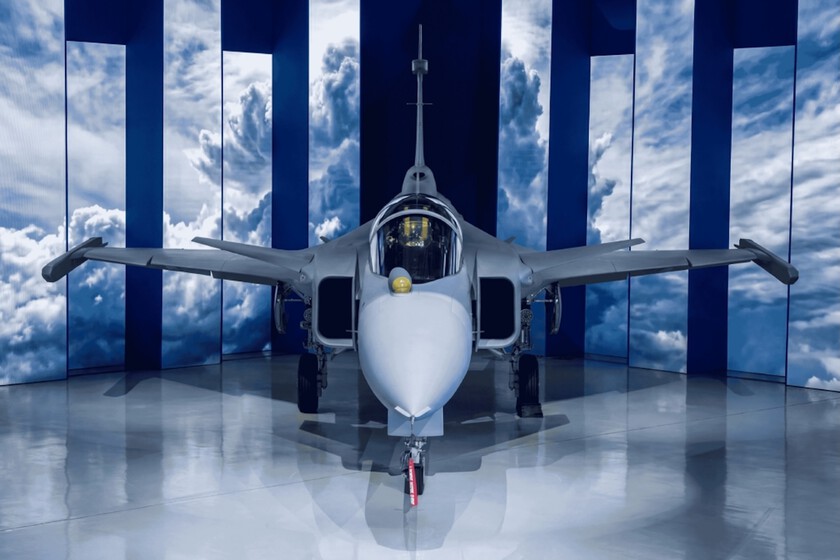
In 1969, Brazil made a decision that many considered excessive for a developing country: to create a state company called Embraer to manufacture its own aircraft. More than half a century later, that bet has given rise to the third largest aeronautical manufacturer in the world, only behind Boeing and Airbus, and one of the most advanced aerospace industries outside of the traditional great powers.
A milestone beyond defense. Brazil has celebrated the departure of the production line of the first supersonic fighter assembled in its territory, an event that far transcends the military sphere. What is truly relevant is not only the arrival of a new aircraft to the ranks of the Brazilian Air Force, but the fact that a Latin American country has reached an industrial level that for decades seemed reserved for a very small group of powers.
In a region accustomed to importing advanced combat systems, Brazil has managed to join an extremely exclusive club in which the ability to manufacture supersonic aircraft is as important as owning the aircraft themselves.
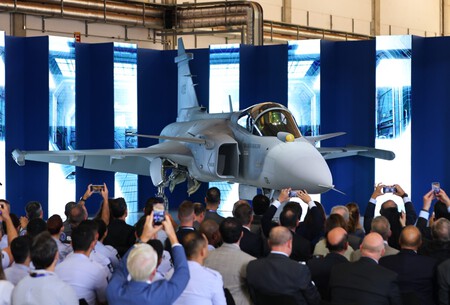
The road to the Brazilian Gripen. The Gripen program began with the contract signed in 2014 between Brazil and the Swedish Saab for the acquisition of 36 devices, but from the beginning the objective went far beyond purchasing aircraft. The agreement included technology transfer, training of engineers and direct participation of Embraer in the manufacturing and assembly of the devices.
A decade later, the result is visible in Gavião Peixoto, where the first Gripen E built on Brazilian soil has left the factory. Although the design remains Swedish, the process has allowed the development of industrial capabilities that did not previously exist in the country and that would hardly have been acquired through a simple purchase of foreign material.
Enter the most difficult club in aeronautics. Building a commercial airplane is a complex task. Building a modern fighter aircraft is one of the most demanding industrial activities on the planet. In fact, only a small group of countries have the capacity to design and manufacture supersonic fighters from scratch, including the United States, France, Russia, China and Sweden.
Brazil is not yet part of that circle of independent designers, but it has achieved something that no other Latin American country had achieved: locally produce a front-line fighter capable of operating in the most advanced scenarios of modern aerial warfare. That difference may seem subtle on paper, but it represents a gigantic leap for the region’s technology industry.
Much more than a plane. The Gripen also represents a commitment to technological sovereignty. The ability to assemble, maintain and modernize devices within the country reduces external dependencies and strengthens the operational autonomy of the Brazilian armed forces.
At the same time, the project has driven the creation of specialized knowledge, new supply chains and an industrial base capable of participating in increasingly sophisticated aerospace programs. The same impulse is behind other Brazilian strategic projects, such as the KC-390 transport plane or naval programs developed with foreign technology but growing national participation.

Aerospace power. The true meaning of this program is not measured solely in the number of aircraft or military capabilities. It is measured in the position that Brazil is beginning to occupy within the global industrial map. While much of Latin America remains dependent on the export of raw materials or the import of advanced technology, Brazil is building an industry capable of participating in some of the most complex and profitable sectors in the world.
The release of the first Gripen assembled in Brazilian territory symbolizes precisely that: the moment in which the country stops being only a buyer of defense technology to become one of its producers. There is no doubt, it may never arouse the same passion as a football World Cup, but for the industrial history of the region it will probably be an even more exceptional achievement.
Image | Embraer
In | We tend to assume that the Wright brothers invented the airplane in the United States. In Brazil they believe they have evidence to the contrary
In | A Brazilian has shown that having Internet in mid-flight is possible with Starlink. It has also shown that it is a real danger