In 2022, I drove my motorcycle up 13,000 feet to the top of Cinnamon Pass on the spine of the Continental Divide in Colorado. I was well into a 30-day, 5,000-mile cross-country solo bike trip, and I was ready to take a break. I dropped the mud-covered kickstand, swung my stiff, middle-aged body across the bike’s seat, and dismounted. I’m somebody’s Pinterest pin, I thought to myself as I surveyed the jutting, rust-colored peaks around me. Look at this place.
(Credit: Michael Lydick/Jeffrey Hazelwood/PCMag; Getty Images)
Then, a shock back to reality: a vibration in my chest pocket. I was still on the clock.
I pulled out my Pixel 4 XL, which showed a tentative half-bar of 3G. Below that, a message to review a document, loading byte by byte like the crowning of a baby’s head during childbirth. Watching the so-called progress bar inchworm its way from left to right was extremely painful, but I had to make do. This was the deal I’d made with myself: I could take this trip, but I had to work along the way. This experience inspired my PCMag story Working From Roam: How I Ran My Business While Riding 5,000 Miles Across America.

The Ultimate Off-Grid Mobile Office
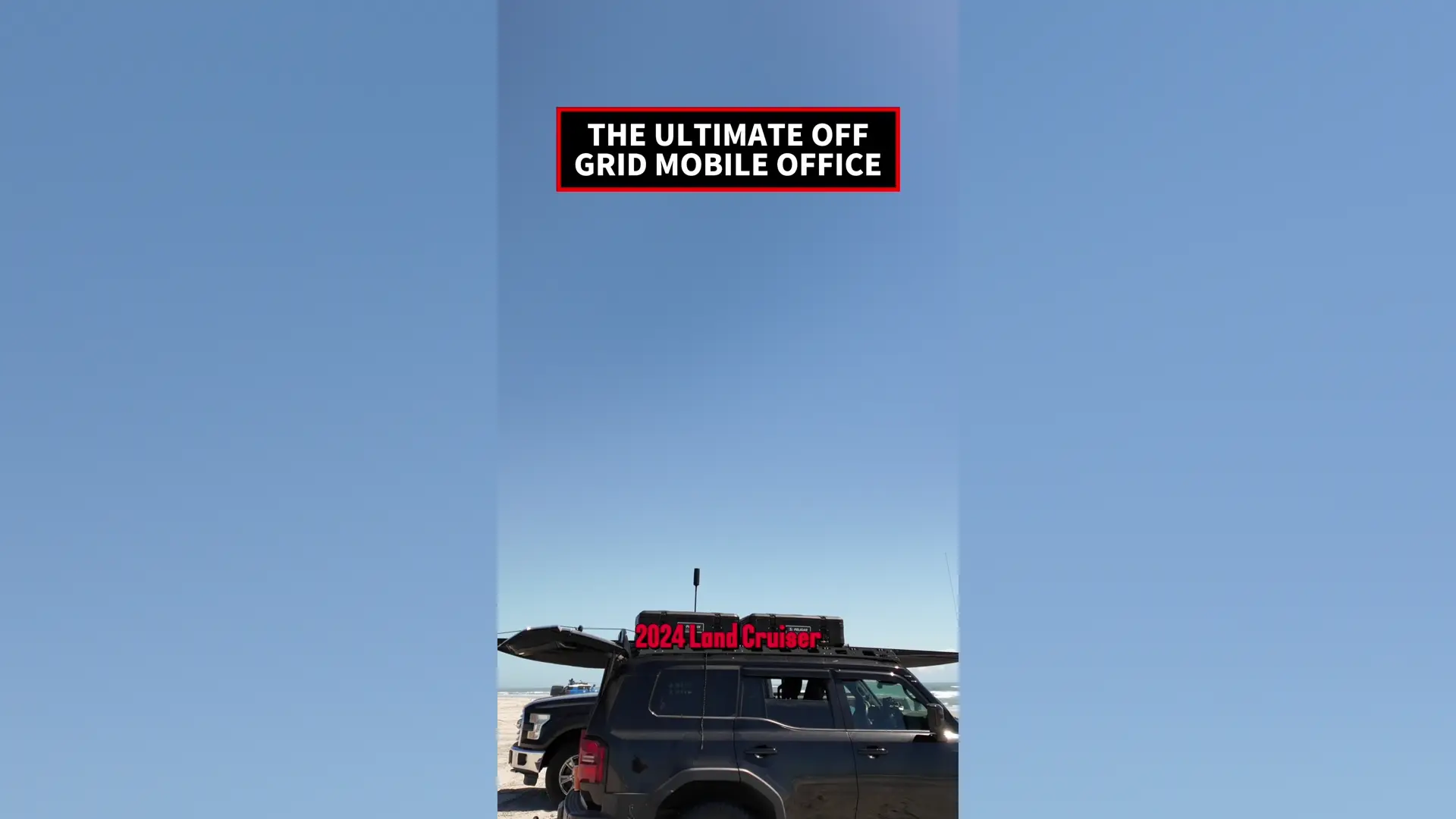
Flash forward to November 2025. This time, I’m on a shorter but much-needed weeklong journey within my home state of North Carolina—from Pilot Mountain near the Appalachians to a remote fishing village on Ocracoke Island—in my 2024 Toyota Land Cruiser that I call Luci. In the rear hatch, I have installed a 2,047-watt-hour-capacity EcoFlow Delta 2 Max solar generator that powers my rooftop Starlink Mini satellite dish, something I didn’t have on the mountain pass that day in 2022 that I carry with me everywhere now. This laptop-sized device keeps me connected to my online financial software company, BacktoTheFutureTrading.

(Credit: Michael Lydick/Jeffrey Hazelwood/PCMag; Getty Images)
My father spent 25 years at Pan Am, once the largest airline in the world, only to watch stability evaporate overnight when the once too-big-to-fail company collapsed. Today, my daughter struggles to find a job in a market frozen with uncertainty, despite her degree in computational mathematics with minors in astrophysics and astronomy. Along the way, I’ve lost faith entirely in corporate America. I’ve realized that stability isn’t something you’re provided anymore; it’s something you build.
As a result, I have constructed a life and a business unbound from a single employer, a single office, or a single point of failure. Now, work travels with me instead of the other way around. Here’s how I do it.
Setting Off on My Starlink-Powered Road Trip
I’m parked at the base of Pilot Mountain, sitting behind the wheel of the Cruiser with the mountain’s sheer rock face rising above the trees in front of me. A few hikers pass by on the trailhead, unaware that my SUV is doubling as a mobile office. My phone shows a full five bars of 5G, and the Starlink Mini is connected with an unobstructed view of the sky.

(Credit: Michael Lydick/Jeffrey Hazelwood/PCMag; Getty Images)
A colleague’s message lights up the screen, alerting me to a prospective customer. I suggest a Google Meet, which runs beautifully on my Pixel 9 Pro XL, and a moment later, I’m conducting a sales conversation from the shadow of the mountain.
I’m confident in the video call because of another great piece of tech I’ve come to rely on: my HiBoost Cell Phone Signal Booster, located under the truck’s front seat. The HiBoost, which plugs into the 12VDC socket, takes the available cell signal from an antenna on my roof and typically increases signal strength by about 50-70 dB. I have at least one bar the whole trip, even on the coast, where cell tower density drops to almost nothing.

(Credit: Michael Lydick/Jeffrey Hazelwood/PCMag; Getty Images)
If and when my 4G LTE signal disappears entirely, the Google Pixel 9 Pro XL can still place calls over Wi-Fi through Starlink. My Starlink Mini rides on the Land Cruiser’s roof using Trio Flatmount hardware with rubber-coated magnetic feet (the device is protected by a black silicone cover). I’ve used these mounts since the early days of Starlink roaming, when the much larger V3 dish was affixed to the roof of my old Nissan Xterra alongside solar panels and battery gear.
Today, the Mini makes the entire setup dramatically easier. Starlink claims that its speeds doubled last year, while latency has dropped significantly. (PCMag’s own testing largely corroborates these improvements.) The number of satellites in low Earth orbit expanded from 3,000 to over 9,000 in the past few years. The newest model Mini dishes are almost twice as small and weigh half as much.
For longer stays, I power the larger V3 dish from an EcoFlow Delta 3 Max power station. On the move, the Mini typically runs from smaller battery systems like the Anker Solix 300DC, which delivers enough USB-C output to keep the dish and my HP Dragonfly laptop running for most of a workday. I also carry inexpensive alternatives like the SYMIK USB-C adapter, which lets me run the Mini from standard Ryobi tool batteries.
When I’m stationary, I’ll occasionally move the dish off the vehicle and onto a tripod to improve the view of the sky. A simple speaker tripod works well for the larger V3 dish, while a compact folding phone tripod handles the Mini when I want something lightweight and quick to deploy.
Spinning Wheels and Closing Deals
I close the deal with the customer and get back to important things, like watching Netflix. I’ve been binging the Lost in Space reboot for the third time. I’m fascinated by the Robinson family’s iconic spaceship, The Jupiter 2, a self-contained home that lets them travel and work almost anywhere. When they land on a new world, a rover rolls out of the cargo bay, and the ship’s reactor keeps everything running.
I’ve always loved that idea: traveling to remote places while bringing the best of modern technology along for the ride.
The Land Cruiser is no Jupiter 2, but it’s 2026, and I’m working with a smaller budget. My vehicle’s turbocharged hybrid drivetrain includes a built-in 2,200-watt pure-sine-wave inverter in the cargo area. That inverter feeds my EcoFlow Delta 2 Max, which serves as the power core for everything in my mobile setup. In my version of the story, the Land Cruiser is both the ship and the rover, and every mile I drive adds a little more energy to the system.
The Delta 2 Max sits nicely behind the Dometic CFX5 45-liter 12V refrigerator and freezer. This fridge is pricey, but it draws very little power thanks to its high-efficiency compressor and evacuated stainless-steel dual-wall construction. I can keep one week’s worth of food back here, and I’ve packed it full for the trip to Ocracoke Island, where I’ll be hard-pressed to find a McDonald’s.

(Credit: Michael Lydick/Jeffrey Hazelwood/PCMag; Getty Images)
As I pull out of Pilot Mountain State Park, I can see that the Starlink Mini is only drawing 25 watts to search for one of thousands of satellites crossing overhead. When you make every watt you use, you appreciate appliances that “sip” electricity like this.
The sky shifts to tangerine and pink. Cruising at 60 mph, well below Starlink’s 100-mph supported speed for in-motion use, the Mini maintains a steady connection. My phone clings to a single glitchy bar of cellular service while the dish pulls down 114 Mbps.
I roll past cotton fields and canals and farmers and fishermen on my way to the ferry terminal. This is my commute. My father had to leave at 4:30 a.m. and fight traffic to get to JFK International Airport. I wonder what he’d think of this trip.

(Credit: Michael Lydick/Jeffrey Hazelwood/PCMag; Getty Images)
I make sure to arrive at the terminal early, because I know how the boats are loaded. If I’m here first, my Starlink Mini won’t be blocked by the steel overhangs and platforms in the middle of the ship. Get here late on a busy day, and I’d have to unravel the 100-foot cable from the Starlink Mini and take it to the boat’s bow, where there’s an unobstructed view of the sky. That would likely lead to awkward questions from tourists about my setup. I prefer the solitude of the driver’s seat.
Working on Water
Once the ferry gets moving, I settle into my cockpit. My HP Dragonfly laptop, connected to the Mini Wi-Fi, sits on a steering wheel desk. This way, I can lower my seat with the electric controls and have the keyboard at a comfortable height.
To the right of my keyboard is my Baofeng UV-5R UHF/VHF ham radio. It’s set to 146.52 MHz, the general calling frequency, and programmed to hit the repeaters along the routes I take where other Hams congregate. If the Hiboost, Starlink, and Verizon go down, I’m still able to communicate.

Get Our Best Stories!
Your Daily Dose of Our Top Tech News

By clicking Sign Me Up, you confirm you are 16+ and agree to our Terms of Use and Privacy
Policy.
Thanks for signing up!
Your subscription has been confirmed. Keep an eye on your inbox!
To my left is my Garmin inReach Mini, my fourth redundant communication layer, which is connected to the Pixel 9 via Bluetooth. My $12 monthly plan tells my wife, who is at home, where I am every 15 minutes. I can text through the Iridium satellite network that Garmin has contracted with, or quickly send canned “I’m OK” messages.

(Credit: Michael Lydick/Jeffrey Hazelwood/PCMag; Getty Images)
It’s a two-and-a-half-hour ferry ride, which gives me ample time to answer emails and update my company’s socials. As the boat arrives at shore, I close the Dragonfly with a sense of accomplishment. I drive off to find my spot for a few days.
Outfitting My (Very) Remote Office
Long before tourists in golf carts and beach cruisers rolled in, Ocracoke Island was home to the Woccocon tribe—Algonquin people who fished the shallow waters and traveled by dugout canoe. By the 1600s, Ocracoke wasn’t just a remote sandbar—it was a pirate playground. Think shifting shoals, hidden inlets, and water so tricky it practically begged ships to run aground.
I turn the truck onto the sand ramp, which takes me to a 14-mile-long strip of coastline. I lock Luci’s center differential and turn the mode dial to “sand” and drive miles to the middle of nowhere. The Starlink Mini, before I shut it off, is at its highest speed yet (195 Mbps), with the lowest latency.

(Credit: Michael Lydick/Jeffrey Hazelwood/PCMag; Getty Images)
I take my many bags and gear out of Luci’s hatch and set up my office in 30 minutes. I love how everything unfolds, unfurls, and expands. My Gazelle T3 tent makes a great office; there’s ample room for a table, chair, and a cot. It’s also rated for up to 40 mph winds, which is important out here.
I deploy the full-size Starlink V3 dish on a repurposed speaker tripod to lift it off the ground. I have a 100GB-per-month cap with the Mini (though subscribers now get additional data, albeit at reduced speed), so using the V3 means I can stream Netflix while talking to Victor in Prague without fear of a dollar-per-gig-bill at the end of the month. Plus, out here, away from the congestion zones, I easily get 300-400 Mbps down and up to 50 Mbps up. The situation provides another great excuse to get away from people.
Recommended by Our Editors
I rely on the Ecoflow 220-watt folding solar panel to power my Anker Solix DC300, which has a 150-watt DC power output and can power the Starlink Mini for up to eight hours. Plugged into the solar panels, the Mini can operate 24/7 without needing a house plug.

(Credit: Michael Lydick/Jeffrey Hazelwood/PCMag; Getty Images)
Inside the tent, I have quite possibly the greatest view on earth right now. I’m not a billionaire, but I feel like one. My investments fluctuate the same as theirs, but I get to watch the low tide of the Atlantic roll over into the high tide through my no-see-um mesh. There is no mortgage to worry about in this abode. No neighbors. No passing cars.
As the markets open, I use the Meta Quest 3’s pass-through mode to see my laptop and mouse. I can type and browse as I normally would without being fully virtual. This screen has 30% more pixels than the Meta Quest 2, and the pass-through is clear and fast. I don’t feel like I’m wearing anything on my head.
Out here, I don’t need an uber-powerful workstation. A customer wants a screenshot of the performance of our automated trading software, a resource-hungry program I keep installed on my home workstation. I log in from the Dragonfly using Remote PC and leverage the much larger workstation’s CPU.

(Credit: Michael Lydick/Jeffrey Hazelwood/PCMag; Getty Images)
These are the kinds of things I want to share with my father. He’d always put things like this trip off. We were always almost going to do something, whether it be visiting the Air and Space Museum in Washington, DC, or hunting whitetail deer in the Adirondack Mountains. But there was constantly work to be done at Pan Am, and another emergency for him to solve.
I’ve gone the other direction, thanks to the tech tools at my disposal. They are passports to freedom. When work ends, I can just walk outside the tent and stare out into the water.
Reflecting on the Stark Reality of It All
Shortly after Pan Am collapsed and laid my father off after 25 years of service, he suffered a heart attack, likely due to the stress. After his surgery, I watched his powerful Clint Eastwood frame dwindle down to something closer to Steve Buscemi. He got mean. Angry. Then, at the age of 56, he died of congestive heart failure. As I write this, I’m only a little more than a year off from the age he was when he passed.
I close my laptop and get back into the Land Cruiser. I’ve been seeing birds flying to the south end of the island, and I’m curious to see where they are going.
I navigate my vehicle about 10 miles down the beach from my impromptu office site, where thousands of black cormorants gather in dense clusters just offshore, tracking and feeding on the schools of migrating baitfish carried south by the warmer ocean currents.

(Credit: Michael Lydick/Jeffrey Hazelwood/PCMag; Getty Images)
I drive as close to them as I possibly dare, so as not to disturb them or make them anxious. I know this sight—them stopping and eating and gathering and resting and drying in the sun—is rare, and I am thankful to be present for it.
As I watch the cormorants fly overhead, thoughts begin to empty from my mind. I’m not thinking about satellites and solar panels. Or phones and fiber optic cables. Or birthdays and funerals.
“Where shall we all go next?” I say through the driver’s side window to the birds. “We can go anywhere we want.”

(Credit: Michael Lydick/Jeffrey Hazelwood/PCMag; Getty Images)
Curious about creating your own Starlink Mini-powered remote work setup like mine? Check out our complete guide to third-party accessories, as well as our recommendations for what gear to purchase directly from the Starlink shop.
About Our Expert

Experience
I’m a mechanical engineer with more than 30 years of experience in industrial automation and design, with projects ranging from individual inventors to international corporations. I hold credit on six patents and have never stopped looking at the world through the glasses of “What if we did this?”
I’ve been 3D printing for more than 15 years, designing in Autodesk Inventor and Fusion 360, and working across both SLA and FDM printers. My fabrication background spans machining, CNC programming, welding, and brazing. I’m also an Amateur Extra Class ham radio operator (AA2QO), with a focus on portable low-power HF communications.
I’m a curious Gen Xer, inspired early on by Jim Henson’s groundbreaking Creature Shop. His work showed me how imagination, engineering, and design could bring new worlds to life—a lesson I’ve carried through my career and personal passions.
I live in the foothills of North Carolina’s Appalachian Mountains with my wife of 30 years. From home base, I explore in my technology-laden 2024 Toyota Land Cruiser, and when I’m not on the road, I develop predictive financial software for retail traders and investors.
Read Full Bio