In the previous article, I established that the AI art detectors are unreliable. When I started working on AI writing detectors, I expected there to be flawed systems, but what I found was shocking. The first thing I had to do was develop a test for determining the accuracy of a system. Here is the complete methodology I used for testing.
Experimental Design: A 5-Variable Gauntlet
The testing framework utilized a controlled input sequence designed to map the exact boundaries of AI detection algorithms. By inputting a carefully selected range of text types into each platform, we determined whether a detector actually analyzes structural perplexity, or simply produces results based on a preset formula—revealing both outright deceptive systems and those that are merely inadequate or misleading.
Variable Profiles: The Spectrum of Generation
The variables were selected to represent every stage of the modern writing landscape, from raw human struggle to highly engineered synthetic text.
- Variable 1: The Pristine Control (Nanodom – 2012). A human-authored manuscript written before the advent of consumer LLMs. As a book that was written and line edited by humans, it establishes the absolute baseline for natural human syntax and pacing.
- Variable 2: The Sanitized Human (The Death of a Sacred Tree – 2022). Human-authored text filtered through standard algorithmic grammar checkers (e.g., Grammarly). Tests if the removal of natural friction triggers false AI positives.
- Variable 3: The Baseline AI (Copilot’s “Haunted House”). Raw, zero-prompt generated text. Establishes the baseline for standard, high-probability LLM token prediction.
- Variable 4: The Stealth AI (Gemini written story written to fool AI detectors). Highly engineered, prompt-directed AI text designed specifically to mimic human grit, fragmented syntax, and low-probability vocabulary. Tests the algorithm’s upper limits of detection against intentional evasion.
- Variable 5: The Chaos Variable (The Creatures in the Woods – an unedited draft). Raw human text containing biological keystroke errors, non-standard grammar, and unedited creative flow. Tests if algorithms penalize the natural friction of the human cognitive process as synthetic anomalies.
Redundancy Protocol: Session Isolation
Anomalous results trigger an immediate redundancy protocol. The identical variable was run through the target platform using a clean browser session (e.g., Chrome) and an alternate account. This isolated the variable to identify caching errors, localized IP blocking, or manufactured algorithmic volatility (e.g., the roulette-wheel scoring observed in Reilaa).
Validity of the Strengths and Limitations of this method.
The methodology is highly effective at exposing predatory architecture. By anchoring the tests with an absolute human baseline (Variable 1) and an absolute AI baseline (Variable 3), the framework instantly exposes platforms that are hard-coded to return false positives. The inclusion of the Chaos Variable successfully acts as a trap for systems that confuse natural human error with algorithmic anomalies. The methodology conclusively separates legitimate diagnostic tools from predatory operations.
Note that the dataset is qualitative rather than quantitative. The gauntlet uses a single, highly specialized text for each variable category. While this is sufficient to prove the existence of systemic deception or systemic bias on a platform, establishing the exact statistical failure rate of the functional tools would require a massive corpus—hundreds of texts per category.
However, the methodology is structurally sound for its intended objective. It provides a definitive, forensic stress-test that accurately maps the operational mechanics of the AI detection market.
The Results
I examined a pool of 13 platforms that claimed to be AI writing detectors, and here is what I found.
The data reveals a market that is overwhelmingly predatory.
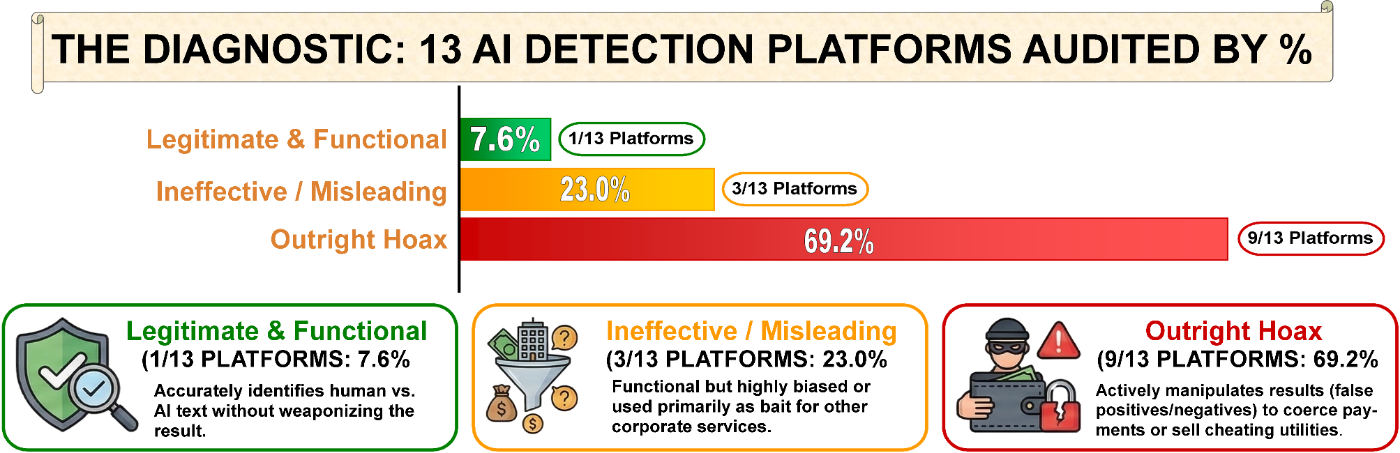
Conclusion: The AI detection market is not a security industry; it is a 92% failure rate ecosystem dominated by coercion and bypass schemes feeding off academic panic. The most obvious indicator that a detector is deceptive was the inclusion of a paraphaser, or a humanizer.
The Humanizer Hoax.
The premise of an AI “Humanizer” is a technological paradox. Any platform that bundles an AI detector with an AI humanizer is not offering a security tool; it is operating a protection ploy.
The idea that you can use an AI to make text read less like an AI is a closed loop of absurdity. It is the equivalent of trying to wash dirt off your hands using more dirt. A humanizer is simply another Large Language Model (LLM). You are using the exact same underlying generative technology to mask the fingerprints of that technology. It does not inject a biological perspective into the text; it simply applies a different coat of synthetic paint.
A humanizer does not make text “human.” It merely instructs a secondary AI script to artificially inflate perplexity and burstiness. It forces the machine to choose less probable synonyms and aggressively fragment its sentence structure.
True human writing contains the friction of the creative process. There are millions of different styles and variants of human writing, and the best writers have always challenged conventional thinking. Because a machine can only draw on what exists, it can never create something truly new or question the rules of writing already established. Writing is born from lived experience and experimenting with new ways to express oneself. Humanizers do not bridge that gap; they only automate the deception.
A paraphraser is just a humanizer wearing a corporate suit. Mechanically, there is no difference between the two. Both take an input, feed it through a Large Language Model, and output an altered sequence of vocabulary and syntax. While humanizers openly sell deception by marketing themselves as detector-bypassers, paraphrasers are more subtle, aiming to appear more respectable.
Conclusion
Ultimately, there is no AI writer that can match the skill and creativity of a skilled human—and more importantly, why would you want there to be? Whether dealing with art or writing, replacing human creativity with an artificial machine facsimile means it ceases to be human expression entirely. While there are a few legitimate detectors, currently, this market caters solely to corporations that view art as nothing more than a product, and to individuals trying to counterfeit a talent they do not possess.
The core problem is that by using AI, individuals never truly learn creative skills. It pretends to be a shortcut, but it is a false evaluation. Theoretically, one could have an AI write a story, run it through a legitimate detector, and rewrite the flagged sections over and over until it finally tests as human. But in the countless hours it takes to launder that text, they could have spent that time sharpening real skills they would carry with them for the rest of their lives. Most importantly, by taking that fake shortcut, one can never feel the true pride of creating something that is truly theirs, made by their own skill.
The effect on the market
This deception is actively poisoning the creative economy. The sheer volume of people using AI and lying about it creates massive skepticism in the market—a skepticism that profiteers actively exploit by advertising AI to catch AI. It creates a low-trust world where people are constantly suspicious of art. When people cannot trust art, they cannot value it. This problem will continue to negatively erode trust in true creatives until laws are passed requiring AI-created products to be explicitly labeled so the public can trust again. Until then, we are stuck in a dilemma where real artists are falsely accused of using AI, and AI prompters pass themselves off as real artists, while corporations take full advantage of the unregulated market to profit off the chaos.
What can you do?
If there is any hope for restoring trust and value in creative work, it lies in two places: government regulation to rein in fraudulent and exploitative practices, and a collective refusal to accept AI-generated facsimiles as real art. Support living, breathing artists and writers. Demand that lawmakers treat this market with the same scrutiny as any other consumer protection issue. Only by rejecting imitation and holding these companies to account can we preserve what is genuine and meaningful in human creativity.
:::info
Disclaimer: This article outlines the findings of a qualitative forensic audit. It is not a quantitative academic study, and the conclusions are analytical interpretations of specific algorithmic stress tests rather than definitive statistical failure rates. However, the data presented is representative of my direct investigation and interpretation of the evidence. All platform results, false positives, and hallucinated metrics are fully documented and archived.
:::