By using this site, you agree to the Privacy Policy and Terms of Use.
Accept
World of SoftwareWorld of SoftwareWorld of Software
  • News
  • Software
  • Mobile
  • Computing
  • Gaming
  • Videos
  • More
    • Gadget
    • Web Stories
    • Trending
    • Press Release
Search
  • Privacy
  • Terms
  • Advertise
  • Contact
Copyright © All Rights Reserved. World of Software.
Reading: Lyft Scales Global Localization Using AI and Human-in-the-Loop Review
Share
Sign In
Notification Show More
Font ResizerAa
World of SoftwareWorld of Software
Font ResizerAa
  • Software
  • Mobile
  • Computing
  • Gadget
  • Gaming
  • Videos
Search
  • News
  • Software
  • Mobile
  • Computing
  • Gaming
  • Videos
  • More
    • Gadget
    • Web Stories
    • Trending
    • Press Release
Have an existing account? Sign In
Follow US
  • Privacy
  • Terms
  • Advertise
  • Contact
Copyright © All Rights Reserved. World of Software.
World of Software > News > Lyft Scales Global Localization Using AI and Human-in-the-Loop Review
News

Lyft Scales Global Localization Using AI and Human-in-the-Loop Review

News Room
Last updated: 2026/04/13 at 10:08 AM
News Room Published 13 April 2026
Share
Lyft Scales Global Localization Using AI and Human-in-the-Loop Review
SHARE

Lyft has implemented an AI-driven localization system to accelerate translation of its app and web content, supporting international expansion while maintaining quality and cultural relevance. The system processes roughly 99% of user-facing content through a batch translation pipeline, targeting a 30-minute SLA for 95% of translations. Real-time translation, such as ride chat, uses a separate workflow optimized for low latency.

Previously, Lyft relied on largely manual translation workflows, which became a bottleneck as the company expanded into new markets and increased product velocity. The new system integrates large language models (LLMs) with automated evaluation and human review, enabling faster turnaround while preserving consistency in tone, style, and legal messaging.

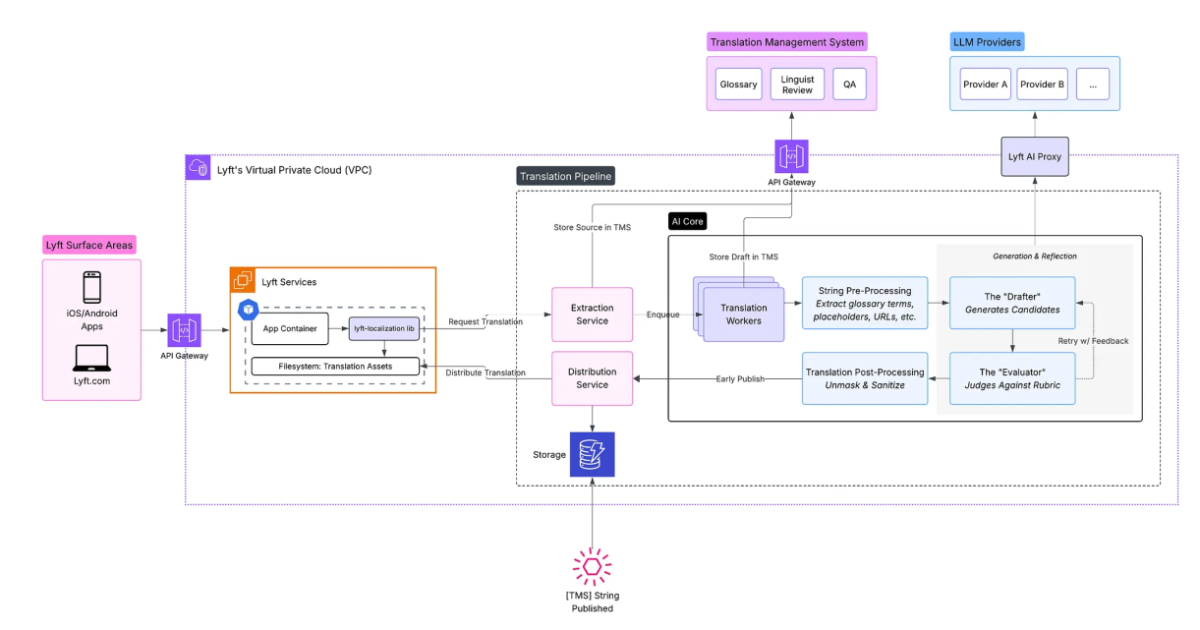
The batch translation pipeline follows a dual-path architecture, simultaneously submitting source strings to a translation management system (TMS) for human oversight and to LLM-based workers for rapid draft generation. This approach allows AI-generated translations to be used immediately to unblock releases, while the TMS remains the system of record. Human linguists review translations asynchronously, and approved versions replace initial outputs to ensure quality and consistency.

The pipeline processes multiple strings in parallel and supports iterative refinement across multiple passes. It introduces a division of responsibilities between a Drafter and an Evaluator: the Drafter generates multiple candidate translations, while the Evaluator assesses them across dimensions such as accuracy, fluency, and brand alignment, selecting the best option or triggering retries for low-confidence outputs. This separation improves error detection and reduces bias by decoupling generation from evaluation. Context injection, including UI metadata, placeholders, and regional considerations, guides translation quality, while deterministic guardrails enforce safety, legal, and stylistic constraints.


Batch Translation Pipeline Components (Source: Lyft Blog Post)

Lyft engineers reported that the system has reduced translation turnaround from days to minutes for most content, improving release speed across languages. The architecture also supports prompt rollouts, allowing new AI translation strategies to be tested on small batches before full deployment, ensuring stable production output.

Real-time translation, such as ride chat messages, follows a separate architecture focused on low latency. While batch translations benefit from broader contextual information and iterative evaluation, real-time translation models prioritize immediate user feedback.

Iterative Localization Workflow (Source: Lyft Blog Post)

Lyft’s localization system integrates AI into batch and real-time translation workflows. Large language models handle first-pass translations, reducing the workload for human reviewers, who validate outputs to ensure accuracy, adherence to style, and cultural context. Metrics on translation quality, model performance, and reviewer consistency are collected continuously and used to adjust models and improve subsequent translations.

Approximately 95% of translations pass through human review with minimal changes. The remaining 5% involve complex cases, such as regional idioms, legal disclaimers, or brand-specific language, where human oversight ensures accuracy and consistency. Tracking these outcomes enables Lyft to measure translation quality, refine AI model performance, and maintain stable, reliable production translations across multiple languages.

Sign Up For Daily Newsletter

Be keep up! Get the latest breaking news delivered straight to your inbox.
By signing up, you agree to our Terms of Use and acknowledge the data practices in our Privacy Policy. You may unsubscribe at any time.
Share This Article
Facebook Twitter Email Print
Share
What do you think?
Love0
Sad0
Happy0
Sleepy0
Angry0
Dead0
Wink0
Previous Article Trump Coin Price Prediction as Pepeto Builds Beyond One-Day Events Trump Coin Price Prediction as Pepeto Builds Beyond One-Day Events
Next Article China’s Manner Coffee faces criticism over intense working conditions after clashes exposed · TechNode China’s Manner Coffee faces criticism over intense working conditions after clashes exposed · TechNode
Leave a comment

Leave a Reply Cancel reply

Your email address will not be published. Required fields are marked *

Stay Connected

248.1k Like
69.1k Follow
134k Pin
54.3k Follow

Latest News

Best Crypto Presale: Why AlphaPepe is Making XRP and Cardano Look Like Stablecoins with Projected 1,000x Launch Returns
Gadget
Zoom Perspectives: Why ‘agentic’ work is the new enterprise standard –  News
Zoom Perspectives: Why ‘agentic’ work is the new enterprise standard – News
News
This Is The Least Dependable Car Brand In 2026, According To JD Power – BGR
News
54 African countries have one cloud problem
Computing

You Might also Like

Zoom Perspectives: Why ‘agentic’ work is the new enterprise standard –  News
News

Zoom Perspectives: Why ‘agentic’ work is the new enterprise standard – News

10 Min Read
This Is The Least Dependable Car Brand In 2026, According To JD Power – BGR
News

This Is The Least Dependable Car Brand In 2026, According To JD Power – BGR

5 Min Read
Survey says paying for YouTube isn’t worth it, even before incoming price hike
News

Survey says paying for YouTube isn’t worth it, even before incoming price hike

8 Min Read
We Want to Hear From You. Help Us Crown the Most Loved Headphones and Earbuds of 2026
News

We Want to Hear From You. Help Us Crown the Most Loved Headphones and Earbuds of 2026

2 Min Read
//

World of Software is your one-stop website for the latest tech news and updates, follow us now to get the news that matters to you.

Quick Link

  • Privacy Policy
  • Terms of use
  • Advertise
  • Contact

Topics

  • Computing
  • Software
  • Press Release
  • Trending

Sign Up for Our Newsletter

Subscribe to our newsletter to get our newest articles instantly!

World of SoftwareWorld of Software
Follow US
Copyright © All Rights Reserved. World of Software.
Welcome Back!

Sign in to your account

Lost your password?