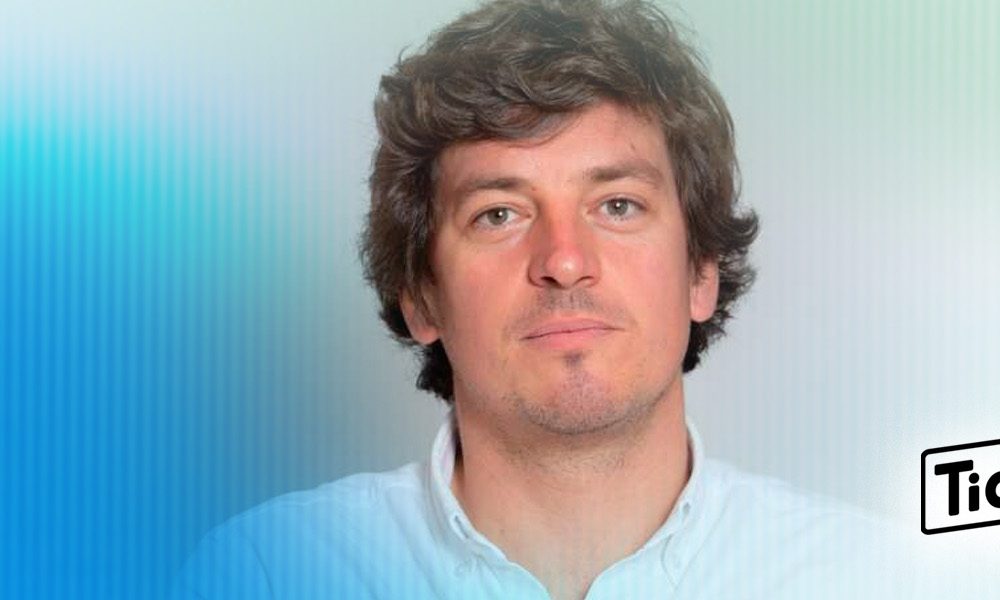
Jaime García Prieto He is CEO and founder of Galeneo Healtha company that is redesigning the conventional hospitalization model to transfer the complexity of care from the hospital to the patient’s home. With a background in science and a history marked by innovation in health, García Prieto has built a company that defines itself as a healthcare logistics company: its mission is to guarantee that everything the doctor has prescribed occurs in a timely manner, with security and traceability, outside the walls of the hospital.
Galeneo currently operates in Madrid, where it works with hospitals to extend their home hospitalization programs to stabilized patients who require clinical supervision but not continuous bed occupancy. Its own platform, Perégamo, was born precisely because no logistics system on the market was capable of managing the specific complexity of the home healthcare environment. In this interview with MCPRO, García Prieto explains how technology, behavioral economics and a philosophy of slow progress without shortcuts are transforming healthcare.
The hospital hallway at home
(MCPRO) Galeneo was born to transform conventional hospitalization. What are the structural challenges that make this change necessary and what role does technology play in making it possible?
(Jaime García Prieto) What we are trying to do is transfer the complexity of the hospital to the patient’s home. The hospital is a highly specialized, operationally intense environment, designed to care for any type of patient at any stage of their illness. Taking that home is enormously difficult. For us, the most important thing is to maintain the coordination that occurs in the hospital hallway: when two or three professionals talk to each other, many decisions are generated. How do we ensure that these interactions are equally effective in a delocalized way?
Added to this is guaranteeing patient safety, understanding which profiles can leave the hospital and, finally, that unit economics work. Technology allows it to be done and will increasingly allow it, but the challenge is to make it profitable for a payer. Those are our three axes: security, coordination and making the numbers work.
(MCPRO) How is your technological architecture designed to guarantee continuity of care without interruptions?
(Jaime García Prieto) Our commitment is to be the infrastructure that allows a hospital to integrate all the systems it needs, just as multiple suppliers coexist in a hospital plant. We are not a copilot or a diagnostic tool. We are the hospital hallway: how we make everything the doctor has prescribed happen in a timely manner, with security and traceability. From a technical point of view, the system works 247, is incident-proof and guarantees full traceability of all actions.
And it has to be as simple as possible, because if it is not simple the healthcare professional will not adopt it, and if they do not adopt it we cannot control either the security of the data or the security of the care itself. Simplicity is not a concession, it is a premise of security.
(MCPRO) How are you integrating artificial intelligence and language models into your product?
(Jaime García Prieto) Right now almost all of our uses of AI are operational. Think about the complexity of coordinating a doctor, three nurses, a physical therapist, an equipment supplier and the company’s operational team around a patient that none of them are seeing at that moment. That requires agile summaries and quick structuring of information so that everyone has the same context. That’s where LLMs bring us real value today. For the diagnosis or the CE marked medical device, I think there is still a lot to mature, although the pace is dizzying.
My opinion is that we will work with hybrid models, because LLMs are very good at contextualizing and saving administrative time, but they fail where medicine cannot fail: they do not evaluate causality, they evaluate probabilities. They are not deterministic. And medicine needs that determination in many cases.
Compliance from day one
(MCPRO) The health sector is one of the most regulated. How does that affect your product development and speed of innovation?
(Jaime García Prieto) We are ISO 27001 from the beginning, we structured it like this from the beginning. In our context, it is better to go slowly and steadily than quickly and with risks. The accelerated technological growth model has many risks in the hospital environment and we decided to be one hundred percent compliant from day one. It has never been a difficulty for us, it is a condition of the environment in which we operate. Furthermore, for those who come from abroad without that DNA in the company, complying with European regulations will be a barrier to entry.
In that sense, being European and having started this way gives us an advantage. We work with patient voluntariness, informed consent and complete traceability on servers in Spanish environments. And before tackling any new algorithm, we test it internally. We have to apply it to ourselves first.
(MCPRO) You mention that one of your most important developments right now is the assignment of professionals to the home. What is special about this problem?
(Jaime García Prieto) It is where we are working the most now and it is one of the most intellectually beautiful. In the hospital you don’t care who comes into your room, but when you’re at home you put up barriers. You don’t want just anyone to come. And for us as a company that has a direct translation into costs: if I send a professional to your home and you tell me that you don’t like that person, that is an error, cost, inefficiency. So we have developed a series of models that we internally call harmony, which basically try to predict which combination of professionals is going to generate the least friction in each patient’s home.
It is not a route optimization problem, that has already been solved by others and we simply integrate it. It’s a human compatibility problem at scale. And we did not have any platform on the market that addressed it in a health context, that is why we set up Perégamo, our logistics operating system.
(MCPRO) What is the most common mistake that companies trying to innovate in health make?
(Jaime García Prieto) I come from science and there are two premises that for me are inalienable. The first: shortcuts are bad. The second, which we have learned in these years: unhappy health professional, sick patient. With those two ideas, I think health companies have to understand that you can’t go fast. If you fail once, you’re out. You can’t sell smoke, you can’t skip steps, you have to move forward like in science: a question, an experiment, and you build on that. Many people criticize that hospitals are rigid or old-fashioned, but that’s not it.
The thing is that a thousand-bed hospital cannot afford serious mistakes, and it almost never makes them. That should be the guide for any company that wants to enter this sector. Very simple things that solve a real problem are going to scale much better than a super algorithm that promises 99.9 accuracy in all contexts, because in the end the healthcare professional will not use it or will use it poorly.
30% of beds, at home
(MCPRO) What type of patients are candidates for home hospitalization and what is your growth horizon?
(Jaime García Prieto) We only address stabilized patients with acute requirements that need supervision, but not continuous presence. We work with a matrix that combines type of patient and necessary resources with clinical stability and potential for incidents. Where we are most efficient is in postoperative periods that require medical supervision but not frequent admission to the room, such as once-a-day antibiotic therapy or a stable pulmonary context. There, a nurse who in the hospital would occupy 24 hours of resource in a bed, at home occupies only one hour.
That’s where unit economics work better than the hospital. As for the horizon, I am optimistic: I believe that in the coming years between 30 and 40 percent of continued hospitalization beds will be home-based. And that is not a revolution, it is a logical evolution. The healthcare system is already quite networked. What will change is that hospitals will reserve their physical beds for unstable and multi-pathology patients, who are the ones who really need them.
To listen to the full interview: