An international team of astronomers has provided direct observational evidence that a exoplanet inherits the ratios ofrocky elements of its host star. The discovery, made on the planet WASP-189b located nearly 320 light years away, validates a hypothesis of planetary formation and astrobiology.
A measure which is a world first
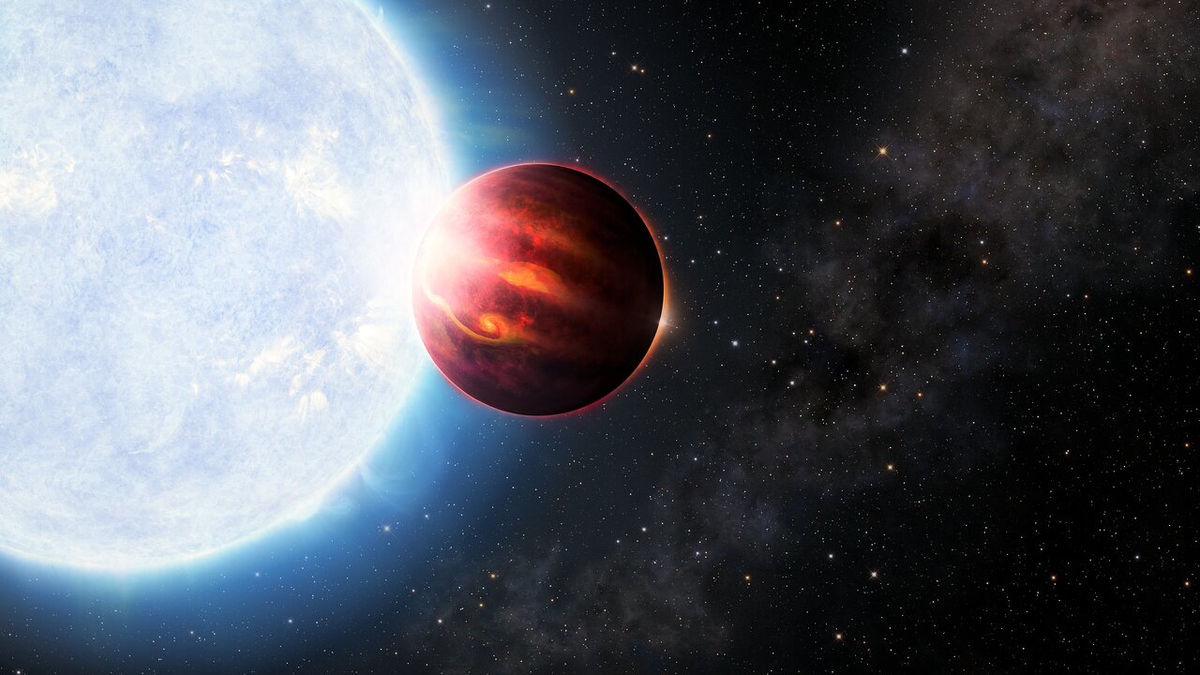
WASP-189b is an ultra-hot Jupiter-like exoplanet, with temperatures so high that they vaporize rock-forming elements like magnesium and silicon.
This offers a unique opportunity to analyze them spectroscopically and is the first time that the content of magnesium and silicon gas has been able to be measured simultaneously in the atmosphere of a planet.
This feat was achieved thanks to the high resolution spectrograph IGRINS, then mounted on the Gemini South telescope in Chile. The instrument allowed the team, led by Jorge Antonio Sanchez of Arizona State University, to obtain data of unprecedented precision, revealing the chemical link between the planet and its star.
A pillar of planetary formation models
Scientists have long assumed that planets form from a disk of material, the protoplanetary diskwhich surrounds a young star. Since the star and disk come from the same primordial cloud of gas and dust, their chemical compositions should be similar.
However, this connection has until now been mainly based on measurements within our own Solar System and has never been directly observed for other systems.
” WASP-189b offers us an essential observational anchor in our understanding of the formation of terrestrial planets “, underlines Jorge Antonio Sanchez.
A validation for astrobiology
By measuring a star’s chemical composition, scientists can now more confidently infer the abundance of rocky elements in its planets, which determines the geochemical conditions that make a planet habitable.
On Earth, for example, these elements are responsible for our protective magnetic field and plate tectonics. Confirming the correlation between the composition of stars and planets therefore represents a fundamental step in identifying the potentially habitable worlds.