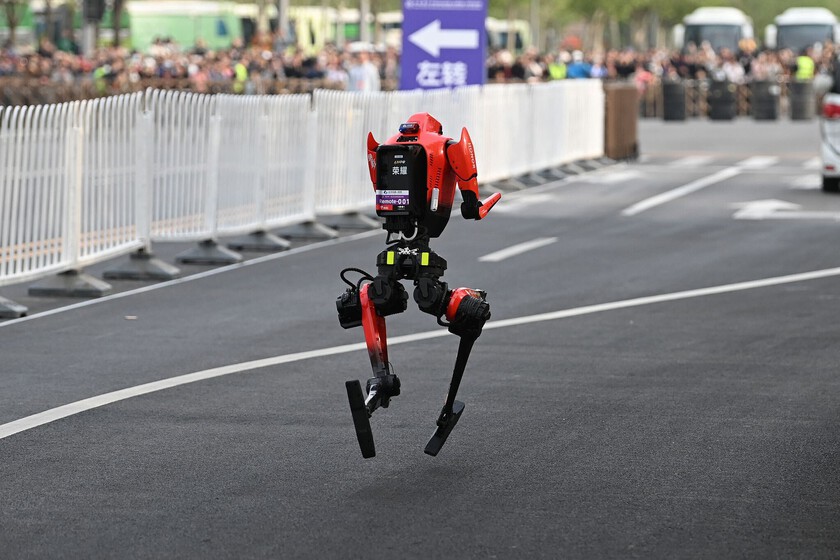
The half marathon world record is held by Jacob Kiplimo with a time of 57:20 achieved just a month ago in Lisbon. This Sunday a humanoid robot named Lightning ran that distance in 50:26, achieving for the first time a milestone that had never been achieved. Robots seemed clumsy and unable to outrun humans, but that is no longer true. And it’s just the beginning.
Robots are already faster than humans. In the half marathon held on Sunday, April 19, 2026 in Beijing, the absolute dominators were the humanoid robots. Lightning not only broke the human world record by almost seven minutes: he managed to arrive 17 minutes before the first human runner to cross the finish line. The top three finishers were also Lightning models developed by Honor.
From disaster to excellence. The first edition of this same event, the Beijing E-Town Half Marathon and Humanoid Robot Half Marathon, was an absolute disaster for humanoid robots. Only a third of those who ran it managed to finish the race, they were controlled remotely and ran at a pace much lower than that of human runners. This year things were very different: more than 100 robots were presented and most finished the test, but also almost half ran autonomously and several managed to surpass even the best human runners in the world.
This is Lightning. The winning robot measures 169 centimeters, weighs 45 kg and was specifically designed to adapt to complex terrain and move at high speed. Its legs measure about 95 cm and its proportions are designed to imitate the stride of elite human runners. It has a liquid cooling system that has curiously been adapted from the one found on Honor smartphones. Du Xiaodi, an engineer leading this project at Honor, explained that “Running faster may not seem significant at first glance, but it allows technology transfer, for example in structural reliability and cooling, and eventually in industrial applications.”
Not everything went well. The race, however, also had moments in which the robots failed. One of them collided with a nearby vehicle although he managed to stabilize himself and continue walking. The H1 model from Unitree, the most famous humanoid robot manufacturer in China, collapsed as it approached the finish line and had to be removed from the road. One of the Lightning models hit a barrier after crossing the finish line, and some other robots struggled with the curves and unevenness of the course. The event also served as a test bed for batteries, joints, motors and algorithms that control these machines.
Industrial applications. Xiaodi mentioned it but also Liu Xiangquan, professor of robotics at the University of Science and Information in Beijing. According to him, these long-distance races allow the resistance and behavior of these robots to be evaluated, something essential for their application in industrial environments. Here not only speed is evaluated, but also the aforementioned resistance, stability or the capacity for autonomous navigation in uncontrolled environments.
But a key component is missing. Although the demonstration and milestone is fascinating, what this field needs most is other things. For example, advancing in manual dexterity, perceiving the real environment in unforeseen situations and being able to perform varied tasks and not focus so much on repetitive movements. Industrial robots are already good at this, but much more versatility is sought here because at the moment these robots are not capable of folding clothes or putting plates and cutlery in the dishwasher with sufficient speed and dexterity.
China continues to set the robotic pace. The Asian country has completely devoted itself to the world of robotics. It dominates this segment and its companies manufacture 80% of global production. In recent months we have seen spectacular demonstrations such as the one Unitree performed with a dozen humanoid robots at a martial arts show. Sunday’s half marathon is one more element of that narrative and that message that China is leaving to the world: robots are our thing.
And in a year, what? Breaking the world record is very striking, but this event tells another story: that of how in just one year Chinese manufacturers have managed to improve their models in an amazing way. If everything continues to improve at this rate, it is difficult to predict what the robots that run the next marathon will be capable of, but it seems logical to think that by now the athletic ability of the robots will be absolutely amazing.
Image | CGTN
In | In China they are not satisfied with creating advanced robots: a company has developed a head that gestures like a human