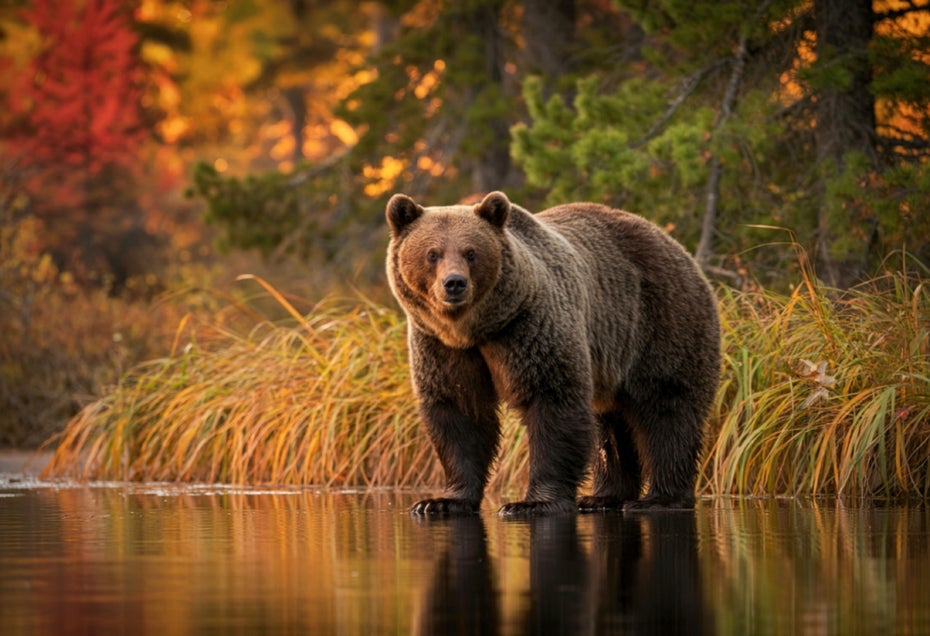
Grizzly bears, once increasingly rare, are doing great in eastern Montana. They have recovered so strongly there that the state hired its first prairie “grizzly manager” in 2017. It was wildlife biologist Wesley Sarmento. For seven years, he worked to protect both bears (still considered endangered under the U.S. Endangered Species Act) and humans, who are encroaching ever further into once-wild areas.
From the small town of Conrad, which has a population of 2,553, he acted as a sort of wildlife first responder, trying to defuse potentially dangerous situations. He even got into a few himself – which is why, before leaving the job to pursue a PhD, he resorted to using drones to do the job remotely.
From bear costume to grizzly manager
Sarmento first studied mountain goats in Glacier National Park. Later he started studying bears. To better understand how goats responded to the predator, he dressed in a realistic bear costume once a week for three years. When he later started working as a grizzly manager, he often drove long distances to keep bears away from farms.
Bears are attracted, among other things, to spilled or leaking grain. An open silo quickly turns into a buffet. Sarmento usually arrived at a yard armed with a shotgun, slugs and bear spray, but after narrowly escaping an attack one day, he knew he had to make a change. “At that moment,” he says, “I thought to myself: This is going to kill you.”
Drones to observe grizzly bears
Sarmento initially used two Airedale terriers, a breed known for scaring away bears on farms – but the dogs were too easily distracted. Meanwhile, drones slowly became common tools. Biologists could use it to count animals and map habitats. Sarmento first used a drone in field testing in 2022, when a mother grizzly and two cubs were observed rummaging around in a silo outside the city. The drone’s infrared sensors helped quickly pinpoint their location, and he used the sound of the aircraft to drive them away from the property. Researchers suspect that bears instinctively dislike the whirring of the rotor blades because it sounds like a swarm of bees. “The whole thing was so clean and controlled,” he says. “And I did it all from the safety of my truck.”
Since then, the aircraft that Sarmento bought for $4,000 – a fairly simple model with a thermal imaging camera and a 30-minute battery life – has proven effective at tracking grizzly bears in dangerous terrain. Otherwise, Sarmento would have had to approach them on foot, which often involves going through dense undergrowth or along river banks that are difficult to access.
Editorial recommendations
${content}
${custom_anzeige-badge}
${custom_tr-badge}
${section}
${title}
Next step: AI for wildlife management
Sarmento, who is now studying wildlife ecology at the University of Montana, doesn’t let go of the bears here either. He hopes to develop a drone that campus police can use to keep black bears off school grounds. In the future, artificial intelligence could be integrated into wildlife management work for image recognition – perhaps even so that drones can identify bears and autonomously “redirect” them away from areas frequented by humans.
Such measures help prevent bears from learning behaviors that lead to conflict with humans – which usually ends badly for the bear and occasionally fatally for humans. “The full technology doesn’t exist yet, but the hope is to keep looking for applications,” he says. For him, drones are “the next frontier” in wildlife protection.
Top Article
${content}
${custom_anzeige-badge}
${custom_tr-badge}
${section}
${title}