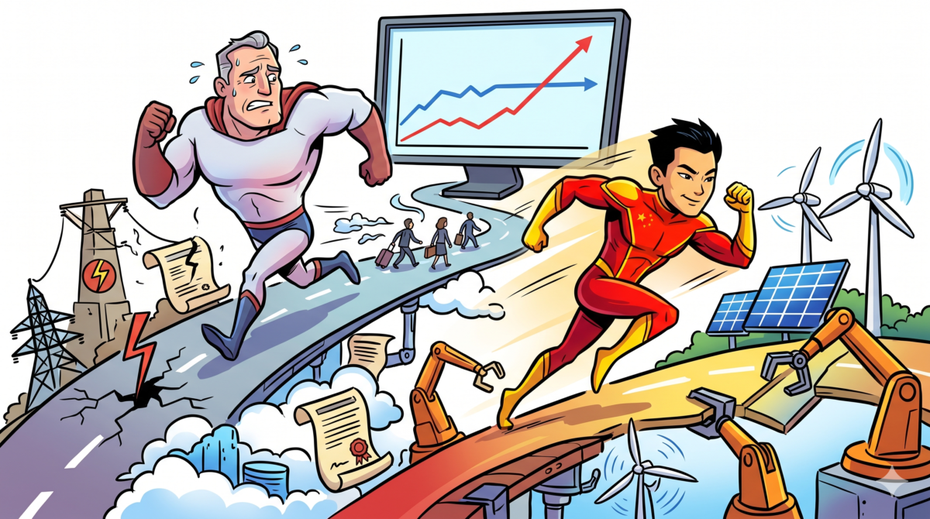
According to the current AI Index Report 2026 from the Stanford University Institute for Human-Centered Artificial Intelligence (HAI) in the US state of California, the USA has almost completely lost its long-standing lead. The report concludes that China is now acting as a massive counterweight and has made up ground in almost all relevant metrics.
Technological parity in language models
The development is particularly clear in the so-called arena scores, which compare the performance of large language models. While the then leading US model GPT-4 from OpenAI still enjoyed a comfortable lead over the competition from the Far East in May 2023, today’s US leader Claude Opus 4.6 from Anthropic is only 2.7 percent ahead of the Chinese Dola Seed 2.0 in March 2026.
Although the USA still has a higher number of top systems, with 50 top models compared to 30 Chinese models, the qualitative gap is rapidly closing. As Fortune reports, this process is part of a broader technological race in which China is increasingly taking the lead in patents and scientific publications.
Dominance in patents and infrastructure
California data shows that China was responsible for over 74 percent of all global AI patent grants in 2024. In contrast, only 12 percent fell to the USA and just 3 percent to the European Union, highlighting the massive shift in global innovative power.
There is also a clear imbalance in Beijing’s favor in the area of physical infrastructure. With more than 295,000 units, China installed almost nine times as many industrial robots as the USA, which only had 34,200 installations, according to Futurism.
Energy capacities as a strategic advantage
An often underestimated factor is the energy supply, which is essential for the operation of large data centers. David Fishman, an analyst with the Lantau Group in Hong Kong, China, told Fortune that China is adding more electricity capacity annually than Germany consumes in total.
The US power grid, on the other hand, is considered vulnerable to extreme weather and localized overloads after decades of underinvestment. These infrastructure bottlenecks could slow the growth of computing power in the US, while China has enormous reserves to expand its data centers.
Slump in the influx of experts
This development is already having a noticeable impact on the job market for highly qualified specialists. According to the Stanford report, the number of AI researchers moving to the USA has fallen by a total of 89 percent since 2017.
What is particularly striking is the fact that this decline accelerated again last year at a rate of 80 percent. Although more experts are currently entering the country than leaving it, the trend has reversed.
Training successes in the Far East
One reason for this shift lies in the quality of domestic education in Asia’s most populous country. A report from Stanford University’s Hoover Institution found that almost all of the scientists behind the foundational work of China’s DeepSeek project were trained in China.
Around a quarter of the researchers were trained at US institutes but then returned to China. This trend represents a fundamental challenge to U.S. technological leadership that cannot be solved through export controls alone.
Differences in private investments
Despite China’s successes, there are areas in which the US continues to clearly lead. Private investment in AI in the US reached $285.9 billion in 2025, more than thirteen times China’s $12.4 billion.
In addition, 1,953 new AI companies were financed in the USA last year, which underlines the dynamism of the venture capital market there. This financial superiority represents a buffer to defend technological sovereignty in specific areas of artificial intelligence.
Critical perspective on development
However, the question remains whether pure capital is sufficient when the infrastructural basis and access to bright minds are eroding. A study published on the Arxiv platform (without peer review) by researchers from the US University of Pennsylvania, the British Durham University and the Chinese Tsinghua University shows that Chinese inventors continue to rely heavily on US borderline knowledge.
The study makes it clear that a complete separation of the technological ecosystems has not yet taken place. Chinese developers continue to make extensive use of the basic knowledge generated in the USA for their innovations and build directly on it through scientific citations.
Editorial recommendations
${content}
${custom_anzeige-badge}
${custom_tr-badge}
${section}
${title}
In the joint study, the scientists from China’s Tsinghua University point out that export controls for microchips alone are unlikely to permanently slow down technological advances. The ability of companies there to adapt to regulatory hurdles has already proven to be very high in the past.
Ultimately, the interaction of computing power, energy and experts determines long-term success. The United States must adjust its infrastructure and immigration strategy if it wants to preserve its slim lead into the next decade.
Top Article
${content}
${custom_anzeige-badge}
${custom_tr-badge}
${section}
${title}