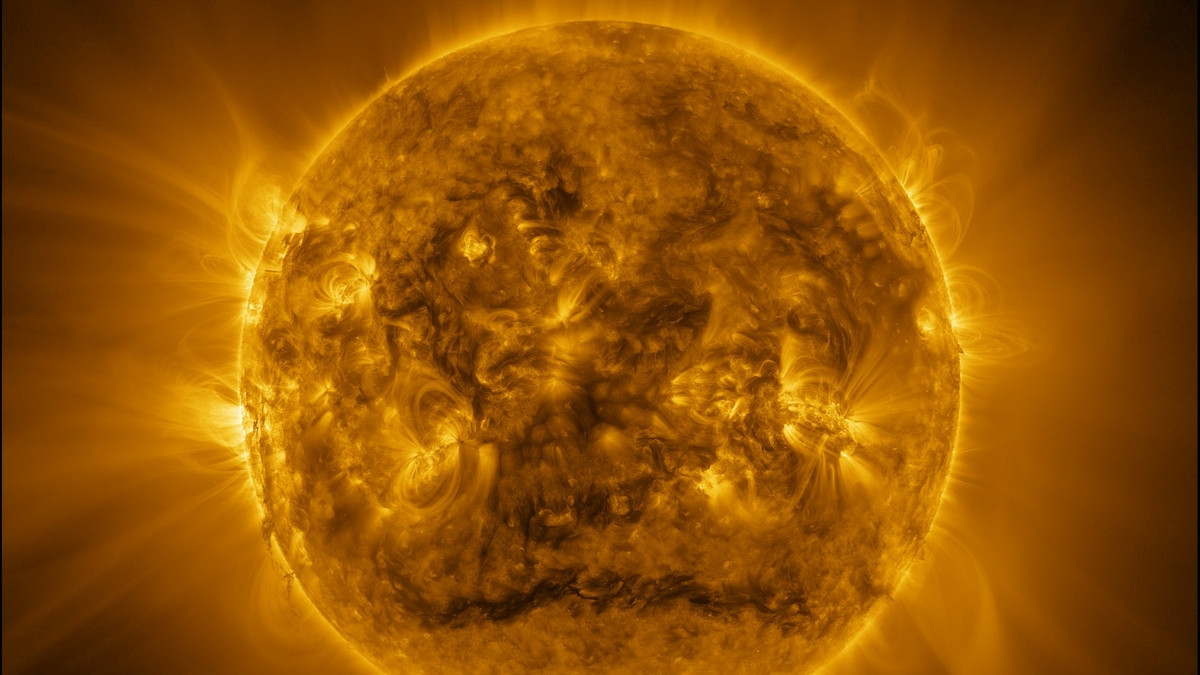
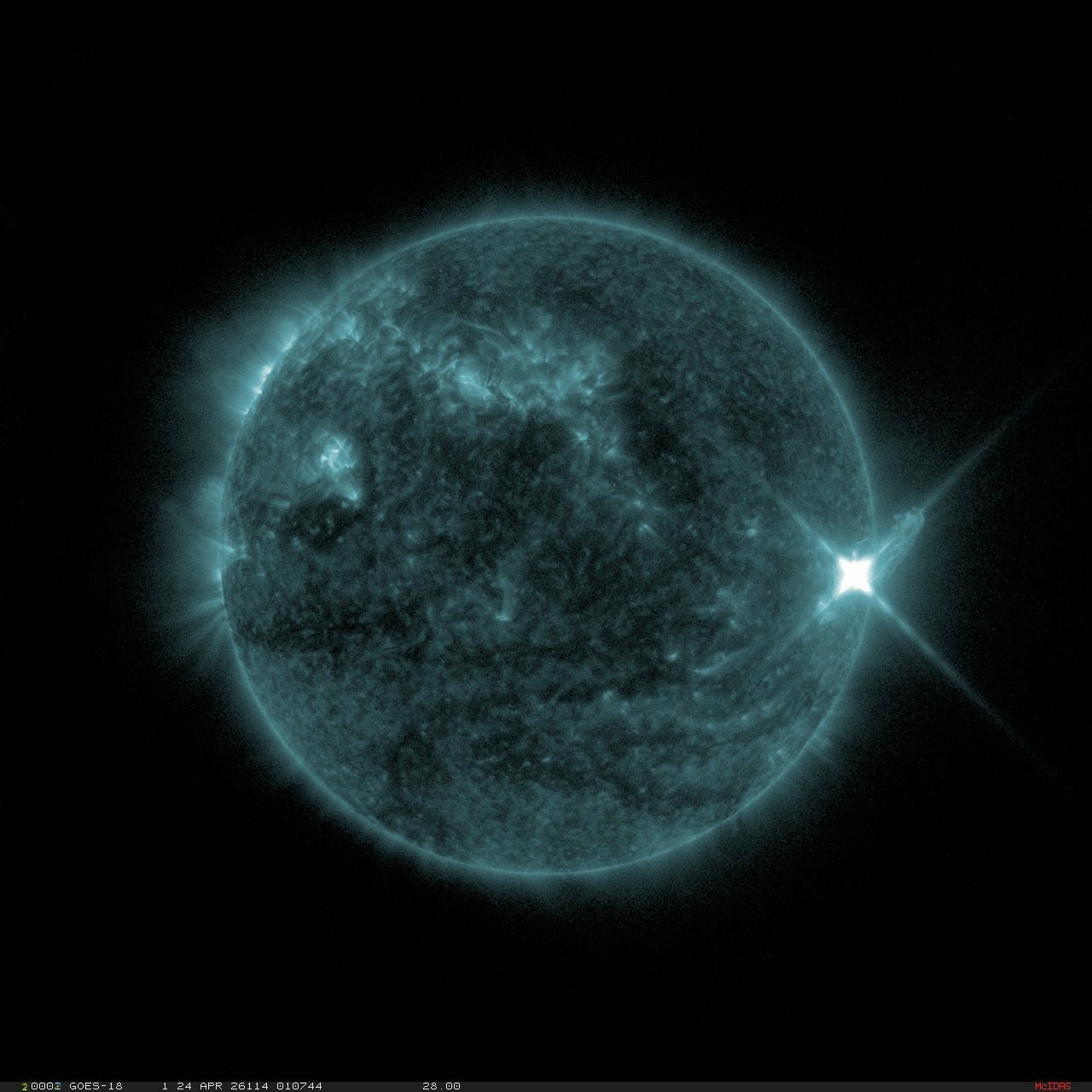
Our star had a particularly turbulent day. On April 24, 2026, a sunspot area identified as the Active Region 4419 (or AR4419)known for its unstable magnetic configuration, released not one, but two class X eruptions.
The first, classified X2.4reached its peak at 01:07 UTC, followed by a second, even more intense one at X2.5at 08:13 UTC. These events, which occurred in less than seven hours, represent the most violent category of solar flares and quickly had their effects felt on our planet, 150 million kilometers away.
These bursts of radiation caused black-outs radio on illuminated areas of the Earth by over-ionizing the atmosphere, which affected high-frequency communications in Asia and the Pacific.
What caused this double radio blackout?
The direct cause is a burst of extreme X-rays and ultraviolet radiation projected at the speed of light. This intense radiation hit Earth’s upper atmosphere in just eight minutes.
The affected areas were the regions of the globe then illuminated by the Sun: first the Pacific Ocean and Australia, then, during the second pulse, a large part of East Asia.
The result was a shortwave blackout, disrupting les communications HF (high frequency) used by aviators, sailors and emergency services.
The source of this fury, active region 4419, is a complex area with a “ beta-gamma-delta magnetic signature “, which means that it has colossal energy and a high probability of producing explosive events.
Before this Class X double, she had already produced a burst of class M eruptionsthe category just below.
How can a solar flare cut off communications on Earth?
The phenomenon is fascinating and takes place in the upper layers of our atmosphere. To operate over long distances, high-frequency radio waves ricochet off an atmospheric layer called theionosphere (the upper, electrically charged layer of our atmosphere).
It is this bounce that allows a signal to circumvent the curvature of the Earth. But during a powerful solar flarethe whole mechanism jams.
The X-ray flux overloads the lowest part of this layer, the “D layer”. Normally not very dense, it suddenly becomes an absorbent wall. Instead of bouncing off, the radio waves become entangled, colliding with a myriad of charged particles and losing all their energy. The signal is no longer coming through.
He creates a zone of radio silence for a duration which can range from a few minutes to almost an hour. Only the sunny side of the Earth is affected, because it is sunlight that maintains the ionization of this layer.
Should we expect the Northern Lights or other disturbances?
These eruptions were indeed accompanied by a CME (Coronal Mass Ejection), an immense bubble of plasma and magnetic field. However, since solar region 4419 is located on the western edge of the Sun, these particle clouds do not rush directly towards us.
They were ejected in a direction away from the Earth. It is therefore very unlikely that we will experience the direct impact of a major geomagnetic storm due to these specific events.
However, analysts do not rule out the possibility of a razing impact. If the edge of one of these plasma bubbles were to brush against the Earth’s magnetic field in the coming days, it could trigger minor (G1 class) geomagnetic storm conditions.
The consequences would then be limited but potentially magnificent: superb polar lights visible at lower latitudes than usual. It would be a potentially magnificent celestial spectacle, but under conditionsoffered as consolation after the radio silence.