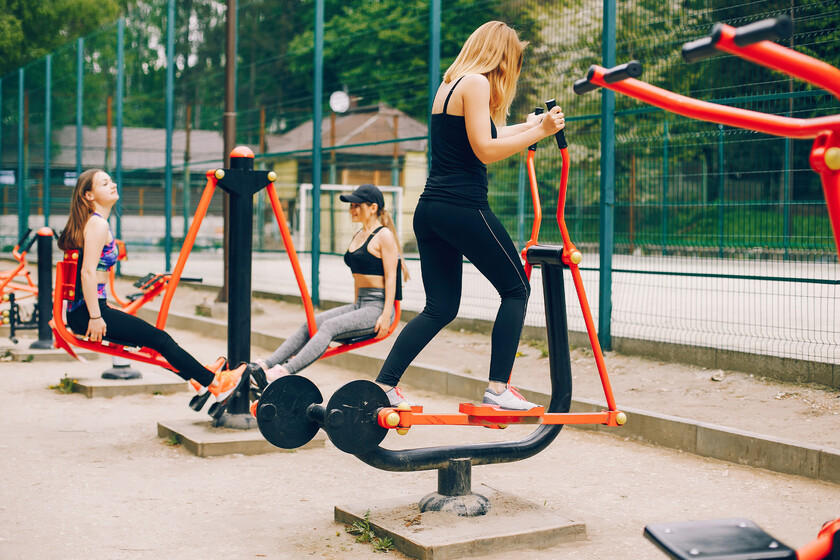
A morning walk through almost any urban park reveals an increasingly common scene: calisthenics bars, wooden benches and grass esplanades have ceased to be simple elements of the landscape and have become the new fashionable gym. Accustomed to the monotony of traditional indoor gyms, with their relentless fluorescent lights and repetitive music on loop, going out to exercise in the park offers a radical and revitalizing change of scenery.
As Nikki Fraser explains to The New York Timesexercise physiologist, we tend to take training in our adulthood too seriously, seeing it as a strict “obligation” (something we have to do) rather than an “opportunity”, but by looking at a park, we regain the wonderful possibility of “playing”.
The rise of the street as a training area. What has happened is that strength routines have left the basements and pavilions to conquer the streets. To perform a full-body workout, it is no longer essential to have complex machinery; All you need is a park bench and a piece of grass to perform routines that include climbing steps (step-ups) and push-ups, to lunges, squats and triceps dips.
In addition, nature itself provides an extra physical challenge: unlike the repetitive monotony of a treadmill, the outdoor environment forces our muscles to constantly adapt to uneven terrain, which promotes balance, improves agility and burns calories dynamically.
“The great moderation.” Behind this movement towards asphalt and grass is a profound generational and economic change. Young people are changing the classic bars for sports when it comes to socializing, a phenomenon that economists, like Joe Wadford, have already dubbed “the great moderation.”
Instead of spending a large portion of their monthly budget on a night out and having to deal with an inevitable hangover the next day, many young people prefer to invest their money and time in ways that are more rewarding for their health. In fact, as we already analyzed when explaining why the gym is the new bar to combat the loneliness epidemic, the data supports that 39% more young people from Generation Z, compared to Generation fitness to meet new people who share your same interests.
And there is science behind this. A systematic review of long-term clinical trials that compared outdoor versus indoor exercise revealed a revealing fact: of the 99 comparisons analyzed, the 25 that showed statistically significant results favored, in all cases, outdoor exercise.
This natural environment encourages higher levels of positive emotions, tranquility and motivation. If that were not enough, simple exposure to sunlight provides a natural boost of vitamin D and works as a powerful antidote to reduce stress, anxiety and depression.
Beyond the muscle. The true impact of this trend transcends body aesthetics and economic savings; It has a profoundly transformative and therapeutic power on a social level. The BBC reported the case of Raymond Goodfield, a 53-year-old man who, due to depression and his dependence on alcohol, had ended up living on the street. After joining free weekly outdoor gym sessions in his local park, his life took a radical turn: he stopped drinking, lost his shyness and found a supportive community.
To make these urban spaces truly inclusive and not just a haven for elite athletes, researchers at Loughborough University have worked closely with the community to design new park equipment. This machinery is designed to improve balance and postural control, which makes it suitable for a very wide range of users, including those who are undergoing physical rehabilitation processes.
A paradigm shift. All this establishes a strong contrast with the wellness trends that prevail in exclusive areas of cities. In the era of “cuqui fitness”, where sport has disguised itself as therapy to charge you more money, we have seen how the industry commodifies calm. People pay large sums for low-impact disciplines or “somatic” classes, which consist of making tiny movements to try to relax the exhausted nervous system, turning well-being into a luxury item.
The park, on the other hand, offers the rebellion of the simple: an alternative where reconnecting with nature and creating a community act as that same escape valve against modern pressure, but in a completely free and free way.
The triumph of simplicity. In short, using calisthenics bars, grass and benches as training tools is much more than a clever trick to avoid paying a sports club fee. It is the reflection of a society that seeks to heal.
Going out to exercise outdoors represents an instinctive response to an excessively digitalized and isolated world. At the end of the day, the park gym reminds us that the goal is no longer just to sculpt the body, but to build real bonds, nourish ourselves with vitamin D and claim our most basic right: to go out and play again.
Image | Magnificent
| The big lie of “cuqui fitness”: sport has been disguised as therapy to charge you more money