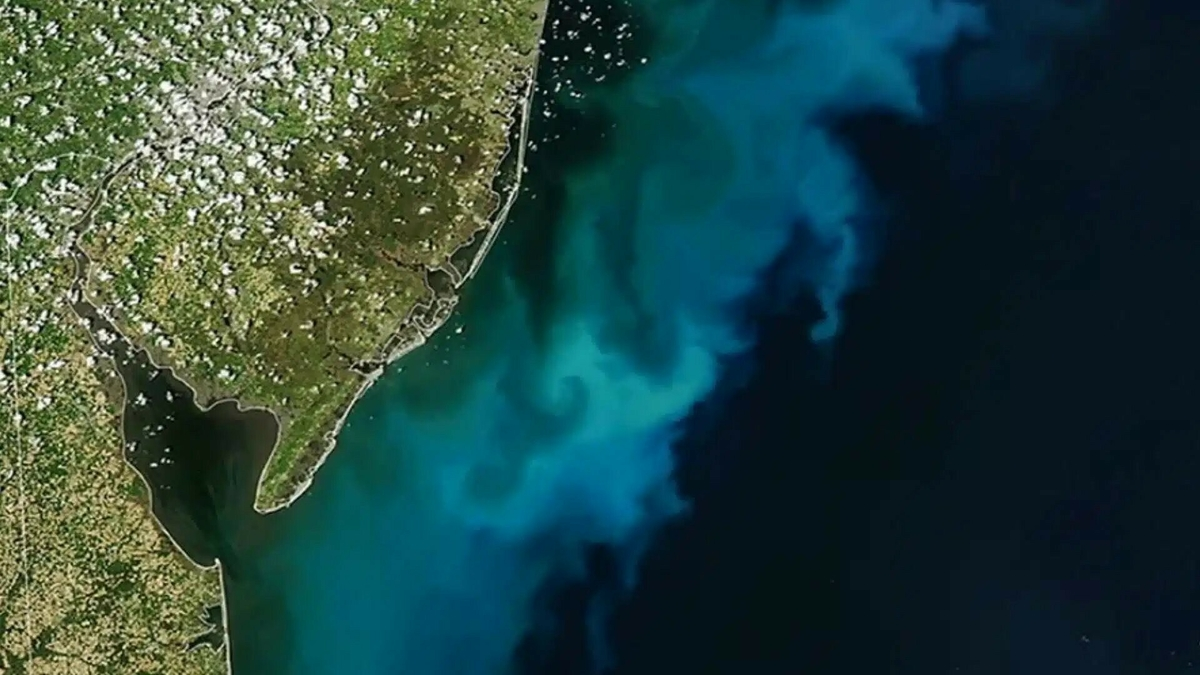
It’s a true living painting that has just been captured from space. Since mid-April, space agency sensors have been sending back images that are unusual to say the least: vast whirlpools with blue, green and sometimes brown hues stretch for hundreds of miles along the coasts of New Jersey, Delaware, Maryland and Virginia. The cause is not an oil spill, but an explosion of microscopic life. This phenomenon is fueled by a cocktail of factors: nutrients carried by rivers, sediments stirred up by spring storms and a increased brightness.
What exactly is this colorful tablecloth made of?
At the heart of this marine fresco is a dense population of marine microorganisms. Analyzes suggest that these are mainly diatoms, unicellular photosynthetic algae that constitute a pillar of aquatic ecosystems. Their proliferation is so intense that it can reach densities greater than 15 million cells per liter of water. This is what makes the phenomenon visible to hundreds of kilometers above sea level.
But diatoms are not alone. Scientists have also detected signs of coccolithophores. These fascinating organisms surround themselves with plates of calcite (calcium carbonate), real little pieces of armor that reflect light in a very particular way. It is their presence that gives the water this milky, almost turquoise in placesand which complicates the visual signature of the event.
How can scientists study it from space?
Observing these phenomena has become a high-precision science. There NASA To achieve this, it deploys a cutting-edge technological arsenal. The color of the ocean is determined by the interaction between sunlight and suspended particles, including chlorophyll, the green pigment essential for photosynthesis. By analyzing the wavelengths of the returned light, experts can deduce the nature and concentration of the organisms present.
THE satellites new generation, such as the PACE (Plankton, Aerosol, Cloud, Ocean Ecosystem) mission launched in 2024, have changed the situation. Their hyperspectral instruments make it possible to distinguish different species with unprecedented finesse, even in the “dirty” and optically complex coastal waters of the Mid-Atlantic Bight. Far from being a simple visual curiosity, it’s a real open-air laboratory which is unfolding, even serving as a model for the search for biosignatures on other planets.
Should we be worried about this spectacular phenomenon?
For now, the answer is no. Although some proliferations of phytoplankton can be toxic or lead to “dead” zones due to lack of oxygen, this is not the case here. These micro-organisms are even vital: they produce between 20 and 40% of the oxygen we breathe and form the base of the food chain navy. The spectacle is therefore above all that of an ecosystem operating at full capacity.
This explosion of life is, however, fleeting. As it develops, the bloom consumes the nutrients available in the ocean. Experts, such as oceanographer Oscar Schofield of Rutgers University, expect to see the phenomenon decline in the coming weeks, unless new storms or significant river inputs replenish the environment. Surveillance therefore remains necessary to monitor the evolution of this biological tide.
Frequently Asked Questions (FAQ)
How important are phytoplankton for the planet?
Phytoplankton is fundamental. In addition to producing a significant part of the earth’s oxygen via photosynthesis, it is the first link in the food chain of almost all marine ecosystems. It also plays a key role in the carbon cycle by absorbing atmospheric CO2.
Is this type of proliferation common?
Yes, phytoplankton blooms are natural seasonal events, especially in spring when light and nutrients are abundant. However, the scale of it, spanning hundreds of kilometers, is what makes it particularly remarkable and worthy of in-depth satellite monitoring.