
“Did you Google it?” », this sentence, you have inevitably already heard or said it one day. And this is not very surprising. Google’s search engine largely dominates the web search sector in Europe, but also around the world. It must be said that Google Search has something to seduce: in addition to being the cornerstone of the Google ecosystem, the search engine benefits from a formidable index of efficiency due to its gigantism which provides it with always very relevant results.
But this efficiency comes at a cost, that of your personal data. Because to build its empire, Google relies on an economic model based on targeted advertising and the collection of your data. His goal? Be able to optimize the results offered to you based on your browsing history, your geographic location or even your advertising profile. Google knows everything about you and your habits and therefore offers you personalized results corresponding to your habits for each query.
More respectful European alternatives
Google’s search engine may be efficient, but do we still have to give up our privacy and personal data to find what we are looking for online? Clearly, no. There are equally credible European alternatives that will respond perfectly to the majority of your requests without jeopardizing your privacy. There are quite a few players, with the best known being Qwant, Ecosia and Startpage. Here are our five favorite alternatives to Google Search for searching the Web.
1. Qwant 🇫🇷
Launched in 2013, Qwant is a French search engine which positions itself as the first European alternative worthy of the name when it comes to online search. Facing the American giants, Qwant promises to be “the search engine of which you are the user, not the product”. The platform therefore makes a point of offering absolute respect for your privacy and demonstrating neutrality regarding the results provided.
Unlike giants like Google and Bing, the French platform does not keep any history of your searches. It also does not seek to know who you are, by establishing a user profile to serve you advertisements. The company is prohibited from using cookies and other advertising trackers to try to get to know you better. It indicates that it is content with data collection limited to the strict minimum, and is also responsible for encrypting requests to avoid any interception. Qwant also praises it loud and clear: to guarantee its commitments in terms of respecting its users’ data, the company has its services audited directly by the CNIL.
For a Web guaranteed without discrimination, Qwant offers all its users the same results. As the search engine does not establish a profile of its users, it does not modify its search results according to the user at the origin of the request, and thus serves the same answers for all users in the same region. Qwant explains that its ranking algorithms are applied with the same rigor, whatever the sites searched, thus guaranteeing no highlighting, for political or commercial reasons.
If search engines like Google and Bing make money mainly through advertising and the exploitation of your personal data, Qwant’s business model is somewhat different. It also relies on contextual advertising, but based only on the keywords that you have just submitted, and not on your history or your usage profile. The search engine also claims that no personal information is recorded or transmitted to advertisers when advertisements are displayed.
To maintain your usage preferences, Qwant does not rely on the creation of an account (even if it is possible, in particular for the use of AI functions), but on a secure local storage system. The language of use, filtering options, appearance and even your home page preferences are stored locally on your machine rather than on its servers.
Historically, Qwant (like Ecosia) relied on the Microsoft Bing search index to provide its search results. However, since 2025, the French search engine has partly relied on Staan / EUSP (for European Search Perspective) a European search index developed in partnership with Ecosia.
Founded in 2009, Ecosia is a German search engine which has the particularity of using the revenue it generates to finance reforestation and environmental protection around the world.
Like the majority of search engines, Ecosia generates its revenue primarily from advertising displayed alongside search results, through partnerships with the advertising services Microsoft Advertising and Google AdSense. If the company devotes all of its profits to climate action, at least 80% of these are used to finance tree planting in more than 35 countries. The search engine also boasts of using entirely carbon-free electricity. To achieve this, he uses his own solar power plants with which he manages to produce twice as much energy as he needs to power his research.
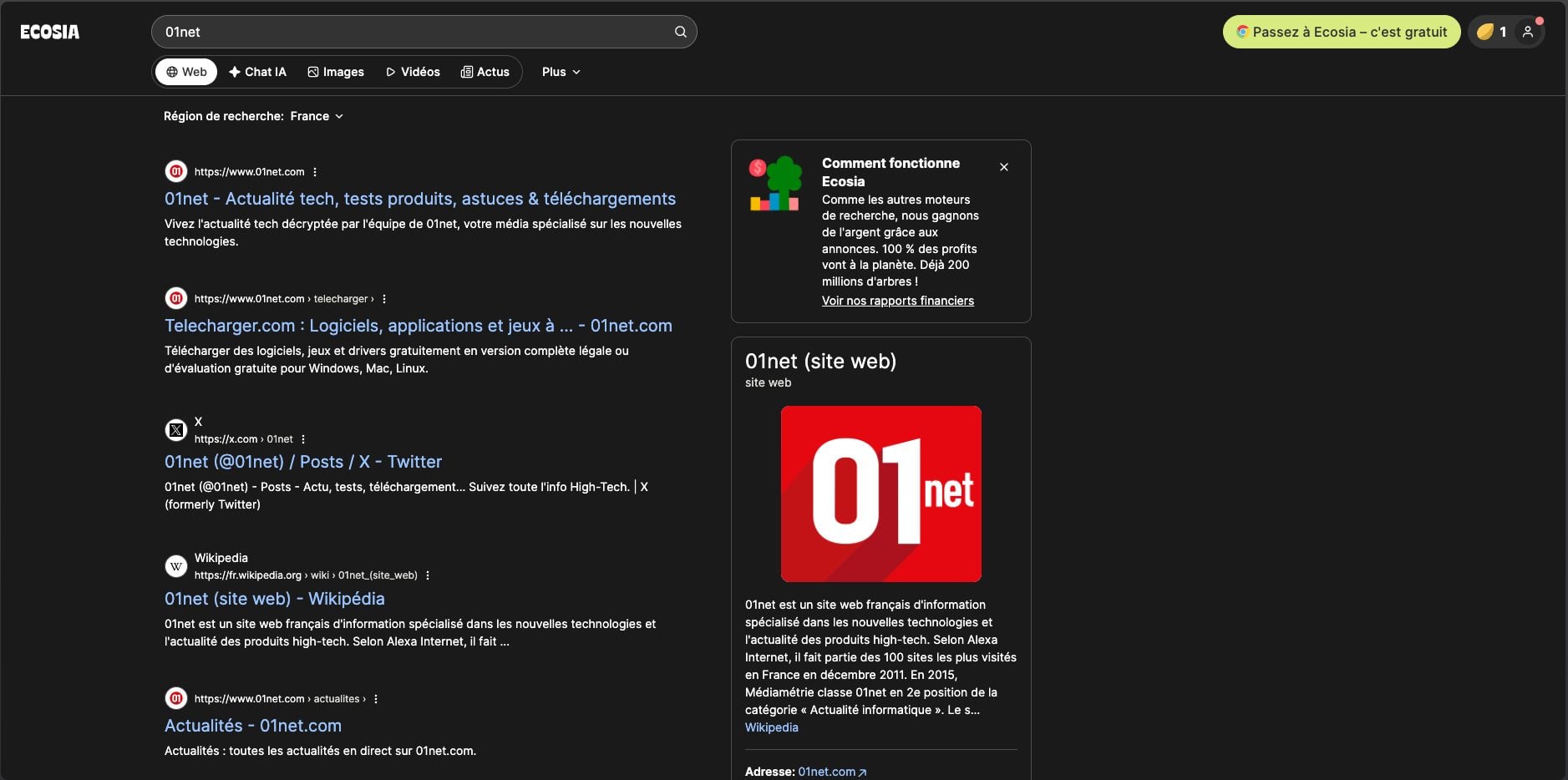
Beyond its commitment to the environment, Ecosia also strives to provide a service that respects the privacy of its users and is perfectly transparent. Like Qwant, Ecosia refuses to create a user profile for advertising targeting and does not store any personal data for commercial purposes. The company also publishes detailed financial reports every month to show exactly how the money is invested.
As for the security of its users, Ecosia complies with European (DSA) and British (OSA) regulations to protect its users against illegal and harmful content. The search engine also activates its SafeSearch secure search system by default in certain countries such as the United Kingdom.
The only downside is that Ecosia does not currently host its own search index. The platform relies on those of Microsoft Bing and Google, for classic results as well as for images. However, Ecosia partnered with Qwant a few months ago to build a European search index to reduce dependence on American technologies.
Startpage is a search engine founded in 2006 in the Netherlands. Recently purchased by the American company System1, it continues to be operated from its head office in The Hague.
Like its other European competitors, Startpage promises absolute confidentiality in your requests. The search engine does not save or sell your personal data. It also does not carry out any profiling of its users. Everyone receives the same search results, which are therefore not influenced by individual search history or usage habits. The platform also indicates that it prevents advertising retargeting or the use of trackers.
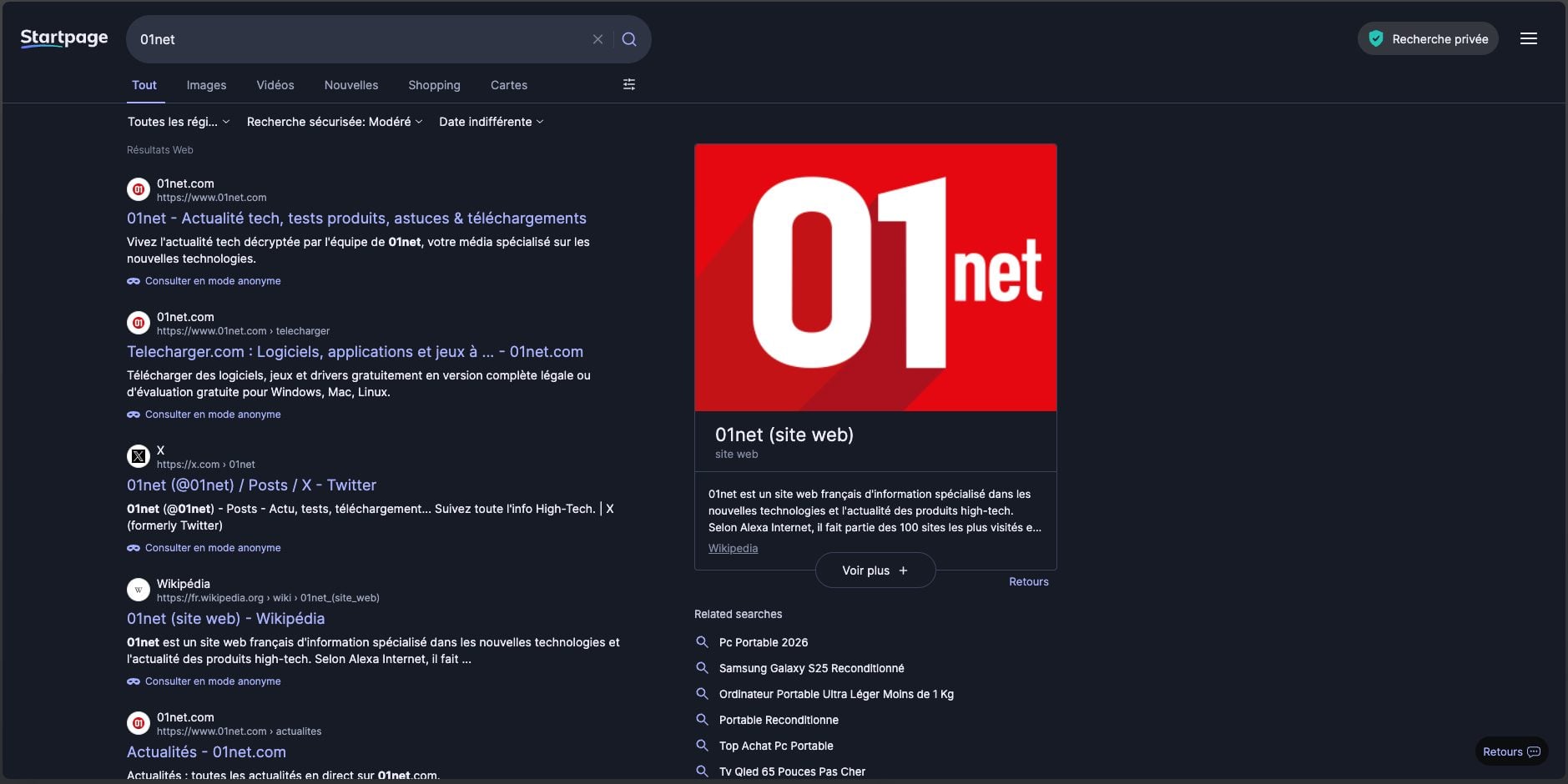
To provide its search results, Startpage does not rely on its own index. The engine uses Google and Bing indexes, but applies its own anonymization process to ensure that no tracking is carried out. It therefore offers a very good compromise to benefit from the efficiency of Google, but “without Google”.
The search engine also offers an anonymous mode which works like a VPN. When enabled, it allows you to visit websites without being visible, hiding your original IP address and blocking third-party cookies.
To finance itself, Startpage relies on the display of contextual advertisements which respect the privacy of users without the need to “profile” them.
Swisscows is a search engine founded in Switzerland in 2014. It positions itself as a credible alternative to the tech giants Google and Microsoft and emphasizes the protection of privacy and family security.
With a “zero tracking” policy, Swisscows does not collect, store or trace any personal data from its users. The requests sent are anonymized and no user profile is created for advertising. This search engine also does not keep any history of your queries and does not record your IP address or any other information from your web browser.
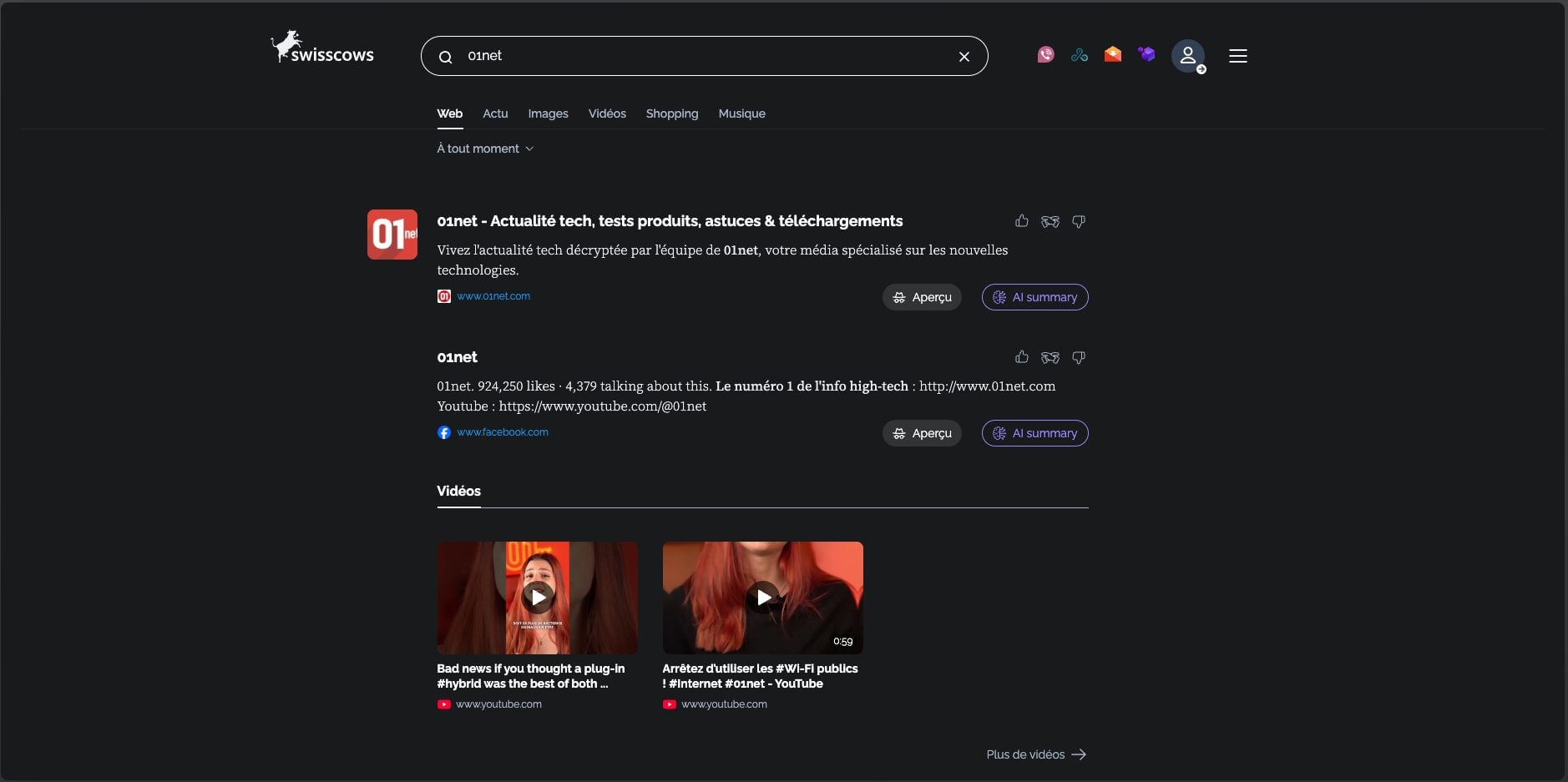
The platform, whose servers are hosted in a bunker in the Swiss Alps, benefits from some of the strictest data protection laws in the world, beyond the reach of the EU and the United States. The Swisscows Data Center is also TIER IV certified, which allows it to continue operating even in the event of a major breakdown or maintenance. Note that the search engine is also intended to be ecological since it operates with green electricity, part of which comes from its own photovoltaic plant.
The main particularity of Swisscows lies in its commitment to the protection of young people. Its search results are automatically purged of pornographic and violent content. They are therefore neither indexed nor displayed. The engine thus uses its own search index and its own semantic technology to provide fast and relevant results. Note that Swisscow also works in partnership with Brave to enrich its results.
To maintain its independence, Swisscows relies on two modes of operation. The first, free, is financed by advertising displayed in search results. The second, Swisscows Pro, is a paid version, 100% anonymous and guaranteed without advertising, with the possibility of personalizing its sources, in particular to hide some of them. Swisscows can also rely on revenues generated by other services it offers, such as encrypted messaging (swisscows.email), a VPN service (swisscow.VPN), a secure alternative to WhatApp called Teleguard, a secure online storage platform (Edelcloud), or even an AI tool called GetDigest.
Mojeek is an independent search engine launched in 2004 in the United Kingdom. Its main strength lies in the use of its own technology and its own search index, unlike other search engines which still depend on Google and Bing.
The search engine actually uses its own indexing robot and its own ranking algorithms. In 2025, the search engine will have passed the milestone of 9 billion indexed pages, making it one of the few to have an index of this size without depending on American Tech giants. Mojeek also advocates the neutrality of its results. The platform, which does not use any profiling, will thus display identical results for two users who carry out a search with the same parameters.
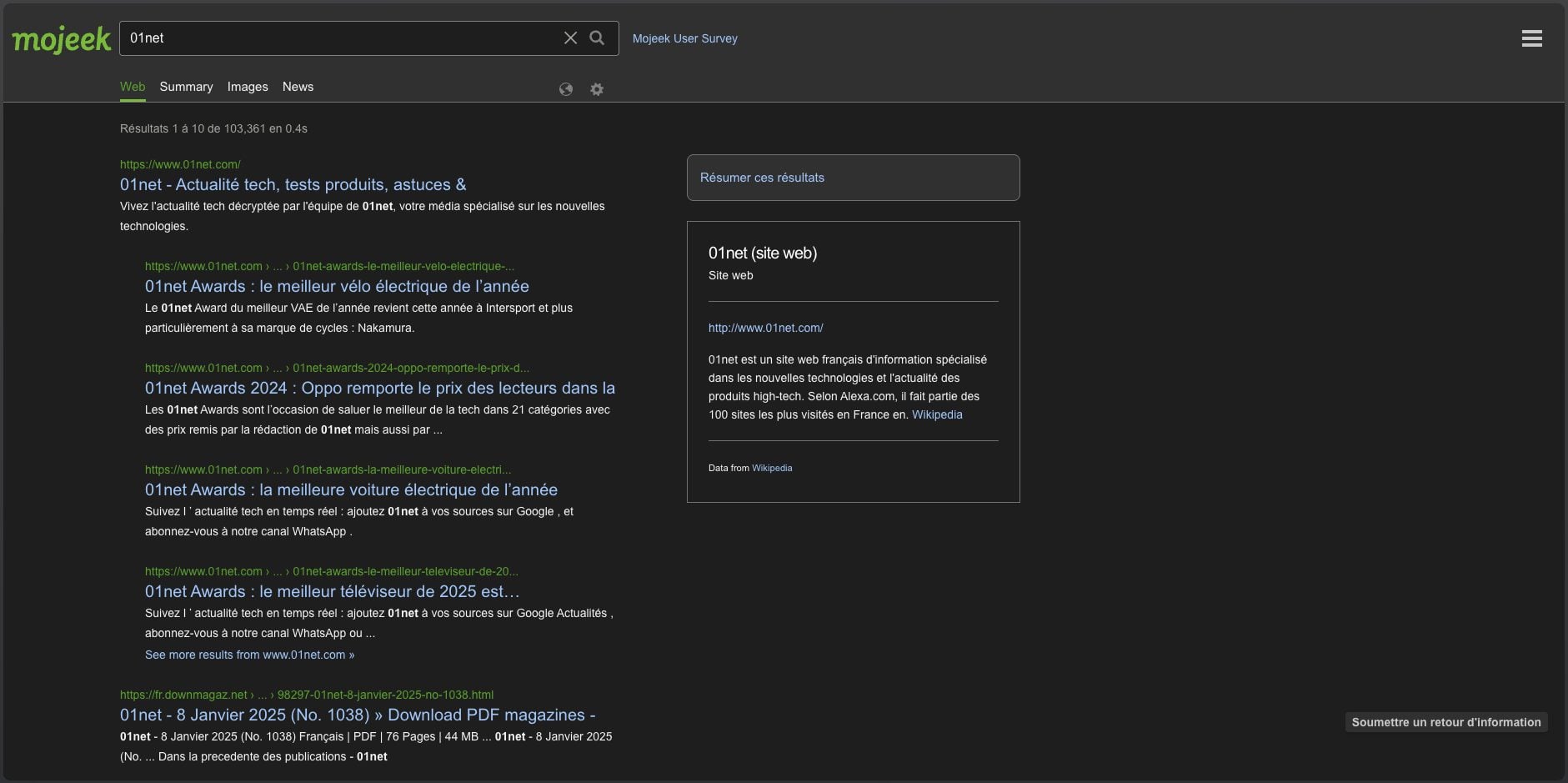
Mojeek, which claims to have been the first search engine in the world to adopt a no-tracking privacy policy back in 2006, does not collect any personal data. The search engine does not record your IP address, your search history, or your click behavior on the Web either.
As the platform is based in the United Kingdom, questions may naturally arise regarding respect for privacy and the digital surveillance capabilities of the British authorities.
However, Mojeek claims not to keep any usable personal data: no IP addresses stored permanently, no individualized user history, and no tracking cookies. Thus, even in the context of a legal request from the authorities, the company would theoretically have very little, if any, data allowing it to identify or draw up a profile of its users.
👉🏻 Follow tech news in real time: add 01net to your sources on Google, and subscribe to our WhatsApp channel.