

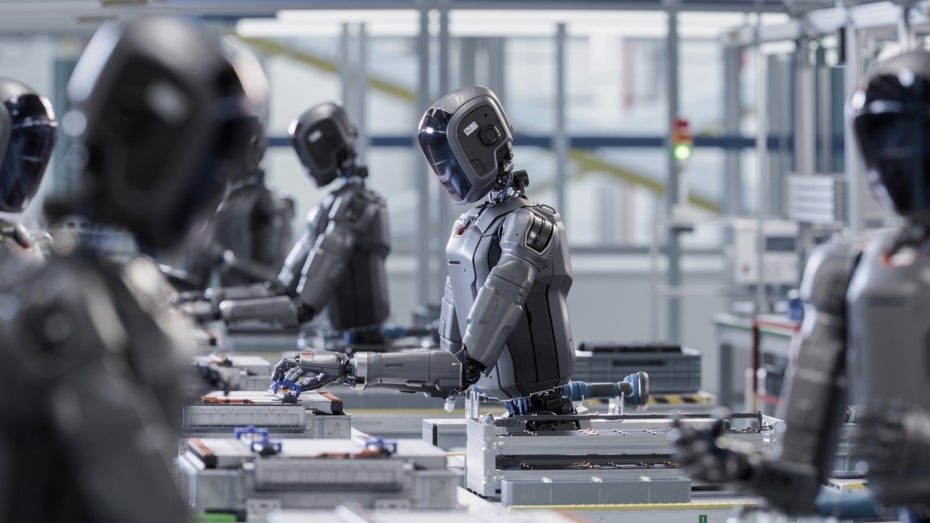
Humanoid robots could carry out a whole range of routine tasks in the future. The manufacturers are not only thinking about use in factories and warehouses, but also want to bring the machines into private households, for example to fold laundry or empty the dishwasher. Researchers at the US investment bank Morgan Stanley predict that a billion of the machines could be in use worldwide by 2050. Before this is possible, however, significant security risks must be addressed.
Humanoid robots must become safer
In February, Chancellor Friedrich Merz traveled to China and marveled, among other things, at the Kung Fu arts of humanoid robots from the startup Unitree. However, the machines are still a long way from being ready for the market. According to the Wall Street Journal, manufacturers are not aware of any cases in which people have been seriously injured, but as the devices become larger and heavier, experts are becoming increasingly concerned about what will happen if they lose control. This is not unfounded: As Focus reports, a humanoid robot recently injured a child in China – videos show the machine kicking a boy in the stomach.
Uncontrolled behavior also poses risks in the home or at work: even the tipping over of a heavy machine can seriously endanger people. There is also a fundamental technical problem: While industrial robots work “deterministically”, i.e. ensure reliably the same results according to fixed rules, humanoid robots work “probabilistically”. They use AI to handle a wide range of tasks and make decisions based on statistical probabilities. What this means in practice can also be seen when using chatbots – but there are no physical dangers if an AI model does not continue a sentence in a meaningful way.
Top Article
${content}
${custom_anzeige-badge}
${custom_tr-badge}
${section}
${title}
Manufacturers are working on different solutions
A panel of the International Organization for Standardization (ISO) is currently considering safety guidelines for humanoid robots and expects to publish a corresponding standard by mid-2028. The manufacturers are working in parallel on their own solutions. As the Wall Street Journal reports, some of them presented their approaches at the “Automate” conference in Chicago. The German company Neura Robotics, for example, is developing a two-legged model called 4NE1 that weighs just under 90 kilograms. Founder David Reger explained that it was designed to minimize the risk to people nearby. If the robot detects a problem such as a knee joint that no longer works, it attempts to restore its balance. If he doesn’t succeed, he should collapse like a collapsing building to avoid injuries. Some manufacturers have gotten around the problem by completely forgoing classic legs in their models.
Nvidia also announced a new security system for humanoid robots that will be based on its Blackwell chips. Amit Goel is senior director of robotics and edge ecosystems at Nvidia. According to the Wall Street Journal, he said at the conference that the system can use sensor data to calculate potential dangers and stop the robot in unsafe conditions. “The safety brain and the functional brain need to communicate frequently and with a much broader context,” says Goel. “We developed this operating system layer and the software stack so that you can operate these two components together.” In addition to their own sensors and cameras, humanoid robots can also be controlled via external devices in the work area, which offer additional perspectives. For example, the Philadelphia company Fort Robotics produces controls and software that process information from multiple sources and are intended to provide greater security.


