For years we have assumed that build a GPU It was a field reserved for companies with advanced factories, engineering teams and million-dollar budgets. It wasn’t an absurd idea: just look at the complexity of any modern graphics card to understand why it seemed out of reach for a person. But what Matthias Balwierz, known as Bitluni, has done forces us to qualify that certainty. It has not replicated a GeForce nor does it intend to compete with NVIDIA, but it is building a graphics machine with thousands of RISC-V microcontrollers from home.
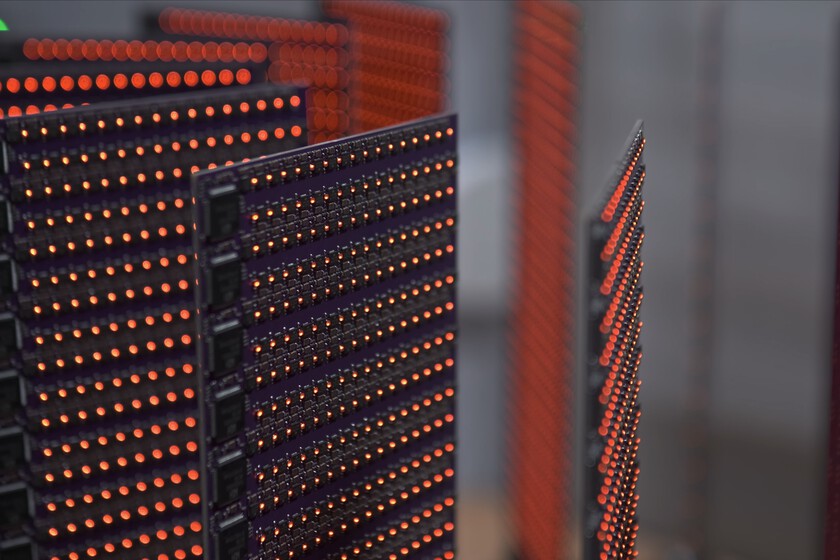
The first phase brings together 8,192 of those microcontrollers, each linked directly to an RGB LED. This decision makes the montage difficult to fit into the usual categories: the design brings together in the same structure the graphic processing and the surface on which the result must appear. In technical terms, it is designed to act as both a graphics card and a screen, without depending on a separate monitor. Of course, the project remains a partial prototype, still far from the scale and capabilities planned for the complete system.
A GPU made pixel by pixel
That architecture was not defined from the beginning. The maker began thinking about building some type of screen, but when studying the cost and difficulty of the project he ruled out resorting to components Addressable RGBwhich would have made the whole set too expensive. The alternative was more direct: solder an LED to each microcontroller and turn each chip into a visible graphics unit on its own. The decision contained part of the budget, although it multiplied the design, assembly and programming work necessary to coordinate thousands of elements.
The scale becomes clearer when we look at the complete objective. A resolution of 1920×1080 would have required more than two million microcontrollers, shooting the cost and complexity far beyond what Bitluni had set itself. The maker then lowered the ambition to 320×200 pixels, a resolution associated with video games of the DOS era, but which still requires 64,000 chips. The components installed so far represent just a first stage of a machine that would multiply its size almost eightfold if it is completed.
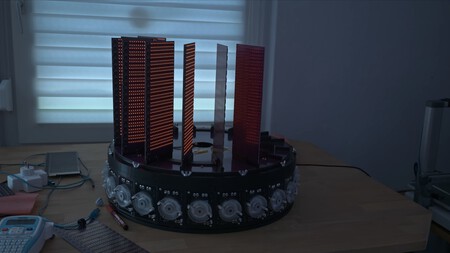
To organize such a large amount of hardware, Bitluni divided the system into 16×32 “pixel” boards, conceived as independent modules within the set. These are distributed in a circular arrangement that reminds of Cray-1the historic supercomputer of the seventies, although the reference is mainly visual. Internal coordination is also hierarchical: each group of 32 microcontrollers is under the control of a more powerful CH32V unit, in charge of organizing the operation of that section and serving as an intermediate level within the machine.
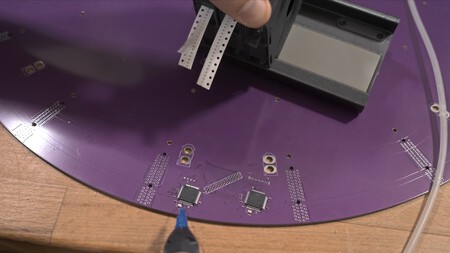
The choice of the QingKe CH570 explains part of the economic logic of the project. It is a microcontroller with a 32-bit RISC-V CPU, a limited instruction set and a frequency of up to 100 MHz. It also integrates a USB controller, a 2.4 GHz transceiver and support for Bluetooth 5.0 LE. Bitluni was able to buy each unit for about $0.13, but the advantage is diluted when multiplied by the entire planned matrix: only the chips necessary to reach 320×200 pixels would exceed $8,000.
The problem grows when projecting the power supply of the complete system. It speaks of an estimate of 2,161 W, equivalent to about 655 amps at 3.3Vfor the final planned configuration. The media points out that each microcontroller consumes around 10 mA, although it does not offer a breakdown that allows us to separate the expense of the chips, LEDs and auxiliary electronics. To sustain such a load, Bitluni has used a Corsair WS3000 power supply and its own converters capable of transforming the 12 V output into the required 3.3 V.
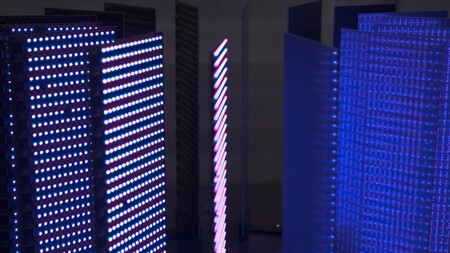
A big part of the project is also making the infrastructure that allows everything else to work. Bitluni designed the PCBs, power circuits, interface boards and breadboards, tackling a six-layer board for the first time. The complexity of the design ended up pushing him to the limits of the manufacturing service he used. In parallel, he studied an immersion cooling solution and came to the size of the acrylic container he would have needed, although he left that option on hold for economic and environmental reasons.
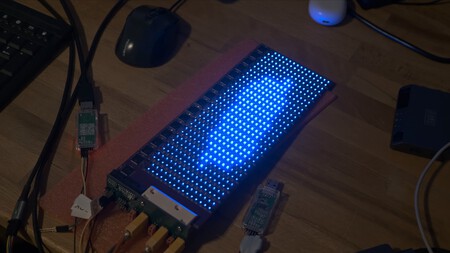
Programming posed another problem of scale: it was not enough to manufacture the boards, the code also had to be loaded into each microcontroller. To avoid doing it by hand, Bitluni 3D printed a small tool with three contacts and attached it to the carriage. a 3D printer. A Python script sent G-code commands to move it to the exact position of each chip and complete the process in a repeatable manner. The printer thus stopped manufacturing parts to become an automated programming machine.

This machine does not compete in performance, efficiency or size with a modern graphics card, nor has it yet reached the scale that Bitluni projected. Its value lies in exposing, through separate components, tasks that a commercial solution concentrates or distributes among specialized chips and circuits: calculation, control, power, coordination and visualization. By rebuilding them with low-cost microcontrollers, the maker has turned an unusual idea into a system that can be designed, tested and expanded in stages. It is not a conventional home GPU, but an engineering experiment taken to unusual limits.
Images | Bitluni
In | Huawei’s He Tingbo: “This is the first time China has proposed a new principle for the chip industry.” Not everyone is convinced