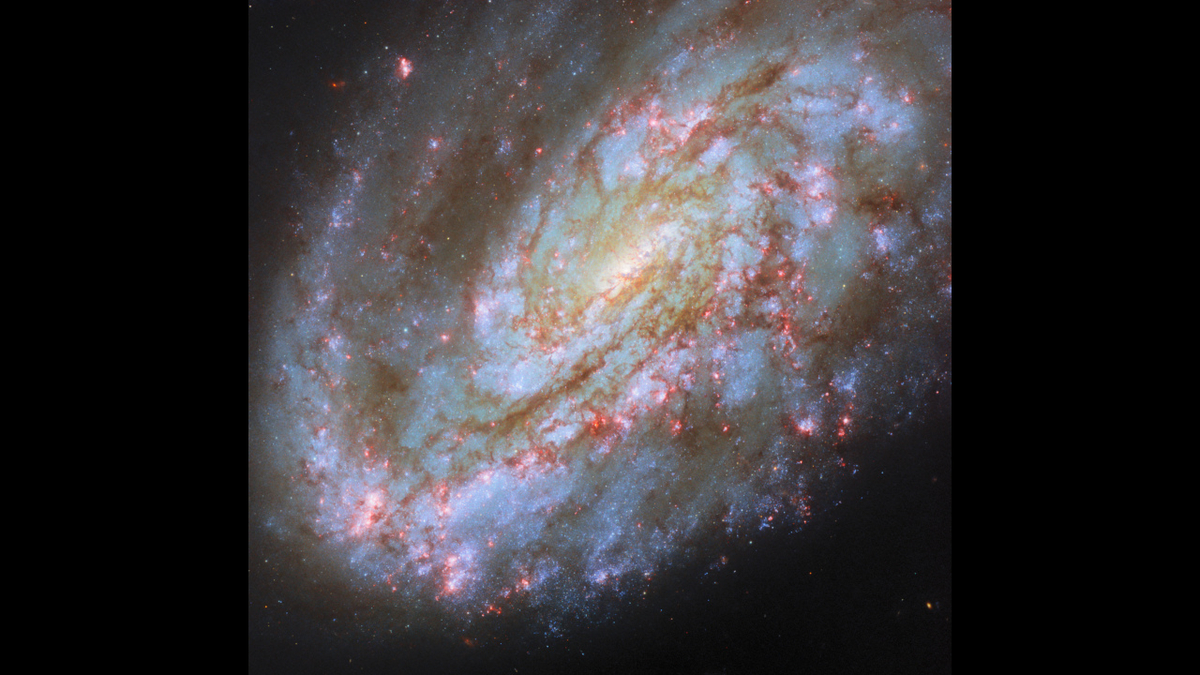
Observed by the Hubble Space Telescope, the galaxy NGC 4654 presents a physiognomy that is singular to say the least. Located 72 million light years away in the Virgo cluster, this intermediate spiral galaxy is distinguished by a deep asymmetry.
On one side, a well-defined spiral arm rich in stars, on the other, a diffuse structure and a long trail of gas that extends well beyond what its image reveals.
What forces are responsible for its deformation?
Moving at very high speed, NGC 4654 crosses the intra-cluster mediuma hot, rarefied gas that fills the space between galaxies. This interaction puts considerable pressure on its leading edge, compressing it, while stripping gas from its opposite side, creating a long gas tail.
However, this phenomenon alone is not enough to explain the uneven distribution of stars. Researchers believe that an ancient gravitational interaction with another galaxy, NGC 4639, played a role.
A close flyby about 500 million years ago would have stripped some of the gas from one side of the galaxy, limiting star formation in that arm since then.
Star formation survives this chaos
Galaxies that experience such a loss of cold gas should see their star formation rates drop dramatically. However, NGC 4654 is an exception.
The galaxy continues to create the equivalent of nearly two solar masses in stars each yeara rate quite comparable to that of galaxies of similar size, and even to our own Milky Way.
Data from Hubble, which detects the red light emitted by the gas clouds where stars are born, confirm this intense activity. Bright pink bubbles, witnesses of this stellar nursery, are visible throughout the galaxy.