The ad acted as a powerful detonator in already feverish financial markets. In the space of a few hours, Asian stock markets saw red: Seoul fell by more than 10%, Tokyo lost almost 4%.
The wave of panic has swept away the flagships of the sector, from Samsung Electronics to Tokyo Electron, including the Taiwanese giant TSMC. But why such a reaction?
Because this news does not concern a simple product. It touches the heart of the digital economy: the Chinese capacity to produce the most strategic components of the 21st century.
China has launched mass production of its own cutting machines DUV immersion lithographya critical technology for manufacturing advanced chips. The state-owned Shanghai Aishengna Electronic Technology Group is in charge and wants to deliver its first systems to giants like SMIC and Hua Hong this year.
Why is this Chinese announcement panicking the financial markets?
The market reaction is strong because this Chinese breakthrough attacks head-on a Western quasi-monopoly. Until now, the manufacturing of deep ultraviolet immersion lithography machines (DUVpour Deep Ultraviolet) was the preserve of the Dutch group ASML.
This technology is essential for etching the circuits of semiconductors modern, used everywhere from smartphones to AI servers.
The emergence of a Chinese player capable of producing these machines in series, even with initially lower performance, completely changes the situation. It threatens the market shares of Japanese, Korean and American equipment manufacturers, and above all, it offers China a bypass route in the face of sanctions and export restrictions imposed by the United States and its allies.
For investors, this is a clear signal that the strategy of technological containment has its limits and that Western domination is no longer an absolute certainty.
Who is behind this Chinese technological breakthrough?
The main player in this progress is a state-owned company that has until now been very discreet: Shanghai Aishengna Electronic Technology Group. Founded in 2023 with a colossal capital of one billion dollars, this entity was specifically created to centralize China’s efforts in this area.
It has absorbed the teams of several promising start-ups, notably Shanghai Yuliangsheng Technologywhich was already testing a prototype, and the best known Shanghai Micro Electronics Equipment (SMEE).
This consolidation of talents and resources under a single state banner shows the Beijing’s absolute determination to become autonomous in the manufacture of precious computer chips.
The first machines produced by Aishengna are intended for strategic customers such as SMIC, the largest foundry in China, Hua Hong Semiconductor and the memory chip manufacturer CXMT.
Can this “made in China” DUV machine really compete with the leader ASML?
Experts agree that the first Chinese machines will be far from matching the performance, reliability and efficiency of the Dutch giant’s systems ASMLwhich can produce more than 300 wafers (silicon wafers) per hour.
Chinese production is also in its infancy, with an objective of five machines this year and around twenty in 2027, compared to the 130 DUV systems delivered by ASML in 2025.
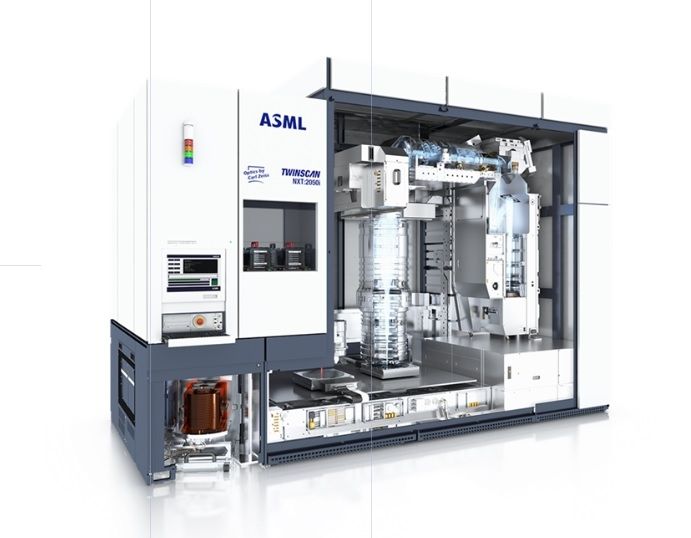
DUV equipment from Dutch ASML
However, the speed of progress should not be underestimated. China proves that it has mastered the principles of lithography par immersion. These machines, even less efficient, are sufficient to produce a wide range of chips and can, via the technique of multi-patterning (a superposition of patterns to engrave more finely), achieve advanced engraving finesse, such as 7 nm or 5 nm, at the cost of increased complexity.
What are the geopolitical implications of this new Chinese independence?
The major implication is a weakening of the West’s most powerful economic and technological weapon: the control of technological limiting factors.
By developing its own DUV sector, China is sending a message of resilience in the face of external pressures. This breach in the sanctions wall could widen quickly.
Ultimately, this means that export restrictions could become less and less effective. China will be able to secure its chip production for its critical industries, whether telecommunications, automotive or defense.
The “chip war” is thus entering a new phase in which competition is no longer played only on the most advanced technology (EUV, still beyond Beijing’s reach), but on the ability to maintain a sovereign and robust supply chain.