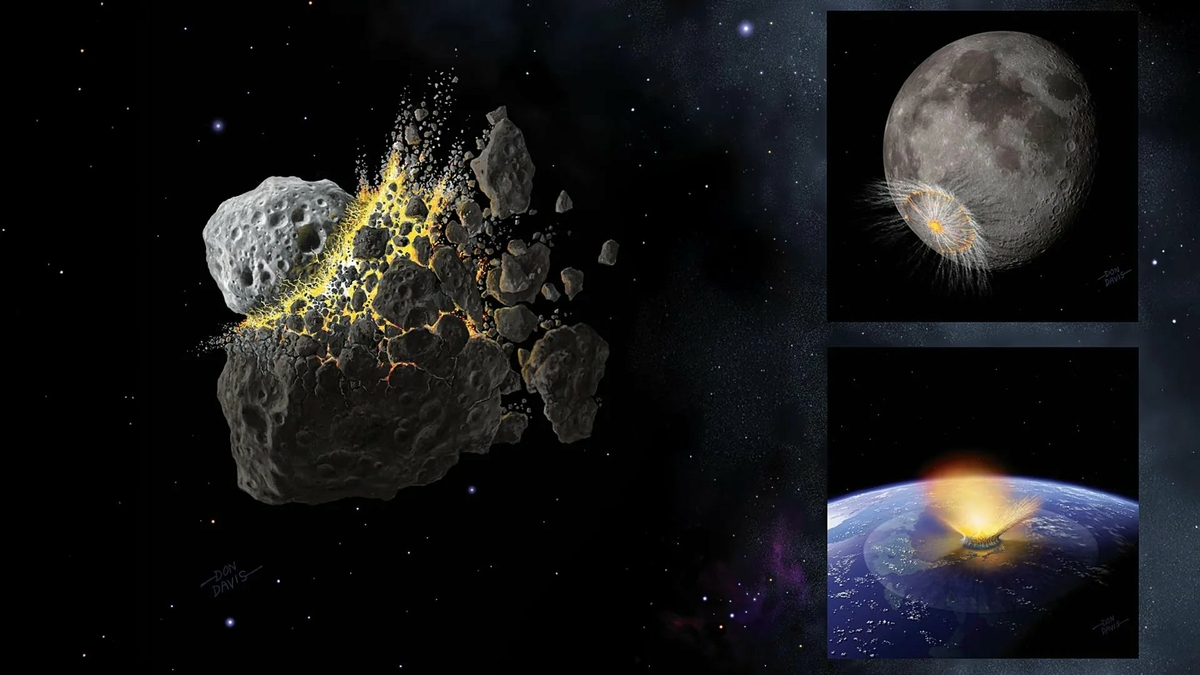
A major study from the Southwest Research Institute, led by Dr. William Bottke, reveals a cosmic event of unsuspected magnitude. 800 million years ago, the ancestor of the Eulalia asteroid family broke up near Jupiter’s “gravitational gate.” This deluge of rocks hit Earth, Moon and Mars for 100 to 150 million years. A bombing that could have redraw the destiny of our planet.
How can an asteroid shake up the solar system?
In the asteroid belt, between Mars and Jupiterthe large asteroid Eulalia exploded. The location was critical: the J3:1 resonance of Jupiter. It’s a gravitational zone where Jupiter acts as a cosmic launcher, destabilizing orbits. This subtle interaction was devastating in the long term.
Half of the fragments were ejected towards the interior of the solar system immediately. An additional quarter followed, attracted by this “gate” for 100 to 150 million years, thanks to the Yarkovsky effect (tiny force due to the unequal absorption and emission of solar heat). Even unsuspected forces can have planetary consequences.
Why are there so few traces of impacts on Earth?
Despite the flood, the Earth is a living planetconstantly remodeled. Volcanoes, plate tectonics, erosion: these processes erase or bury ancient craters. The example of the famous impact of Chicxulub (66 million years) remains an exception, the only collision clearly linked to a mass extinction.
The Luneshe is a space archive. With no active geology or atmosphere, its craters are visible for billions of years. The study of these marks and “impact glasses” (solidified molten rocks) revealed a clear increase in impacts 800 million years ago. The larger and more massive Earth would have attracted around 20 objects for each lunar impact, amplifying the mystery of their disappearances.
What is the link between cosmic flood and terrestrial changes?
This bombing surprisingly coincides with a global cooling and biological mutations on Terre. The idea that these impacts could have contributed to a “Snowball Earth” (like the Cryogenian) is attractive. Dr. Bottke admits: “It is tempting to suggest that the former produced the latter.”
But be careful: correlation is not causation. However, this study offers a plausible source for such a flood. This intriguing synchronization deserves further investigation. Similar impacts would also have affected Mars, causing earthquakes and volcanic activity. This research highlights the direct role of distant events on our world.
Frequently Asked Questions (FAQ)
What is the Eulalia family of asteroids?
The Eulalia family of asteroids is a group of celestial bodies sharing similar orbits, indicating a common origin. These fragments come from the disintegration of a large parent asteroid about 800 million years ago in the main belt between Mars and Jupiter.
Why are impact traces better preserved on the Moon than on Earth?
The Moon is an excellent preserver of impacts because, unlike Earth, it has no thick atmosphere, plate tectonics, or major volcanic activity to reshape its surface. The craters formed billions of years ago therefore remain visible there.