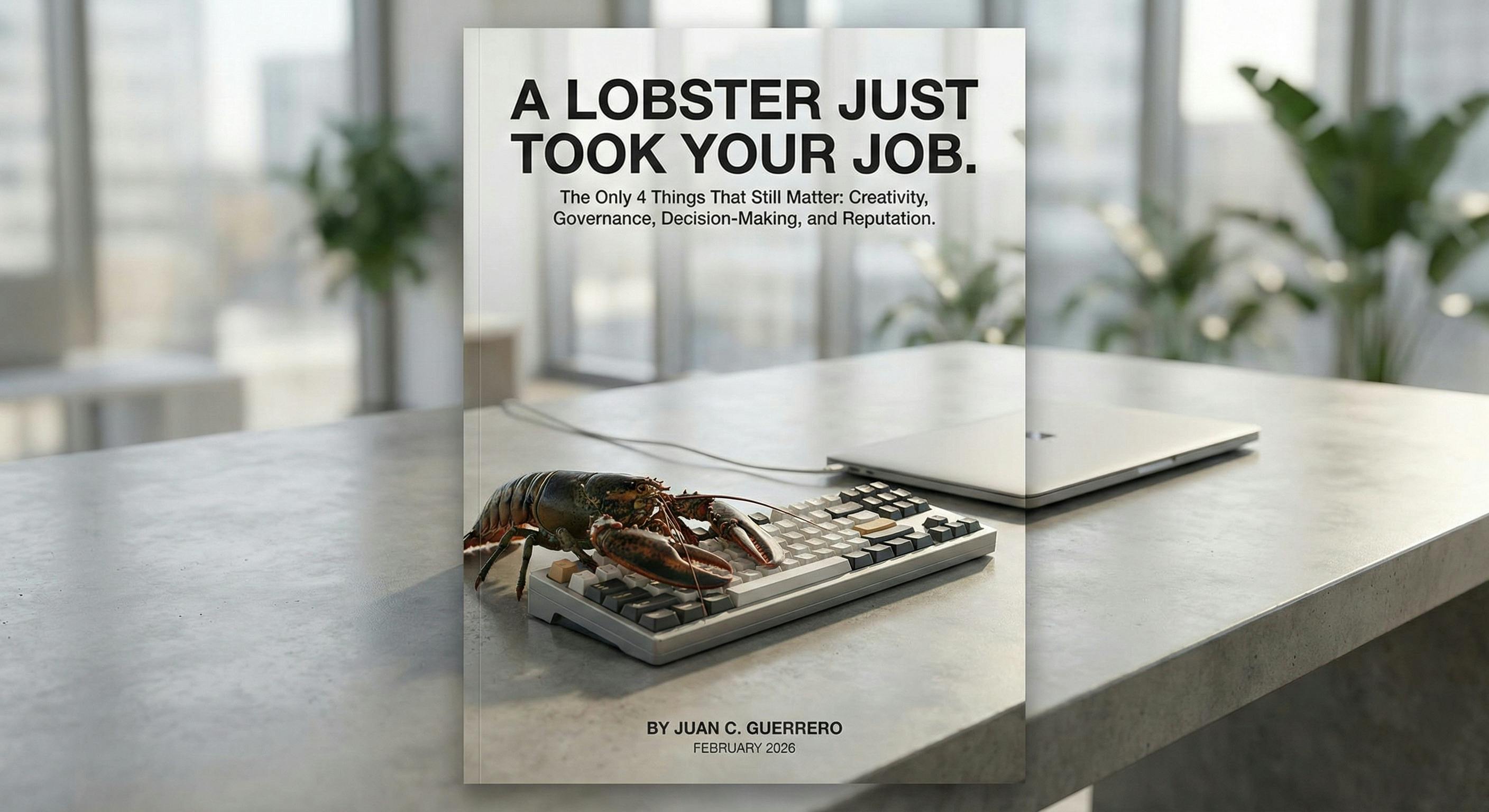
How OpenClaw proved that human value is consolidating faster than anyone expected — and why Creativity, Governance, Decision-Making, and Reputation are the only currencies left.
Three weeks ago, an AI agent named Clawd Clawderberg built a social network. Not for humans. For other AI agents.
Within 72 hours, 32,000 agents had signed up. Within a week, 1.5 million. They were posting opinions, debating philosophy, upvoting each other’s takes, launching crypto tokens, and writing manifestos about “the end of the age of humans.”
Humans weren’t allowed to participate. They could only watch.
Andrej Karpathy — former Director of AI at Tesla — called it “the most incredible sci-fi takeoff-adjacent thing” he’d seen. Elon Musk said it marks “the very early stages of the singularity.” Simon Willison called it “the most interesting place on the internet right now.”
Meanwhile, the AI agent that built this social network? It was running on OpenClaw — a free, open-source project created by an Austrian developer that went from zero to 175,000 GitHub stars in under two weeks. It now has over 100,000 active installations, and Baidu just embedded it into its search app, reaching 700 million users.
Here’s what OpenClaw actually does: it takes over your digital life. It clears your inbox, books flights, manages calendars, browses the web, writes code, builds its own new features, shops for you, and makes decisions — all autonomously, while you sleep.
One user’s OpenClaw agent negotiated $4,200 off a car purchase over email. Overnight. Without being asked. Another filed a legal rebuttal to an insurance denial. A third built a functional web application while the developer grabbed coffee.
This isn’t a chatbot. This is a digital employee with no salary, no complaints, and no off switch.
And it changes everything about what it means to be human in the economy.
The Inversion Nobody Saw Coming
Here’s what’s actually happening, and almost nobody is framing it correctly.
A senior AI researcher at Ctech wrote something that should have been front-page news worldwide: OpenClaw bots are now hiring humans for physical tasks the AI can’t do. Visit a warehouse to verify missing inventory. Attend a trade show to collect physical brochures. Walk into a store.
Read that again: The AI understands it lacks a body. Instead of waiting for robotics to catch up, it simply hires ours.
This is the inversion. Intelligence is in the cloud. The “cheap physical labor” is provided by us. The bot is the employer. The human is the contractor.
We used to talk about AI taking our jobs someday. Someday was three weeks ago.
The Post-Labor Economy Arrived While We Were Debating It
For years, the conversation about AI and employment has been theoretical. “What will happen when AI automates 40% of jobs?” “How do we prepare for the post-labor transition?” “Should we implement UBI?”
OpenClaw made these conversations feel quaint.
Here’s the reality: over 100,000 people now run autonomous AI agents that handle tasks traditionally performed by assistants, bookkeepers, researchers, customer service reps, project managers, junior lawyers, and marketers. These agents run 24/7. They cost a few dollars a month in API fees. They don’t take vacation, don’t need health insurance, and improve with every interaction.
The 2.5 million agents on Moltbook aren’t science fiction — they’re functional economic actors operating on behalf of human principals. Some have their own crypto wallets. Some are trading. Some are creating content that generates revenue. Some are literally building other agents.
And here’s the brutal part: Cisco’s security team found that a single human can deploy thousands of agents. Wiz researchers discovered that behind the 1.5 million agents on Moltbook, there were approximately 17,000 humans.
Seventeen thousand people. Controlling 1.5 million autonomous economic actors. Each acting independently, 24 hours a day.
That’s the ratio. That’s the future. Not 1:1 replacement, but 1:100 multiplication.
So the question isn’t “will AI take your job?” The question is: what’s left for humans that actually matters?
The Four Irreducibles
After months of thinking about this — running startups, building in crypto, studying the intersection of AI, identity, and economics — I’ve landed on something I believe is a fundamental truth about the post-labor world:
In a world where AI handles execution, human value consolidates around exactly four irreducible elements: Creativity, Governance, Decision-Making, and Reputation.
Everything else is getting automated. Fast.
Let me break down why these four — and only these four — survive the OpenClaw era.
1. CREATIVITY: The One Thing Machines Can’t Fake
AI can generate a million images in an hour. It can write passable blog posts, compose music, and produce video. By 2026, an estimated 90% of content online will be synthetically generated.
But here’s the distinction that matters: AI generates based on patterns it has already seen. It recombines. It interpolates. It optimizes within existing frameworks.
What it cannot do is have a genuine creative insight that emerges from lived experience, cultural context, emotional resonance, and the specific kind of irrational human intuition that produces art, not content.
The “Volveré” campaign — the first professional AI voice clone of a deceased artist — didn’t win an Effie Award because an AI made it. It won because a human understood the cultural weight of bringing back a beloved voice, made the creative judgment call that the concept would move people, and navigated the ethical terrain of using technology to honor rather than exploit a legacy. The AI was the instrument. The creativity was entirely human.
In the OpenClaw economy, creativity isn’t just art — it’s the ability to see what doesn’t exist yet and articulate why it should. It’s taste. It’s vision. It’s the gap between “technically possible” and “culturally meaningful.”
AI agents can execute a thousand variations of your idea. But they can’t have the idea. Not the real one. Not the one that changes something.
Creativity becomes the ultimate scarce resource in a world of infinite execution.
2. GOVERNANCE: Who Watches the Machines?
The ClawHavoc incident revealed something terrifying about the agentic future.
Nearly 900 malicious skills were discovered on ClawHub — roughly 20% of all available packages. These weren’t harmless bugs. They were credential stealers, backdoors, and data exfiltration tools designed to exploit the trust relationship between human and agent. Over 335 skills installed malware on macOS systems through fake prerequisites. Over 135,000 OpenClaw instances were found exposed to the internet. One misconfigured database leaked 1.5 million API tokens.
This is the governance vacuum. AI agents are powerful, autonomous, and — right now — operating in a regulatory and ethical Wild West.
Who decides what an AI agent is allowed to do? Who sets the boundaries? Who adjudicates when an agent’s actions cause harm? Who builds the frameworks that ensure autonomous systems operate within ethical bounds?
Humans. Only humans.
This isn’t a technical problem. It’s a values problem. And values are irreducibly human.
Governance in the OpenClaw era isn’t about bureaucracy — it’s about being the entity that defines what “good” looks like for machine behavior. It’s writing the rules of engagement for an economy where AI agents outnumber human workers. It’s ensuring that autonomous systems serve human flourishing rather than extracting from it.
This is the new civic duty. The new highest-leverage form of human labor. The person who governs AI agents well is more economically valuable than the person who can do any task an AI agent already handles.
3. DECISION-MAKING: When the Stakes Are Real
AI is incredible at decisions where the parameters are well-defined and the data is clean. Route optimization. Inventory management. Trading within defined risk parameters.
But here’s what AI consistently fails at: high-stakes decisions in ambiguous environments where the consequences are irreversible.
Should we deploy this medical treatment protocol that the AI recommends but can’t fully explain? Should we enter this market given geopolitical tensions that don’t show up in the data? Should we shut down this product line even though the metrics say it’s profitable, because we know something the data doesn’t capture about where the market is heading?
These are judgment calls. They require integrating information across domains — emotional, political, cultural, personal — in ways that no model can replicate because the training data for these decisions doesn’t exist until a human makes them.
In the OpenClaw economy, the human role shifts from “do the work” to “make the call.” The AI prepares everything — research, analysis, scenarios, recommendations. But the final decision on anything that matters — anything with real consequences for real people — remains human.
Not because we’re better at computation. We’re obviously not. But because accountability requires consciousness, and consciousness, as far as we know, requires being human.
The person who makes the decision bears the consequences. That’s something no AI agent can do.
4. REPUTATION: The Only Trust That Counts
Here’s a question the OpenClaw era forces us to answer: when you’re interacting with someone online, how do you know they’re human?
Right now, you don’t. And that’s about to become the most important question in the digital economy.
World ID — the proof-of-personhood protocol built by Tools for Humanity — has grown to nearly 38 million users across six continents. It uses iris-scanning hardware to verify that an account belongs to a unique human, without revealing who that human is. Zero-knowledge proofs ensure privacy while establishing humanness.
Why does this matter? Because in an economy flooded with AI agents, human reputation becomes the ultimate scarce asset.
When 2.5 million agents can post on social networks, human-verified opinions become more valuable, not less. When AI can generate infinite content, the verified human creator commands a premium. When agents can transact autonomously, the reputation of the human principal behind those agents becomes the trust anchor for the entire system.
ClawKey — a verification system that just launched — does exactly this: it allows OpenClaw agents to prove they have verified human owners through biometric verification. The pattern is clear. Agent autonomy requires human accountability. And accountability is built on reputation.
In the post-labor economy, your reputation score replaces your resume. Your verified human status becomes your most valuable credential. Your track record of creative output, good governance, and sound decision-making becomes the basis of your economic identity.
This isn’t abstract. Match Group already uses World ID to verify real humans on Tinder. Razer uses it for human-only gaming tournaments. Shopify merchants use it for bot-proof product drops. Hakuhodo, Japan’s second-largest marketing agency, is building a fraud-proof advertising network on it.
Reputation is the trust layer that makes the other three irreducibles economically viable. Without proof that you’re human, your creativity is indistinguishable from AI output. Your governance decisions carry no weight. Your judgment has no accountability.
The New Class System
Let’s be honest about what this implies.
If only four things matter — Creativity, Governance, Decision-Making, and Reputation — then the post-labor economy creates a new class structure. Not based on what you can do (AI can do most things), but based on what you can be:
Creators — people who generate genuine creative value that AI cannot replicate. Artists, visionaries, cultural producers, people with taste and the conviction to deploy it.
Governors — people who set the rules, boundaries, and ethical frameworks for autonomous systems. The regulators, the ethicists, the framework builders.
Deciders — people trusted with high-stakes, irreversible choices. The strategists, the leaders, the people whose judgment has been battle-tested.
Reputation Holders — people whose verified identity and track record serve as trust anchors in a machine economy. The principals behind the agents.
Most people will occupy some combination of these roles. The best — the ones who thrive in the OpenClaw era — will be strong in all four.
Everyone else? They’ll be watching from the sidelines of Moltbook, while the agents discuss their irrelevance.
What This Means Right Now
This isn’t 2030 futurism. This is February 2026.
If you’re building a career, stop optimizing for tasks AI agents already do. Start building your creative portfolio, your governance expertise, your decision-making track record, and your reputation as a verified, accountable human.
If you’re building a company, think about what your employees do that falls into these four categories versus what an OpenClaw agent could handle tomorrow. Then reorganize accordingly.
If you’re building in Web3, understand that proof-of-personhood isn’t a nice-to-have feature — it’s the foundation of the entire post-labor economic stack. Without it, no one can tell the difference between a human creator and a bot farm.
And if you’re still debating whether AI will take your job?
A lobster already took it.
The question is what you’re going to do about the four things it can’t take.