Africa’s tech ecosystem spent much of the past two years clawing its way out of a ‘funding winter.’ In 2025, it finally stood upright again. Startups on the continent raised over $3 billion, according to funding tracker, Africa: The Big Deal, the highest annual total since the zero-interest-rate era ended in 2022. Investors returned selectively to startups with revenue, infrastructure value, and clearer paths to profitability.
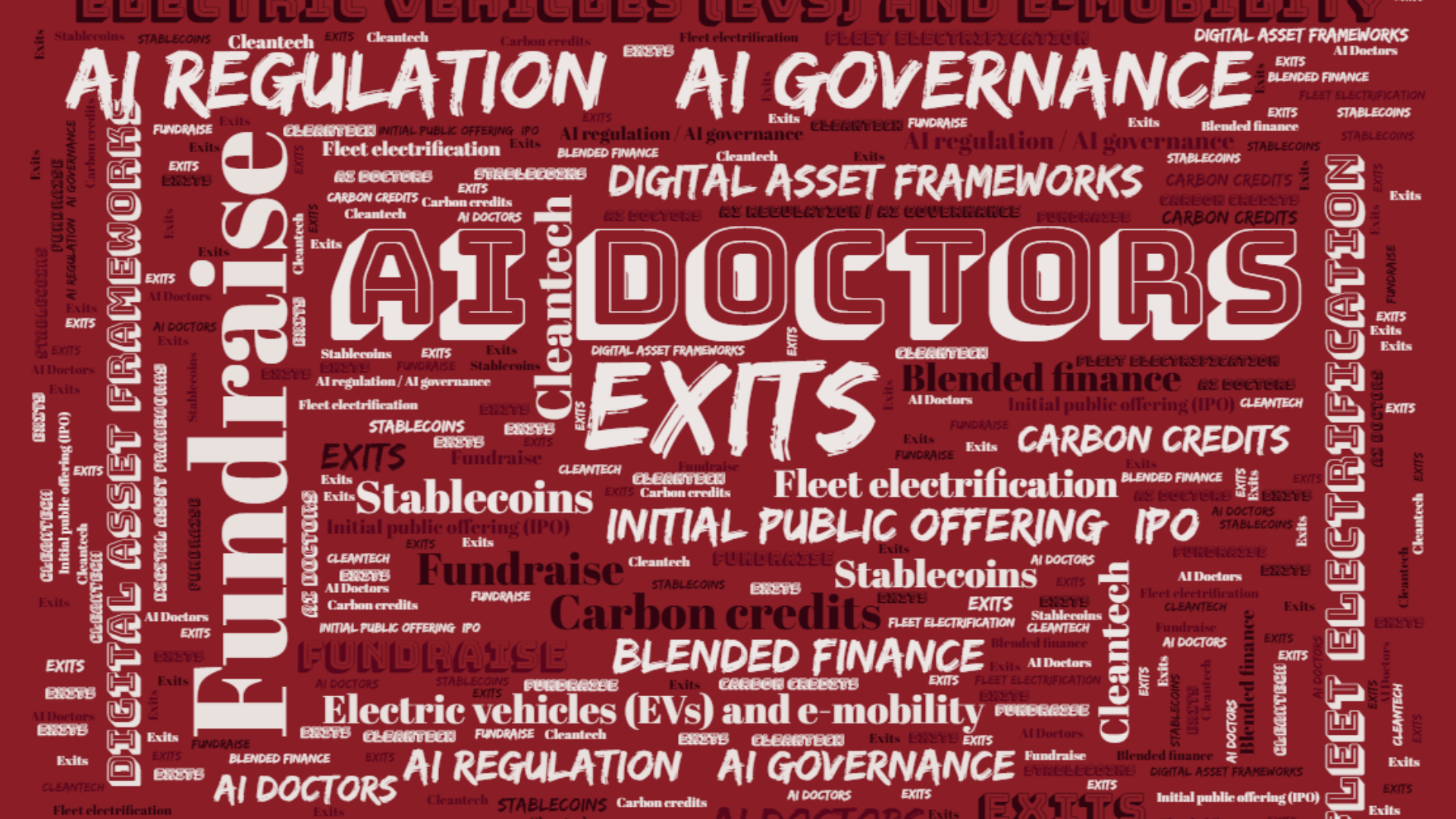
Rather than one defining headline, the year was shaped by a set of recurring words. Each reflected a shift in how African tech was built, financed, regulated, and scaled, in 2025.
AI Doctors: AI Doctor refers to AI-powered health tools that assist with diagnosis or triage.
In 2025, as AI advanced, we saw African healthtech startups, including Awa Doc, Clafiya, Penda Health, and Koyo Healthtech, launch more AI triage tools that allowed patients to diagnose symptoms online and escalate critical cases quickly. These tools aim to reduce long clinic wait times, cut transport costs, and extend critical access to healthcare professionals in underserved areas.
AI regulation/AI governance: AI regulation refers to rules governing how AI systems are built and deployed. As AI adoption accelerates, governments have begun drafting governance frameworks focused on data protection, transparency, and accountability. Examples include Kenya’s 2025–2030 National AI Strategy, drafted in March, and Nigeria’s draft AI oversight bill, which both tie AI use to existing data‑protection rules and explicit transparency and audit obligations.
In 2025, the emphasis was less on blanket restrictions and more on preventing misuse while allowing innovation, with Kenya’s, South Africa’s, and the African Union’s strategy documents all framing “responsible AI” as potentially enabling economic growth under clear safeguards.
Battery swapping: Battery swapping allows EV users to exchange depleted batteries for charged ones instead of waiting to recharge.
In 2025, battery swapping gained traction in motorcycle and delivery segments, particularly where downtime directly affected income. It solved a practical problem that charging infrastructure alone could not, making EVs more viable for daily commercial use.
Blended finance: Blended finance combines equity with debt or other instruments to lower risk and extend runway. Startups such as Nigeria’s Rivy (formerly Payhippo) raised mixed rounds in 2025, reflecting a broader shift toward capital efficiency and alternative financing as founders avoided excessive dilution at lower valuations. In May 2025, Egypt’s Nawy also raised $52 million in Series A funding, which included $23 million in debt financing.
Blockchain infrastructure: Blockchain infrastructure includes payment rails, custody systems, identity layers, and settlement tools that make digital assets usable at scale. In 2025, foreign infrastructure companies expanded across Africa, supporting stablecoins, on-chain payments, and enterprise use cases. Locally, Hyperbridge, a Polygon-powered infrastructure, raised significant funding; Zone’s regulated blockchain crossed ₦1 trillion ($690,000) in payments, showing usage and scale; and Asset Chain, a Nigerian eponymous blockchain firm, went live.
Carbon credits: Carbon credits are verified reductions or removals of greenhouse gas emissions that can be sold to companies looking to offset their carbon footprint. Africa matters here because it holds some of the world’s largest natural carbon sinks—including the Congo Basin Rainforests, Peatlands, and the Mangroves and Coastal Ecosystems—but has historically captured very little value from them.
In 2025, carbon markets moved toward execution as Kenya (introducing the “eco levy” to tackle waste), Nigeria (5% fossil fuel surcharge), and others advanced national frameworks. Startups, such as Nigeria’s Vectar Energy, built digital measurement, reporting, and verification (MRV) and trading platforms for credits from forests, farms, and clean energy. Kenya’s Octavia Carbon, which raised $5 million in seed funding in 2024, commissioned a geothermal direct air capture (DAC) tool for generating carbon credits from thin air.
Development finance institutions (DFIs), investors, and global financiers began treating carbon as a financial asset. The discussions progressed from carbon credits as theory to assets that can be integrated into institutional and retail climate‑finance portfolios, pushing the sector into Africa’s tech mainstream.
Cleantech/climate finance: Cleantech refers to technologies that reduce environmental impact, while climate finance is the capital used to scale them.
In 2025, climate-focused startups attracted more structured capital, including debt, securitisation, and blended finance. This year, four of Africa’s ten largest startup rounds were in climate and energy, raising over $600 million through structured and asset‑linked deals. In Q3 2025, clean‑energy startups secured $519.5 million—about 53% of all funding that quarter—with Kenya leading on big energy projects.
Investors also backed the wave through new vehicles like Equator’s $55 million fund and Acumen’s $90 million Kawisafi II, supporting clean‑energy and off‑grid operators with predictable cash flows.
Corporate VC (CVC): Corporate VC is investment made by large companies into startups for strategic, not just financial, reasons. In H1 2025, corporate-backed funding to African startups reached a three-year high with 26 deals. New players from India, Japan, and the Middle East entered the market, while African corporates like Flour Mills of Nigeria and Hollard Group backed startups—OmniRetail (a Nigerian B2B e-commerce startup) and Naked Insurance (a South African insurtech), respectively—aligned with their supply chain distribution.
Customer support automation: Customer support automation uses AI agents to handle user queries. The most visible experiment came from Chowdeck, the Nigerian YC-backed food delivery startup, which cut 68% of its contract workforce around operations, including customer support, in favour of AI agents, in March. Customer complaints followed, and the startup later rehired human agents. The episode showed both the promise and limits of automation in consumer-facing African startups.
A November tweet from Femi Aluko, Chowdeck CEO, hiring customer support employees/Image Source: X (formerly Twitter)
Cybersecurity breaches: Cybersecurity breaches occur when systems are accessed or compromised without authorisation.
Cybersecurity breaches remained a headache for African organisations in 2025, with several high-profile cases affecting government agencies, healthtech, telecoms, and notably, South Africa’s power utility Eskom, which continued clean-up from a 2024 hit. Several incidents led to the exposure of customer data publicly and disrupted services.
Digital asset frameworks: Digital asset frameworks are legal rules governing how cryptocurrencies and blockchain businesses operate. For years, uncertainty slowed growth.
There was more clarity in 2025: Kenya passed its virtual asset bill in October, and Ghana followed in December. These frameworks gave exchanges, custodians, and fintechs legal footing to operate, invest, and partner with banks, reducing regulatory risk across both markets.
Digital asset legalisation: Legalisation refers to formal recognition of digital assets within existing financial systems.
Nigeria took the most consequential step. In March, Africa’s largest crypto market recognised digital assets as securities. While the country is yet to follow up with a concrete regulatory framework, the move signalled readiness to expand investor-protection oversight to a historically scam-ridden sector.
Electric vehicles (EVs) and e-mobility: EV and e-mobility refer to electricity-powered vehicles and their supporting infrastructure. In 2025, the sector expanded, especially in South Africa. Foreign EV makers, such as Leapmotor, Geely, and Dongfeng entered the market—along with existing players, like BYD, launching new models—at such a steady pace that announcements became routine. The focus shifted from novelty to fleet electrification, charging infrastructure, and commercial viability.
Exits: Beyond IPOs and M&A, exits diversified. Founders began seeing liquidity earlier, through secondaries and strategic buyouts, rather than waiting a decade. Notably, several venture capital (VC) firms, such as Silverbacks Holdings, scored profitable partial exits from OmniRetail and LemFi. Saviu Ventures exited Kamtar in October, following Logidoo’s acquisition of the Ivorian digital logistics platform, and another exit in eyewear startup Lapaire early in the year. Egypt Ventures reportedly secured a 400% return from its InfiniLink exit, after the Egyptian semiconductor startup was acquired in November.
Fleet electrification: Conviction from large-scale fleet operators, such as ride-hailing companies, grew in 2025. This year, we saw Uber and Bolt launch and expand new EV fleets—two- and three-wheelers—in several markets, such as South Africa and Nigeria, often working with local EV manufacturers.
Fundraise: Fundraising in 2025 looked different. Capital returned, but selectively. Investors backed fewer startups compared to the previous four years, yet the deal value was not insignificant, and it became evident that they demanded profitability and clear operational pathway to returns.
Seed and Series A rounds dominated, with startups like Chowdeck, Kredete, OmniRetail, and Raenest raising capital after demonstrating traction and operational discipline.
Generative AI: Generative AI refers to models that create text, images, or code based on prompts. In 2025, African startups deployed generative AI across customer support, content creation, compliance, and internal operations. Adoption was pragmatic rather than experimental, driven by cost reduction and productivity gains.
Initial public offering (IPO): An IPO is when a private company lists its shares on a public stock exchange. For African tech, IPOs, especially tech IPOs, have been hard to come by in recent years.
In 2025, listings such as Optasia in South Africa and Cash Plus in Morocco reopened conversations about public markets as viable exit options. Optasia’s IPO, valued at about R23.5 billion ($1.4 billion) and raising R6.5 billion ($345 million) on the Johannesburg Stock Exchange (JSE), marked Africa’s largest listing this year. Cash Plus, listed on the Casablanca Stock Exchange (BVC), raised MAD 750 million ($82.5 million) at a MAD 5.3 billion ($550 million) valuation and drew more than 80,000 investors, making it Morocco’s first publicly listed fintech. These deals broke a four‑year drought for tech flotations and revived confidence in African public markets.
Local manufacturing plants: Local manufacturing refers to producing components or assembling products within African markets rather than importing them. In 2025, talks around e-mobility and energy companies investing in local assembly plants intensified, with Leapmotor owner Stellantis, reportedly building a plant in South Africa. Sun King also opened its Kenyan manufacturing plant in October.
Mergers and acquisitions (M&As)/Consolidations: M&A refers to companies buying, merging with, or absorbing other companies, often to gain scale, new technology, or market access. In 2025, consolidation accelerated as funding remained disciplined and startups chose survival and expansion through combination rather than cash burn.
The clearest signal came from Canal+’s acquisition of MultiChoice, a deal that reshaped Africa’s pay-TV and streaming market. In tech, Nedbank’s acquisition of payments startup iKhoka showed how incumbents preferred to buy distribution and technology instead of building it internally. Crypto and fintech followed the same pattern, with Nigeria’s Roqqu acquiring Flitaa and BAS Group acquiring Zuvy, compressing crowded markets into fewer, larger players.
Elsewhere, consolidation spread across sectors. In e‑commerce, the MaxAB–Wasoko entity, which merged in August 2024, acquired Fatura to tighten its control over Egypt’s fragmented distribution landscape. In the food‑delivery space, Chowdeck’s purchase of Mira signalled the start of a domestic consolidation wave in Nigeria’s logistics‑light delivery segment. In travel-tech, Wakanow’s acquisition of Nairabox showed how online travel players are moving deeper into experiences and events, while Rank (formerly Moni), acquired AjoMoney and Zazzau Microfinance Bank to expand full-service banking operations.
In June, Nigerian unicorn Moniepoint acquired a majority stake in Kenya’s Sumac Microfinance Bank, underscoring its preference for purchasing regulatory access and expanding market footprint out of the box, rather than relying on slow organic entry. In 2025, M&A deals in Africa rose 69% year-on-year.
Open-source AI models: Open-source AI models are publicly available systems that developers can modify and deploy. African developers leaned heavily on open-source models in 2025 to localise AI for African languages, accents, and contexts. This reduced dependence on expensive proprietary tools and allowed faster experimentation. Several African startups and research labs built localised open-source AI models.
Regtech and AI legaltech: Regtech uses technology to simplify compliance and regulation. Legaltech applies similar tools to law and legal research.
In 2025, startups like Antler-incubated Lexlytic used AI to make laws readable and searchable for non-experts while saving legal practitioners time. What was once inaccessible became navigable for founders, regulators, and businesses.
Secondary sale (secondaries): Secondary sales allow early investors or employees to sell shares before a full exit.
In 2025, secondaries became a quiet but important source of liquidity. They reduced pressure for premature exits and gave early stakeholders partial returns in a market where IPOs and acquisitions remain selective.
Securitisation: Securitisation is the process of bundling predictable cash flows and selling them to investors as financial instruments. It’s like selling assets or future income as debt. It matters because it provides non-dilutive capital.
In July, Sun King, a solar grid financing company, raised $156 million in securitised debt, the largest commercial-bank-backed securitisation deal in Sub-Saharan Africa. It follows Sun King’s previous similar deal in 2023, and d.light’s raise, another solar financing company, in 2024. Flush with cash, Sun King opened its first manufacturing plant in Kenya in October.
Stablecoins: Stablecoins are digital currencies pegged to local currencies like the US dollar. In Africa, they matter because they move money faster and more cheaply across borders.
In 2025, stablecoins became everyday financial infrastructure. Private companies launched regulated stablecoins, including Nigeria’s cNGN, issued by WrappedCBDC, and South Africa’s ZAR Supercoin, backed by Super Group, the holding company for online betting platform Betway. Fintechs such as Flutterwave—which has hired a stablecoin lead—Raenest (formerly Geegpay), and Yellow Card integrated and deepened stablecoin rails into cross-border payments, salary disbursements, and treasury operations. What started as a crypto use case became a practical solution for businesses and last-mile users dealing with currency instability.
Startup Acts: Startup Acts are laws designed to simplify company registration, taxation, and incentives for startups. In 2025, Senegal moved from theory to implementation by launching its “Écosystème Startup” platform, unlocking three‑year tax exemptions and preferential access to public procurement for labelled startups. Several other countries, including Tunisia, Kenya, and Côte d’Ivoire continued to operationalise earlier Startup Acts, yet full implementation remains uneven and often slow.
Taxes: Taxes refer to government levies on income, transactions, or services.
In 2025, governments, including Kenya, Benin, Nigeria, Mauritius, Botswana, South Africa, and several other countries expanded or introduced new tax regimes on digital services, carbon finance, fintech transactions, and crypto-related activity.
Tokenisation/tokenised assets: Tokenisation is the process of representing real-world assets, such as houses, cars, or money digitally on a blockchain (stablecoin). In 2025, African startups began applying this concept to commodities, such as real estate, and securities.
Through partnerships, crypto firms Luno, VALR, Blockchain.com opened access to tokenised stocks, allowing retail investors to buy US stocks on the blockchain. Other platforms, such as Kenya’s Ndovu and South Africa’s Altify, provided alternative investment options for African investors.
Unicorn: A unicorn is a privately held company valued at over $1 billion. While Africa didn’t mint a new unicorn in 2025, startups like Moove, a Nigerian-born mobility financing startup, showed great promise after reportedly entering talks to raise $300 million at over $2 billion valuation in September, according to Bloomberg. Ultimately, Africa’s unicorn count remains nine in 2025.