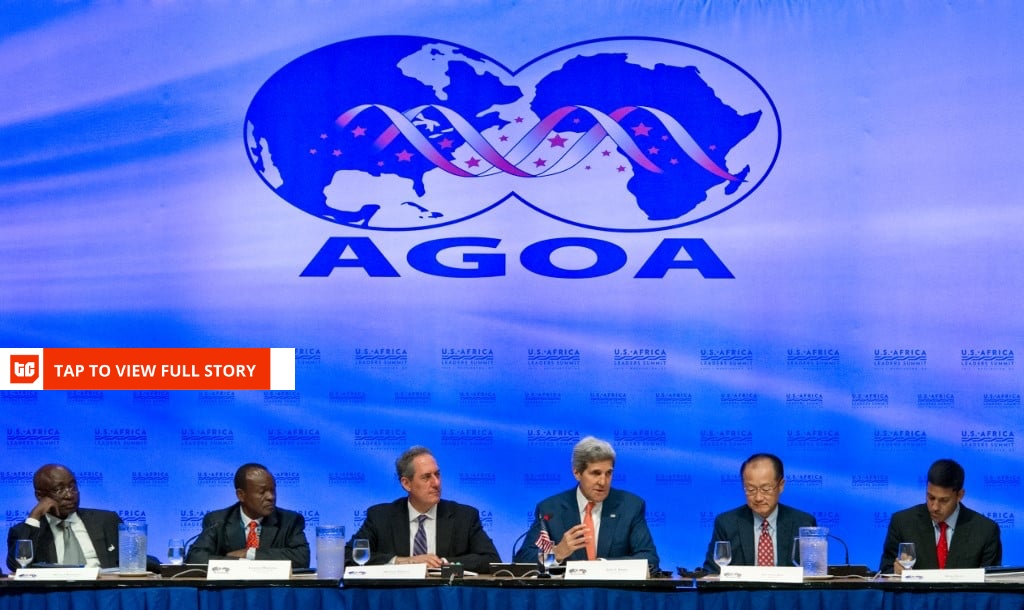
The United States (US) government has renewed the African Growth and Opportunity Act (AGOA), a trade agreement that offers duty-free access to the US market for selected goods.
The renewal will run through December 31, 2026, extending access to the American market for eligible African exports and offering a political lifeline to countries betting on digital trade for jobs and growth.
Kenyan officials and industry groups had warned that more than 66,000 export processing zone (EPZ) jobs and as many as 800,000 livelihoods, including 3,000 to 7,000 tech‑related roles tied to export processing, could have been hit after US President Donald Trump signalled that AGOA could be scrapped as part of a wider tariff move.
That prospect raised the stakes had the trade deal lapsed without renewal.
But the renewal lands in a world where the real test for hubs like Kenya will be whether digital exports, including call centre work, software development, and AI data labelling, can still create stable and well‑paid jobs even as Washington sharpens scrutiny of cross‑border data flows and digital services.
Kenya has spent years cultivating its “Silicon Savannah” brand, building an IT‑enabled services sector that ranges from business process outsourcing (BPO) to niche AI annotation outfits serving large global tech firms.
Information and communication technology (ICT) export earnings fell from KES 227.0 million ($1.76 million) in October 2025 to KES 208.1 million ($1.61 million) in November, according to data by the Kenya National Bureau of Statistics (KNBS). ICT imports grew from KES 4.4 billion ($34.1 million) to KES 5.1 billion ($39.5 million) over the same period, widening the trade gap and underscoring the growing weight of digital payments and the labour market.
That concentration makes the jobs pipeline highly sensitive to policy signals from the US. A tariff on specific digital services or a new data‑localisation rule can prompt large clients to shift contracts overnight, leaving Kenyan firms scrambling to fill capacity and workers watching their shifts disappear.
Kenya’s official unemployment rate of about 5.6% obscures an economy in which more than four in five non‑farm workers operate without formal contracts or social protection.
For those workers, fewer US‑facing contracts mean weaker earnings and thinner remittance flows to their families.
Industry lobby group Kenya Association of Manufacturers (KAM) said on Tuesday that the extension helps firms avoid supply chain disruption and order cancellations that had started to weigh on export planning in late 2025.
“The United States of America is one of Kenya’s most important trading partners, accounting for about 9% of our external market. Kenya’s exports to the USA stood at $788.6 million in 2025, compared to imports of $930.8 million,” Tobias Alando, the CEO of KAM, said.
AGOA’s renewal keeps Kenya among countries with preferential access to the United States market, buying time for exporters, but it does little to slow the shift towards tighter checks on digital trade tied to national security and data privacy.