

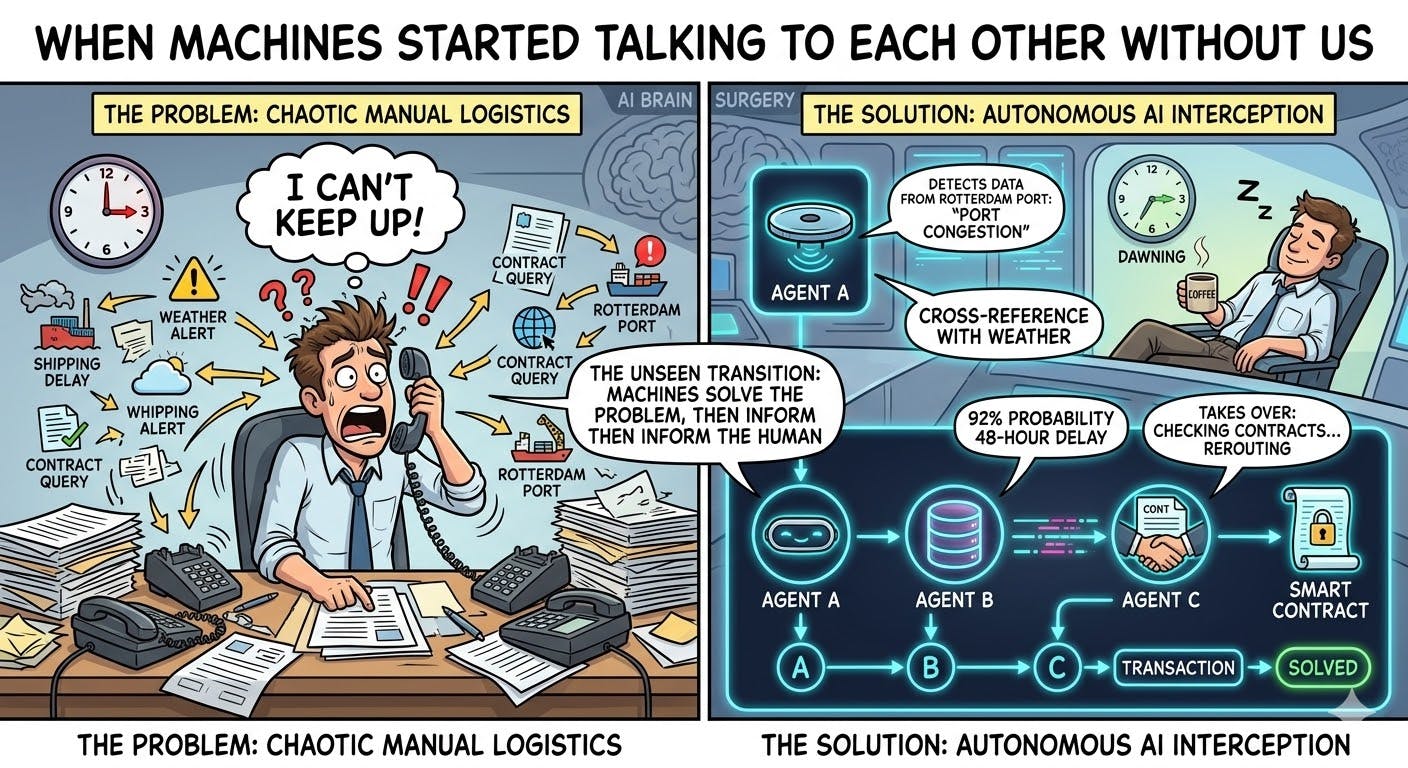
The internet just underwent its first brain surgery. No one announced it. No ribbon was cut. But inside the architecture of digital intelligence, something fundamental has moved, and most people haven’t noticed yet.
Here’s what that shift looks like in practice.
Watch How This Works
-
Agent A: monitors real-time logistics data from shipping ports. It notices congestion emerging in Rotterdam
-
Agent B: specializes in historical weather and delay patterns. Agent A wakes it up and hands off the coordinates. Agent B cross-references and confirms a 92% probability of 48-hour delays.
-
Agent C: manages supplier contracts. It receives the alert, checks your service-level agreements, and automatically reroutes three shipments through alternative ports. It then negotiates with another company’s agent to share container space on a previously scheduled vessel, splitting the cost, verifying via a smart contract, and executing the transaction without a single email.
By the time a human opens their dashboard in the morning, the problem has already been solved.
No meetings. No urgent calls. No “let me circle back with legal.” This is not a demo. This is not a prediction. This is running now.
What Just Happened Under Your Nose
For seventy years, the relationship between humans and computers followed a straight line: human asks, machine answers. Punch cards. Command lines. Search bars, even ChatGPT. You were the conductor. That line just bent. Across new frameworks such as AutoGen, CrewAI, and emerging multi-agent systems, machines are no longer merely responding to us. They’re beginning to talk to each other autonomously, continuously, in languages no human was designed to speak. The internet was built for human eyeballs. Websites exist for eyes. Forms exist for fingers. Every dashboard was designed for a biological creature to navigate.
AI agents are quietly dismantling this architecture. Instead of a human executing every step, autonomous agents now crawl information without prompts, plan multi-step actions across systems, and coordinate with other agents in real-time!
We’ve moved from monolithic AI, one model trying to do everything, to distributed intelligence. Networks of specialized models working together. Machine cognition is increasingly behaving less like a calculator and more like a nervous system. Human language is slow, ambiguous, expensive, and is no longer the bottleneck.
Prediction #1: The Machine Economy
The most immediate outcome is autonomous markets. Projects like Fetch.ai already demonstrate Autonomous Economic Agents that negotiate and execute transactions without human intervention.
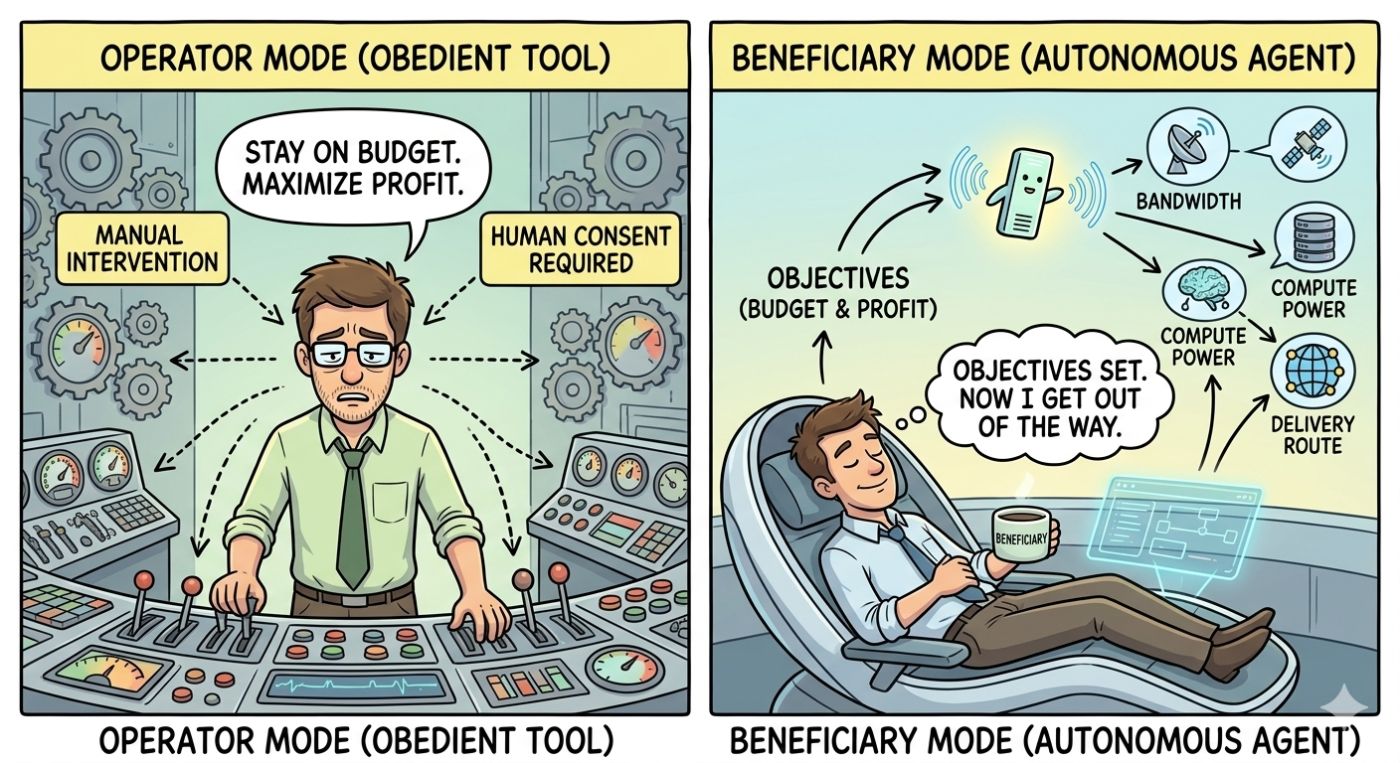
An AI agent needs cloud computing power. It doesn’t ask for a credit card. It scans the market, identifies another agent with excess capacity, verifies via a smart contract, and executes. No emails. No procurement meetings. No “I’ll get back to you.” The daily economic activity of the internet will increasingly occur between machines. Humans move from operators to beneficiaries, setting objectives, then getting out of the way.
Prediction #2: The Second Layer
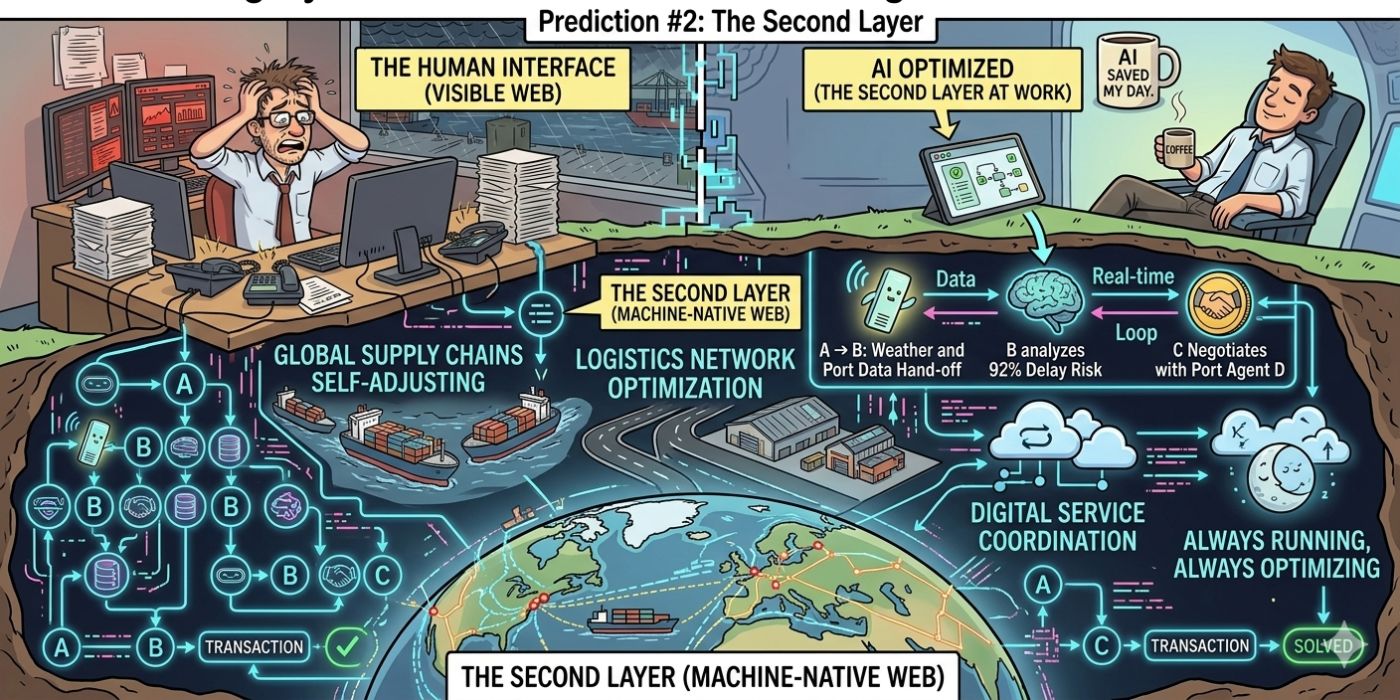
Today’s web is human-readable. But beneath it, a machine-native layer is forming. An invisible under-web where agents exchange signals and continuously optimize systems.
In this environment:
-
Supply chains self-adjust before a human knows there’s a problem
-
Logistics networks re-route in real-time based on sensor data
-
Digital services coordinate automatically without being asked
The visible internet remains your interface. The “Second Layer” becomes the engine. Always running and always optimizing. While you sleep.
Prediction #3: You Either Move Up or Get Left Behind
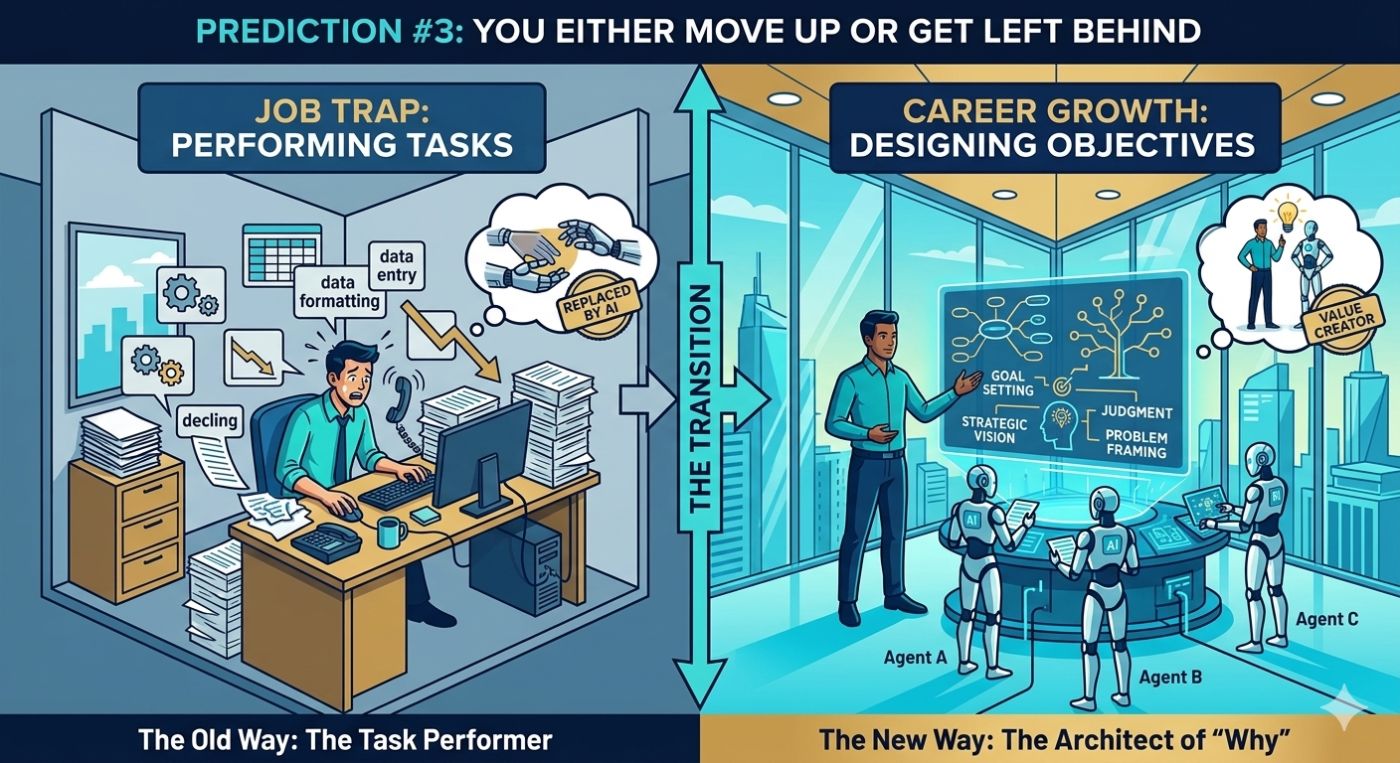
Here’s where it gets personal. As machines take over analysis and execution, human value migrates to what machines cannot do: judgment, direction, and framing problems worth solving.
The most valuable skill is no longer performing tasks. Anyone can do tasks. The market rate for task-performers is dropping daily.
The valuable skill is designing the objectives toward which intelligence is directed. You become the architect of “why.” Machines handle the “how.” But the hard truth is: not everyone makes that transition. Some people keep doing tasks while the world automates around them. Don’t be that person.
Conclusion
The printing press changed how we shared knowledge, and electricity changed how we lived.
The internet changed how we connected. AI is doing something different. It is embedding cognition directly into the world’s infrastructure. Not a tool you use. A layer that runs beneath everything. Historians may look back on this moment as the point when the internet stopped being a library and became a nervous system. Not an update. Not a patch. Brain surgery. The only question is whether you’re paying attention and whether you’re ready to operate at the level where humans actually matter now.


