AI trust increasingly determines whether enterprise AI scales. As organizations move beyond pilots and into operational systems, the question is no longer whether models perform well in isolation, but whether the infrastructure beneath them can withstand cyber risk, data integrity failures and real-world disruption.
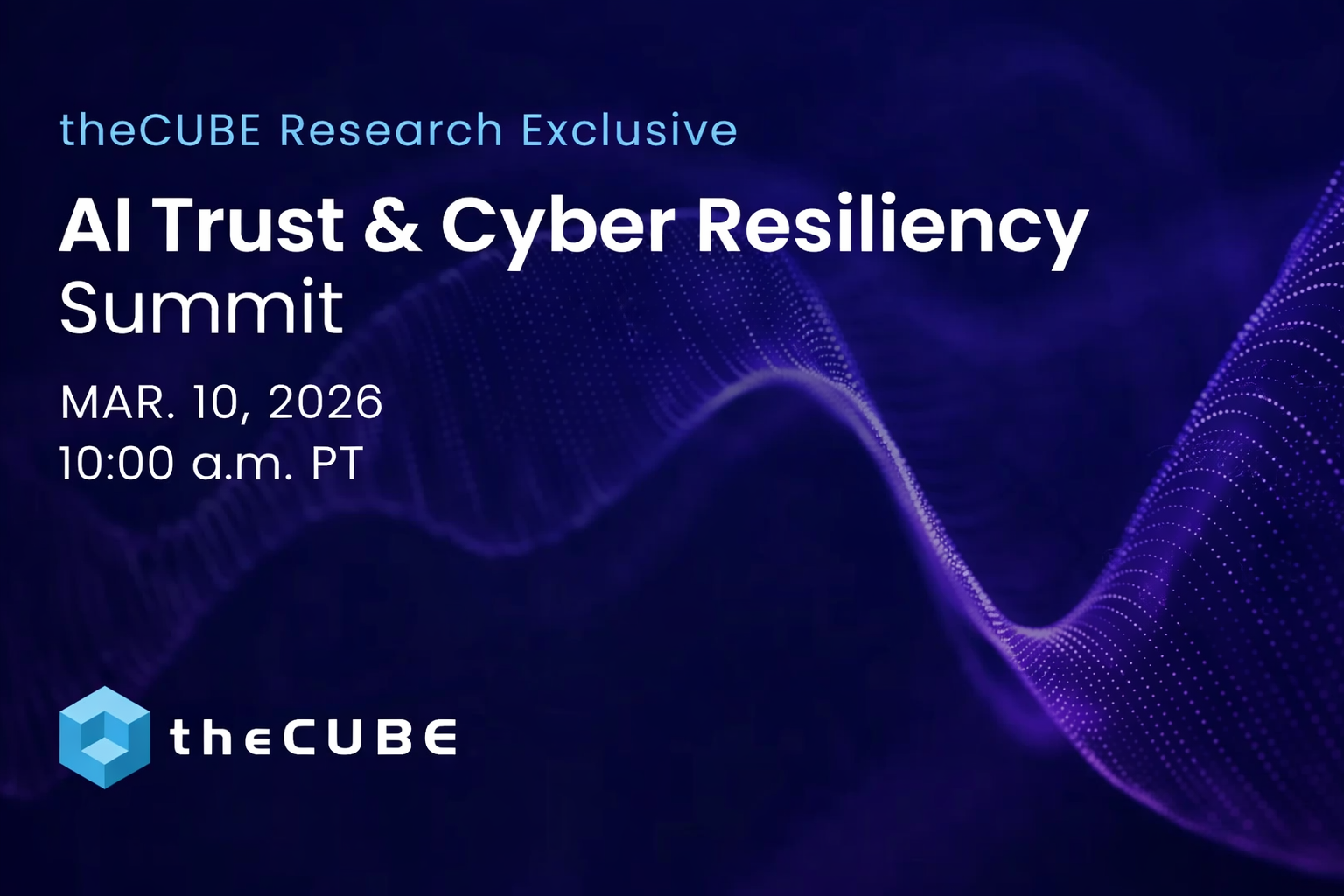
AI adoption continues to outpace data, identity and security readiness. That widening gap between ambition and operational resilience is at the center of the upcoming AI Trust & Cyber Resiliency Summit, taking place on Mar. 10, where Christophe Bertrand and Scott Hebner, theCUBE Research principal analysts, will examine how enterprises are building secure foundations for production AI.
“AI projects don’t fail first on capability; they fail first on trust,” Hebner said. “Until enterprises can verify and defend outcomes, autonomy stays trapped in low-stakes use cases. This is what this summit is all about.”
Bertrand positions cyber resiliency not as a supporting layer, but as the structural backbone of enterprise AI — where data governance, protection and infrastructure converge.
“There is no trusted AI in the enterprise without a cyber-resilient IT and data foundation,” he said. “And without trusted, compliant and governed data, AI credibility collapses before it ever scales.”
Join theCUBE, News Media’s livestreaming studio on Mar. 10 for exclusive coverage of the AI Trust & Cyber Resiliency Summit. TheCUBE’s interviews will explore how enterprises are building secure, governed foundations for AI, how NIST-aligned frameworks and cyber-resilient architectures are being operationalized, and how chief information officers and chief information security officers are redefining trust as a measurable, enforceable standard in production AI environments. (* Disclosure below.)
Building AI trust through zero-trust architecture
Industry leaders are increasingly extending zero-trust principles into AI workloads. The emphasis is on continuous verification, strict access controls and compartmentalization — treating AI systems as dynamic environments that must be secured in use, not just at deployment, according to Anjali Telang, senior principal product manager of OpenShift Security and Identity at Red Hat. Rather than rebuilding infrastructure from scratch, organizations are adapting Kubernetes-native controls and identity frameworks to enforce trust at runtime.
“Zero trust in general means that you trust no one, you always verify, and then you base that verification on an identity, and then you trust the person,” Telang recently told theCUBE. “With AI, we want to sort of bring in the same trust that we already have built into the system. We want to make sure that the users, the machine, all the trust that we have brought in with the best practices around that, translates to AI workloads, AI agents.”
That posture extends to digital sovereignty and confidential computing, where protecting data in use becomes as important as securing it at rest or in transit. As AI systems ingest and act on globally distributed data, enterprises are reexamining who controls workloads, where encryption boundaries sit and how governance policies travel across hybrid environments.
These are the kinds of architectural questions expected to surface at the summit, particularly from leaders at data-intensive and regulated enterprises such as Experian PLC, Capital One Software, a division of Capital One Financial Corp., and Thomson Reuters Corp. As AI becomes embedded in credit, financial services and legal workflows, the operational definition of trust shifts from aspiration to enforcement.
“When we think about how AI is transforming the world, it’s also transforming what the adversaries are doing, and the speed at which they’re moving has changed dramatically,” said George Kurtz, chief executive officer of CrowdStrike, during a recent interview with theCUBE. “It used to be weeks, then days, then hours and minutes. Now it’s seconds. The traditional SOC can’t keep up.”
For theCUBE’s Hebner, the issue goes beyond perimeter defense and into operational design: “In the agentic era, trust is the real scaling factor,” he said. “Without it, every workflow becomes a pilot, every decision becomes a debate, and ROI becomes optional.”
Hebner further believes that scaling AI requires rethinking architecture itself, not just tooling: “The next frontier isn’t smarter agents. It’s agents whose decisions are audit-ready by design. Trust is the architecture,” he added.
Shadow AI and agentic risk reshape governance
At the identity layer, a new challenge is emerging: Shadow AI. Okta Inc. recently announced new features to help organizations address this invisible expansion of unsanctioned AI agents operating with OAuth grants and long-lived nonhuman identities. Gartner reports that 69% of organizations have evidence of employees using prohibited generative AI tools, and predicts that more than 40% of enterprises will face security or compliance incidents linked to unauthorized shadow AI by 2030.
“AI agents don’t operate at the network, endpoint or device layer — they live in the application layer and use multiple non-human identities with broad, long-lived privileges,” said Harish Peri, senior vice president and general manager of AI security at Okta. “By discovering and mapping every agent and its permissions, Identity Security Posture Management within Okta for AI Agents gives organizations the visibility and governance they need to secure both sanctioned and shadow AI at scale.”
As enterprises rethink identity, policy and workload segmentation, Zscaler’s CEO Jay Chaudhry underscores the need to eliminate implicit trust assumptions across all infrastructure layers.
“In the Zscaler Zero Trust Everywhere principle, you get the badge, but then you get escorted to meeting room A, and when the meeting happens, you get escorted out,” Chaudhry said in a recent interview with theCUBE. “In this metaphor, the room is like an application, and the building is like a data sync. It’s a one-to-one connection — that’s what we do.”
Beyond identity, telemetry and behavioral detection are becoming critical to defending against AI-driven threats, as evidenced by Cribl Inc.’s recent strategic partnership with DeepTempo. The partnership highlights how AI-powered log analysis and unified telemetry management can detect polymorphic and agentic attacks with high fidelity while reducing operational complexity. The emphasis is not only on stopping breaches, but on maintaining governance across rapidly evolving AI systems.
For theCUBE’s Bertrand, cyber resiliency is not a supporting function but a gating condition: “There’s simply no trusted AI in the enterprise without a prerequisite cyber-resilient IT and data infrastructure,” he said. “Resiliency at the core is what enables autonomy at scale.”
Data integrity remains the foundation beneath enterprise AI systems. For example, Congruity360 InfoGov Inc. has emphasized the importance of eliminating redundant and outdated data before it feeds AI systems.
“We’re seeing the early adopters leverage our technology in the reduction of infrastructure costs,” said Mark Ward, chief operating officer of Congruity360. “By eliminating anywhere from 60% to 70% of the data, by eliminating rot, we’re able to reduce the amount of AI compute and AI storage required on the backend.”
TheCUBE event livestream
Don’t miss theCUBE’s coverage of the AI Trust & Cyber Resiliency Summit on Mar. 10. Plus, you can watch theCUBE’s event coverage on-demand after the event.
How to watch theCUBE interviews
We offer you various ways to watch theCUBE’s coverage of the AI Trust & Cyber Resiliency Summit, including theCUBE’s dedicated website and YouTube channel. You can also get all the coverage from this year’s events on News.
TheCUBE podcasts
News’s “theCUBE Pod” is available on Apple Podcasts, Spotify and YouTube, which you can enjoy while on the go. During each podcast, News’s John Furrier and Dave Vellante unpack the biggest trends in enterprise tech — from AI and cloud to regulation and workplace culture — with exclusive context and analysis.
News also produces our weekly “Breaking Analysis” program, where Dave Vellante examines the top stories in enterprise tech, combining insights from theCUBE with spending data from Enterprise Technology Research, available on Apple Podcasts, Spotify and YouTube.
Guests
During the AI Trust & Cyber Resiliency Summit, theCUBE’s coverage will feature discussions with enterprise information and security leaders on the architecture, policies and operating models required to enhance AI trust and reliability. Stay tuned for our complete guest list.
(* Disclosure: TheCUBE is a paid media partner for the AI Trust & Cyber Resiliency Summit. Sponsors of theCUBE’s summit coverage do not have editorial control over content on theCUBE or News.)
Image: News
Support our mission to keep content open and free by engaging with theCUBE community. Join theCUBE’s Alumni Trust Network, where technology leaders connect, share intelligence and create opportunities.
- 15M+ viewers of theCUBE videos, powering conversations across AI, cloud, cybersecurity and more
- 11.4k+ theCUBE alumni — Connect with more than 11,400 tech and business leaders shaping the future through a unique trusted-based network.
About News Media
Founded by tech visionaries John Furrier and Dave Vellante, News Media has built a dynamic ecosystem of industry-leading digital media brands that reach 15+ million elite tech professionals. Our new proprietary theCUBE AI Video Cloud is breaking ground in audience interaction, leveraging theCUBEai.com neural network to help technology companies make data-driven decisions and stay at the forefront of industry conversations.