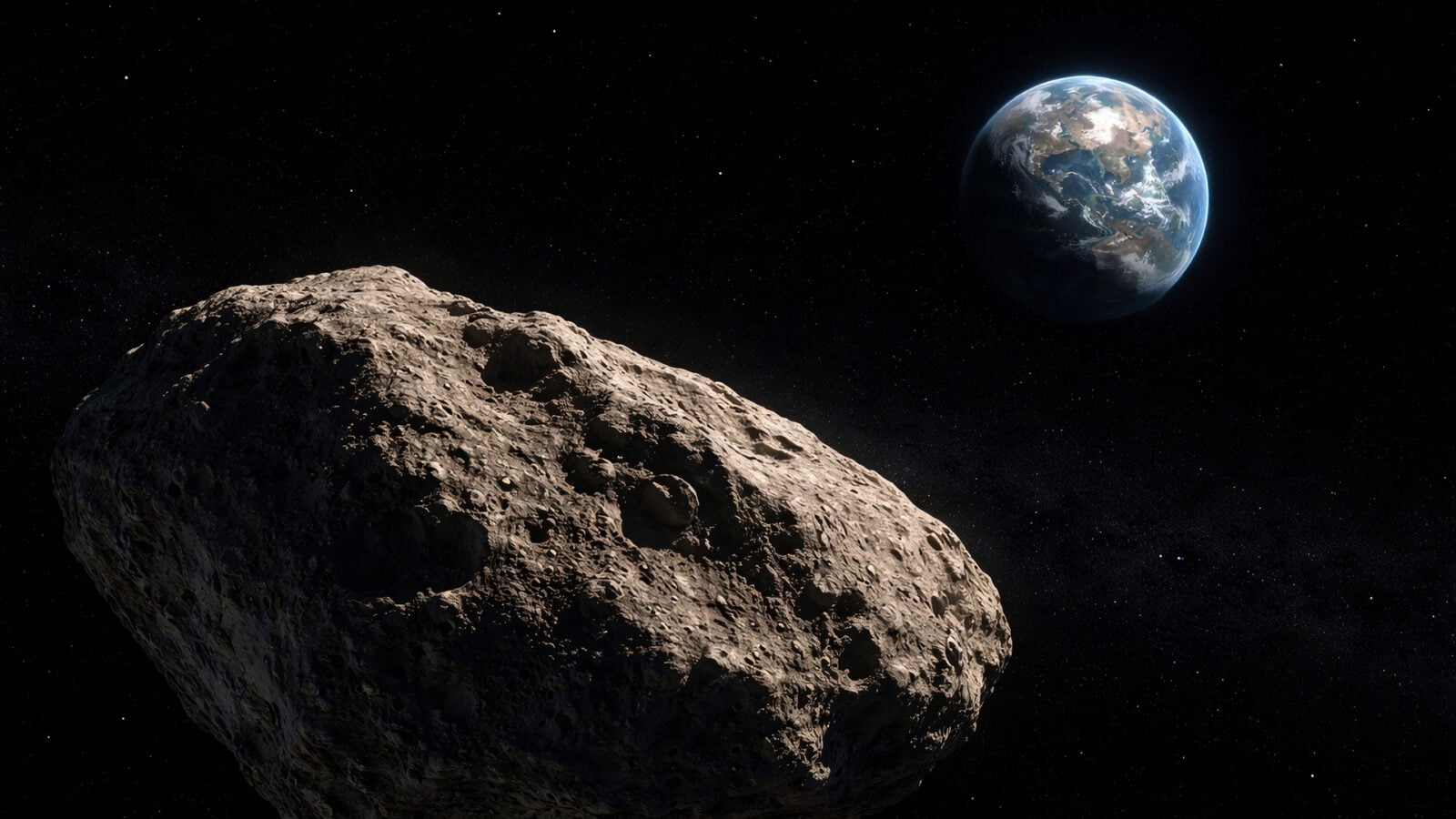
At 12:59 a.m. (Paris time) during the night from Thursday to Friday, an asteroid 16 meters in diameter passed 250,000 kilometers from Earth, or approximately 65% of the distance that separates us from the Moon. With such a size, it is classified among the small asteroids according to the European Space Agency (ESA), equivalent more or less to the size of a beautiful house. Its code name: 2026 GD. Discovered on April 6, it is a surprise visitor, and although this is not necessarily reassuring about our ability to anticipate this type of event, in this specific case, there was no reason to sound the general alarm.
A few hours later, at 2:12 a.m., the asteroid made a closer approach to the Moon, just 163,750 kilometers from its surface. Here again, no danger for our natural satellite, or for the four crew members of the Artemis II mission, about to carry out their atmospheric re-entry in a few hours. If he poses no threat, why do we keep an eye on him and his trajectory ?
An innocent asteroid, too small to panic, but too close to ignore
Yes, 2026 GD is indeed on the NEO Risk List from the European Space Agency; a catalog listing near-Earth objects whose probability of impact with the Earth is not strictly zero. If the name can be frightening, it is simply a watch list which is used to operate statistical sorting to project the risks of impacts over the long term.
In this case, the probability of impact between 2026 GD and our planet was extremely low, since, according to ESA estimates it was estimated at 1 in 124,378. And again, only during its future passages which will take place between 2082 and 2124: a calculation of cumulative probabilities, over several simulated passages.
Indeed, this asteroid will come back to say hello after last night’s brush, because it continues an elliptical orbit of 644 days which takes it beyond Mars before bringing it back towards the Sun. This is why it periodically crosses the vicinity of the Earth: it is prisoner of solar gravity, which forces it to complete the same orbit. Its next notable encounter will not even be with us: it will be Venus, in July 2031, and it will come even further away (around 9.6 million kilometers).
However, asteroids like 2026 GD, even if there are an incredible number of them, are always interesting for different reasons. Firstly, because late detections like this make it possible to test the responsiveness of our global alert protocols. To a lesser extent, they are also a great way to validate our orbital prediction models by comparing the actual position of the asteroid with the initial ephemerides from the first observational data. As soon as an object of this type passes through our neighborhood, it enriches the databases on which the effectiveness of planetary defense will one day depend. if a slightly more threatening asteroid were to come and tickle our orbit too closely. While waiting for the next one, we have other topics what to really worry about down herewhich have nothing to do with asteroids.
🟣 To not miss any news on the WorldOfSoftware, follow us on Google and on our WhatsApp channel. And if you love us, .