Executives from big technology giants including Google LLC, Microsoft Corp. and Amazon.com Inc. met at the White House today, where they made the solemn promise to bear the cost of new electricity generation to power their data centers.
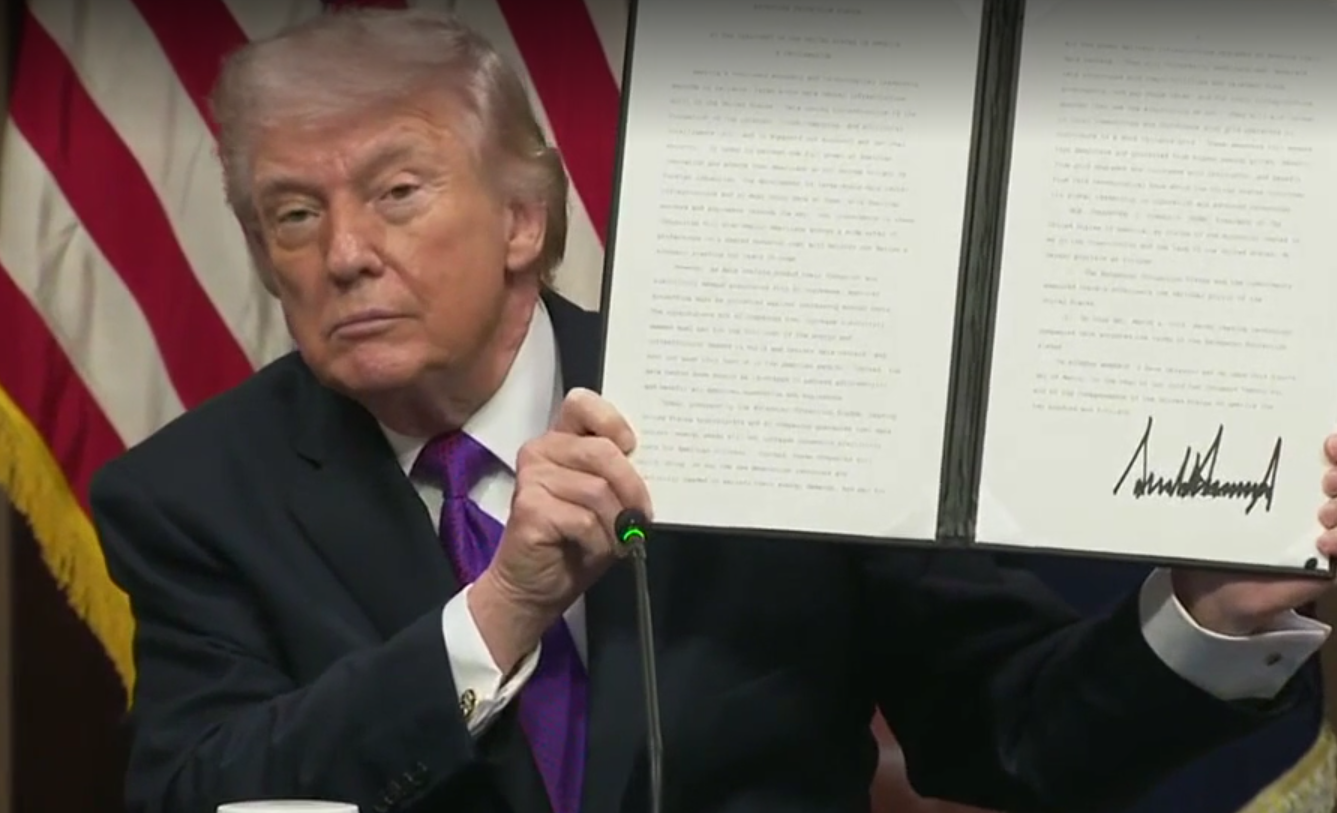
The companies signed a pledge alongside U.S. President Donal Trump (pictured) to try to mitigate concerns that artificial intelligence data centers are driving up the cost of electricity for U.S. households and small businesses at a time when the country battles inflation. “This means that the tech companies and the data centers will be able to get the electricity they need, all without driving up electricity costs for consumers,” Trump said at the signing event. “This is a historic win for countless American families and we’ll also make our electricity grid stronger and more resilient than ever before.”
Trump announced the voluntary “Ratepayer Protection Pledge” during his State of the Union Address, and today he vowed that consumers will soon see their electricity bills decrease as a result of the initiative. “They’re not going to be going up. They’re going to be actually going down,” he said. “In short, America’s largest and richest tech companies will be funding a colossal expansion of U.S. energy.”
Data centers consume vast amounts of energy to run the thousands of servers and cooling systems needed to power AI applications such as ChatGPT, and the fear is that this demand will outstrip available supply, leading to higher costs for everyone. “Some data centers were rejected by communities for that, and now I think it’s going to be just the opposite,” Trump said, referring to dozens of canceled or postponed data center projects across several U.S. states.
The pledge included a commitment by the tech firms to create new energy for their data centers, either by building new power plants or expanding existing facilities, so they’re not tapping into existing capacity. The companies have also committed to paying for the required upgrades to energy delivery systems.
Executives from Oracle Corp., xAI Corp. and OpenAI Group PBC also signed the pledge. Anthropic PBC was notably absent from the signing ceremony, which is not surprising considering that it recently drew ire from Trump after refusing to lift its safety guardrails, preventing the Department of Defense from using its systems in autonomous weapons or for mass surveillance.
Trump responded by ordering all federal agencies to stop using Anthropic’s tools, and designated the company as a “supply chain risk.” However, Anthropic is one of a number of AI companies that have made individual commitments to protect consumers from rising energy costs.
The pledge comes at a time when Americans are becoming increasingly concerned about their household energy costs, but experts say it will be almost impossible to enforce, especially considering that it’s entirely voluntary. None of the companies would face penalties for not complying, although they may fear getting on the wrong side of Trump.
John Quigley, a senior fellow at the Kleinman Center for Energy Policy at the University of Pennsylvania, told the BBC that the U.S. electricity industry is extraordinarily complex, with multiple layers of government, grid managers and electricity regulators involved in power projects. “The burden of proof is on them,” he said, referring to Trump’s administration. “They have to prove this is more than just a stunt.”
Trump vowed to cut electricity bills during his election campaign, and promised to do so within the first year of returning to the White House. But data from the U.S. Energy Information Administration shows that residential electricity prices increased 6% on average in 2025. It’s believed that AI’s energy demands played a big role in that increase.
Even if the AI companies do try to make good on their pledges, they may struggle to bring enough new power supplies online in time to ease the pressure on local grids, said Jon Gordon, senior director at the clean energy trade group Advanced Energy United. Gordon told The Guardian that Trump’s focus on building more fossil fuel-based power centers rather than clean energy facilities could be problematic, as they take longer to bring online. “The problem is the inability to get generation online fast enough to meet data center demand,” he said. “Hyperscalers paying for the generation doesn’t mean it gets online any faster.”
Image: Fox News/YouTube
Support our mission to keep content open and free by engaging with theCUBE community. Join theCUBE’s Alumni Trust Network, where technology leaders connect, share intelligence and create opportunities.
- 15M+ viewers of theCUBE videos, powering conversations across AI, cloud, cybersecurity and more
- 11.4k+ theCUBE alumni — Connect with more than 11,400 tech and business leaders shaping the future through a unique trusted-based network.
About News Media
Founded by tech visionaries John Furrier and Dave Vellante, News Media has built a dynamic ecosystem of industry-leading digital media brands that reach 15+ million elite tech professionals. Our new proprietary theCUBE AI Video Cloud is breaking ground in audience interaction, leveraging theCUBEai.com neural network to help technology companies make data-driven decisions and stay at the forefront of industry conversations.