The two times I have been to China, two things about its automobile fleet have caught my attention: the furor for electric cars in terms of brands, models and dealerships, because you can almost find one on every corner of any central street in the big cities. And on the other side of the coin, I was also struck by the enormous amount of motorbikes (scooter is saying a lot) and cars without licenses parked in any side and circulating any manner.
Don’t call it a light quadricycle, rather say laotoule. There they are known as “laotoule”, something like the joy of the old man. Because if in Spain the light quadricycles you see are usually driven by older people, in China too. They began to be seen back in the 90s through modifications of three-wheeled tuk-tuks in rural areas, although today they have capacity for up to five people and have the most diverse aesthetics.
From occasional mobility to a vehicle for everything. Although the older ones are the star group, they are not the only ones: they are vehicles with very clear profiles of occasional use and short and (relatively) simple trajectories. As China Daily reports, these vehicles are the main means of transportation for running errands or picking up elderly grandchildren, but in recent years they have expanded their range to younger people: they offer a closed space and solve the problem of having to travel at a low cost.
According to the China Electric Vehicle Association, annual sales of these non-highway lightweight quadricycles rose from 1.1 million in 2017 to 2.1 million in 2023, of which 1.4 million went to seniors. According to an investigation by Banyuetan, the magazine linked to the official Chinese news agency Xinhua, these cars are flooding rural roads and urban peripheries. And its proliferation has aroused the suspicion of the authorities.
The legal vacuum of Laotoule. Because unlike Spain, where any motor vehicle requires a technical sheet and a license plate, in China they have been marketed as if they were devices for personal mobility, something like a scooter or an electric wheelchair. Thus, the bulk of laotoule are sold without registration or approval or the need to pass their ITV. In fact, they are increasingly sold online as low-cost imitations of luxury cars.
There is even a Porsche Cayenne without a license. Because there are brands and models of Chinese electric cars to bore, in a light quadricycle version, too. In fact, there are even Maseratis and Porsche Cayenne models, or rather, Maserati style and Porsche style, because they are not official from the respective houses. And because the Maserati costs about 3,200 euros in exchange. It’s all about taking a look around the Alibaba website and finding models for all tastes, like this Mini.
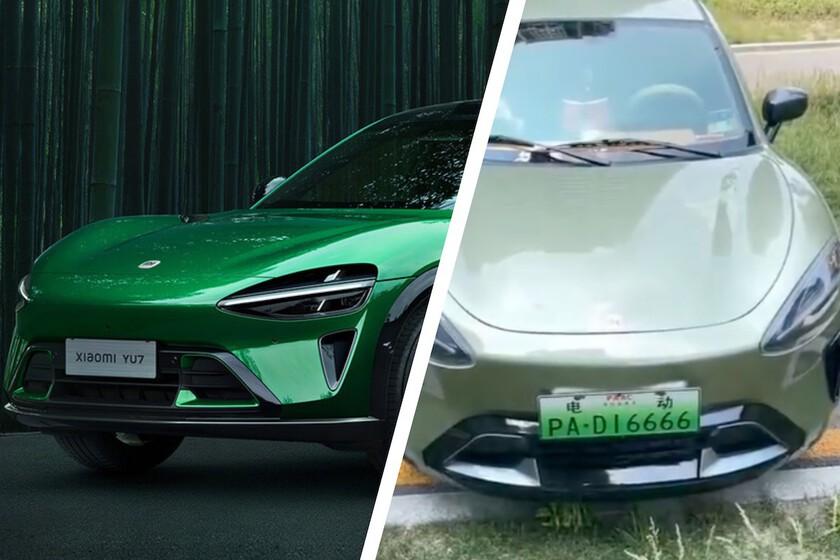
There is also a license-free version of Xiaomi’s second electric car, the ambitious Xiaomi YU7, as you can see below these lines. From afar they hit the mark, up close ya tal. Under that attractive bodywork they hide electric motors of low or medium power and a top speed of up to 70 km/h.
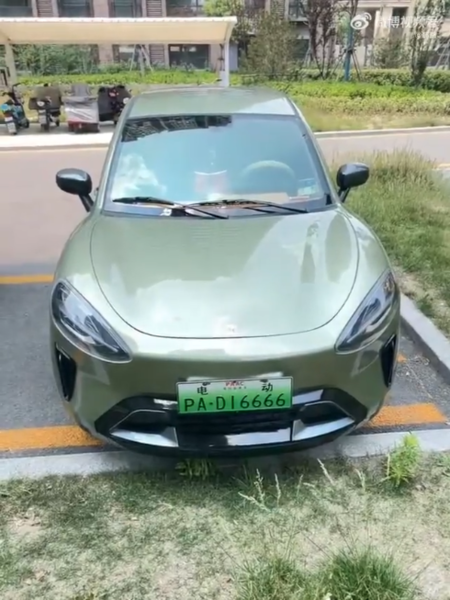
Tap to go to the post. The card-free version of the Xiaomi YU7
The real problem is road safety. Leaving aside industrial property issues, laotoules look like miniature cars but they are not: they lack basic elements that are found in passenger cars, such as steel frames or airbags. Banyuetan’s report echoes a fatal hit by a 59-year-old driver in a laotule in Hebei, northern China.
From prohibition to regulation. Some local administrations have already made a move: since January 1, 2024, cities such as Luoyang and Beijing banned low-speed three- and four-wheeled electric vehicles from circulating on public roads.
However, there is a middle path: China issued regulations on technical specifications and safety requirements for electric vehicles, finally classifying laoutoule as motor vehicles. From here and as Lu Yong, researcher in the low-speed electric vehicle sector for Sixth Tone, explains:
“We must recognize the real demand for low-speed vehicles and strengthen the design at national level, both for industry development and traffic management. Clear and enforceable rules must be quickly introduced for both product and driving standards, as well as for road access.”
In WorldOfSoftware | China has so many electric cars running on its streets that it is going to use them to generate energy for homes
In WorldOfSoftware | China is the only country in the world where car prices are falling. So much so that the Government is taking measures