The history of Volkswagen goes a long way. So much so that its origins have to be sought in Nazi Germany when the State commissioned Ferdinand Porsche to create a Volkswagen. That is, a car for the people. It was 1934 but with all the state machinery working on a piece-rate basis, in 1938 the first stone of the Wolfsburg factory was already being laid, taking as an example the Ford factory in Dearborn, United States.
Since then Volkswagen has not stopped growing. With its good moments and also its bad moments, the truth is that the company has established itself as the second largest car producer in the world, only surpassed by Toyota and in a comfortable position compared to Hyundai-Kia, which remains in third position.
In these ideas and comings, the company has maintained a recipe: the German industry is not touched. Until now. In the midst of the reconversion of the European automotive industry, Volkswagen seems to have crossed a red line.
Why does an electric car have less autonomy than advertised?
for the first time
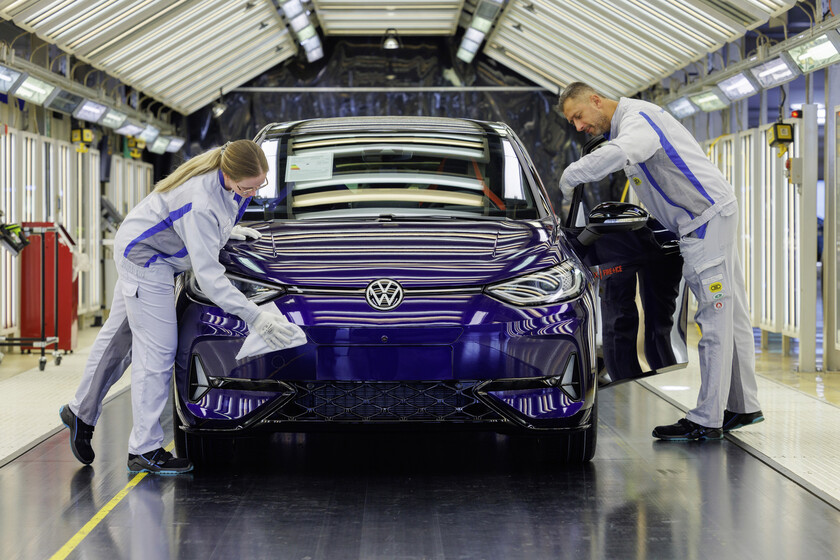
It was 2018 when WorldOfSoftware We went to the Volkswagen glass plant in Dresden for the first time. There, the company had been producing its Volkswagen Phaeton, a luxury sedan that ended up being a drain on millions and, above all, a resounding sales failure.
The company had converted the space into a laboratory to produce the first e-Golf there, one of the first steps that the company took in the purely electric car market. Its productive volume was almost ridiculous If we compare it with any current plant: 72 cars a day.
In 2022, we had the opportunity to return. The factory had changed completely. At least in his spirit. It was still producing electric Golfs… more or less. And that’s where their ID.3 came from, Volkswagen’s first big bet that had been born with the spirit of being its first best-seller and positioning itself as the new electric Golf. Production had already fallen by half, to about 35 cars a day.

Now, Volkswagen has shelved the plant. The glass space is converted into a university center. The movement has much more to say in the symbolic field than in the practical one. The 230 workers have three options on the table: dismissal with negotiated compensation, retirement or transfer to another factory.
But the closure of the German plant goes much further. For the first time, Volkswagen has to cease production at a plant in Germany. Its production, as we have seen, was very low and the center was intended more for development and innovation than for nourishing the German fleet. However, the move is important because it demonstrates the extent to which the company is struggling.
Dresden wasn’t just a car plant, it was status. It was a declaration of intent, the confirmation open to the world that Volkswagen invested in cars that were not profitable in the short term but from which they could extract knowledge in the future. Thomas Schäfer, CEO of Volkswagen, said that the closure of the factory “was essential from an economic perspective.”
A little over a year ago, Volkswagen already announced that it intended to cut its production in Germany, to the point that it assured that “all factories in Germany are in danger.” They were the first steps of a savings plan of 10,000 million euros over three years.
The company had decided to bet heavily on the electric car but European demand It does not seem to have been enough until it grew very recently. In Europe, Tesla has been making a strong splash until last year but, above all, customers didn’t seem to be interested in Volkswagen’s more affordable electric cars like the ID.3. Nor in the most expensive ones, like the Audi e-tron that ended with the closure of a shop in Brussels. Porsche is already retracing the path of electric car investments.
Volkswagen has encountered a perfect storm with three open fronts. In Europe, as we said, the customer is not buying the expected electric cars, which puts the amortization of investments at serious risk. In the United States, the tariffs applied by Donald Trump’s Government have caused losses of 1.5 billion dollars in the last quarter alone, it reported. The New York Times. And in China the customer has turned their back on the European product.

That has put too much pressure on cash flow, forcing Volkswagen to get rid of space that went far beyond a car plant by renting it out to the local university. The problem is that when financial difficulties force us to think about readjustments in the short term, what suffers are long-term investments (just what was being studied in Dresden), which implies less competitiveness in the future.
A wheel from which it is only possible to escape if, once again, it is possible to sell what the public asks for, with sufficient profit margins to reinvest in the future. And that, they believe in Germany, means taking steps back in electrification.
Photo | Volkswagen
In WorldOfSoftware | In 2017, the owner of an electric car installed a charger with his neighborhood community against him. The Supreme Court has spoken