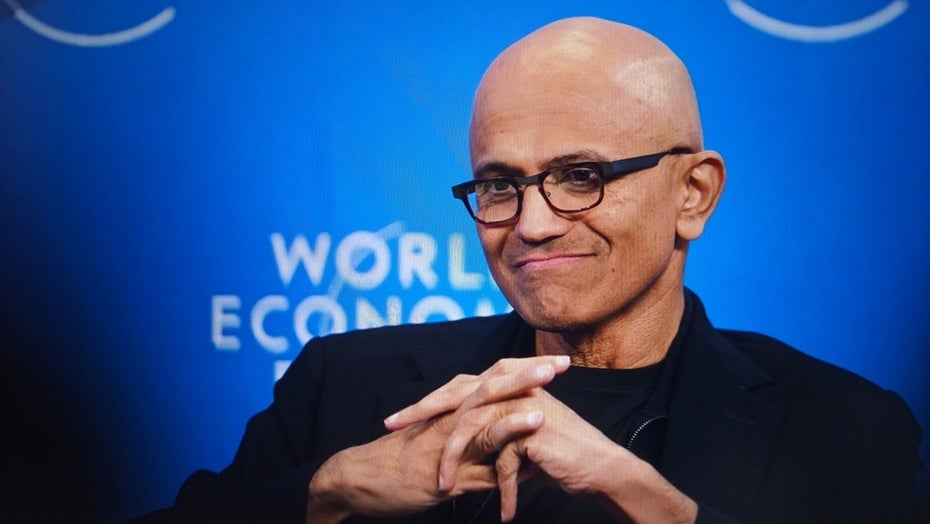
Satya Nadella, CEO of Microsoft, is known for being critical of AI development. Last year he warned against excessive hype without any real added value, which could end in a crash similar to the dot-com bubble. As The Next Web reports, he has now criticized the hidden costs of AI in companies and in this context coined the term “reverse information paradox”. He says companies would pay twice for their AI use – once for the tools themselves and once for the data and secrets they input into them.
Companies pay with valuable knowledge
The Microsoft boss formulated his idea in a long post on X, which has so far received over eleven million views (as of July 14, 2026, 1:30 p.m.). The term “reverse information paradox” is based on the paradox of Nobel Prize winner Kenneth Arrow, who described the problem on the seller side: Anyone who wants to sell information has to disclose it – and as soon as it is known, it loses its value. Nadella reverses this principle. In the age of AI, the risk lies with the buyer: for a model to be useful, it must be “fed” with proprietary knowledge. The more powerful you want it to be, the more you have to give it. “The seller learns more and more about you as you use what you bought,” he writes. “But you learn very little about what the seller learns in return.”
Top Article
${content}
${custom_anzeige-badge}
${custom_tr-badge}
${section}
${title}
The perfidious thing about it is that the knowledge does not escape through security gaps, but through so-called “exhaust”, which roughly means “exhaust gas” in German. This means the prompts that users write, the tools they use, and most importantly, the corrections they make when the model is wrong. Each correction further trains the model. “It’s the kind of knowledge that a competitor could never buy,” says Nadella. “Note by note, correction by correction, evaluation by evaluation.” His conclusion: If learning only flows in one direction, the money flows there too. In the end, the AI providers would benefit more than the companies that own the knowledge. What’s exciting is that Nadella, of all people, is publicly naming this problem – the CEO of a tech company that makes its money in exactly this way.
Microsoft benefits from corporate knowledge
Microsoft has invested billions in OpenAI and is selling Copilot, an AI assistant that delves deep into company data – exactly what Nadella warns about. He addresses this double standard himself in his article. As a solution, he suggests a strict “trust boundary” around a company’s data, ratings and storage. As The Next Web reports, this is a product that Microsoft also sells.
This type of communication is widespread among AI providers. For example, OpenAI boss Sam Altman compared the development of GPT-5 last year to building an atomic bomb – and published the model anyway. The same applies to Anthropic: Co-founder Christopher Olah joined Pope Leo XIV’s calls for more ethics in AI development in the Vatican. Critics then accused the company of “Vatican washing”.