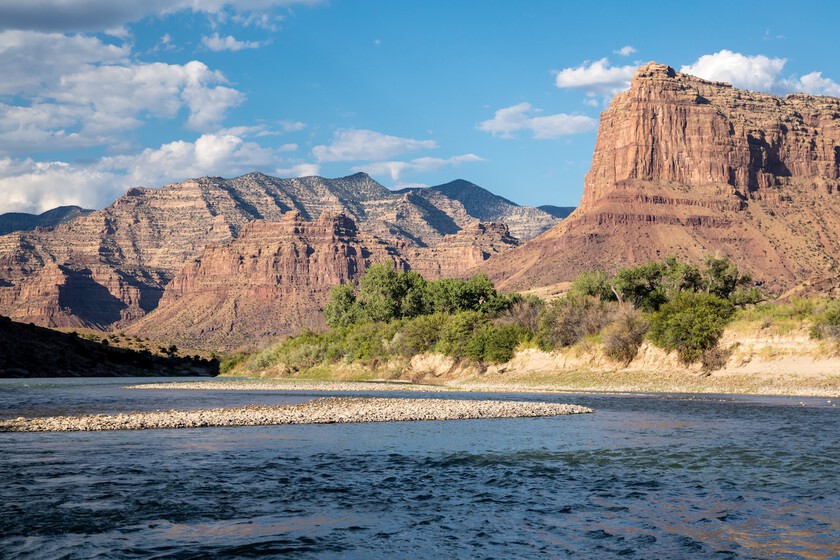
There is no need to brush up on school time to know that rivers begin in the mountains and literally fall to the sea. Essentially gravity takes care of everything. This is how all the rivers on the planet work. What’s more, if you yourself spill a glass of water on the floor you could discover if there is an unevenness. But sometimes there is fine print and it can confuse what at first seems logical.
What’s wrong with the Green River?. Without going any further, the Green River in Colorado (United States) has been making the scientific community think for 157 years because this river flows against all odds, crossing the Uinta Mountains (Wyoming/Utah) instead of surrounding them to flow into the Colorado River. A recent study has found the solution to this mystery by investigating the geodynamic mechanism that makes it possible.
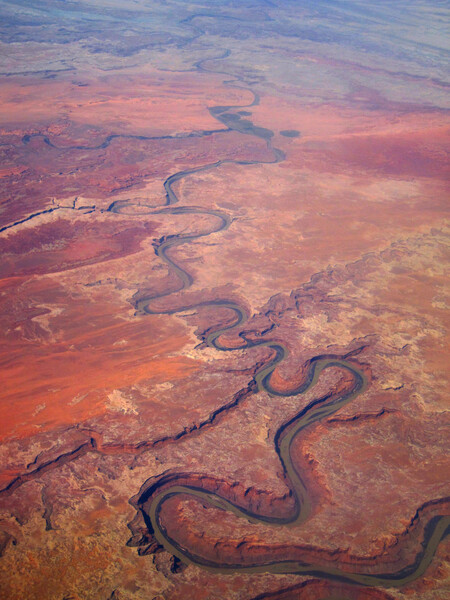
El Río Green in Utah. Drroid41, CC BY-S 3.0
The context. To understand why, it is essential to talk first about those Uinta Mountains, a very particular mountain range in that it unfolds from east to west, unlike the majority of the United States, for almost 250 kilometers. With peaks up to 4,000 meters high, it is also the highest of those arranged in this way. The bulk of the US mountain ranges follow a North-South orientation due to the tectonic forces between the Pacific plates and the North American plate.
The Uintas are the most prominent case of transverse structure and their origin is due to much older faults that were reactivated. More specifically, the Uinta were formed about 50 million years ago. The Green River, for its part, traced its current course less than 8 million years ago where there is something that draws attention: a canyon that the river eroded in the middle of the mountain range about 700 meters long, the Canyon of Lodore.
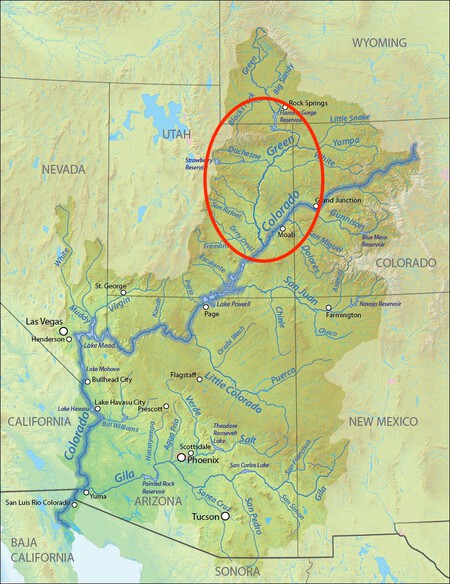
Los afluentes del Colorado. Shannon – Background and river course data from DEMIS Mapserver and The National Map, both public domain, CC BY-SA 4.0
Better to cross than to go around. Rivers flow according to gravity, yes, but also following the path that offers least resistance (in general). Following this basis of geology, it seems a priori surprising that the Green decided to traverse the mountain range instead of through it. The canyon is a mechanical paradox in an environment without active compressive tectonics, that of the Uinta.
The study and the discovery. Rivers have memories, so by studying their current shape you can reconstruct what the terrain was like before. To do this, they used a mathematical model (a 2D topographic inversion of the river networks) that allowed them to reconstruct the ancient topography. Then they detected a rise in the terrain of about 450 meters in the center of the mountain range with a circular pattern. This particularity was validated with a seismic tomography, a type of terrestrial ultrasound that allows us to see hundreds of kilometers beneath the ground, which revealed a lithospheric blob.
What is a lithospheric drop? A dense mass of mountain root that breaks off and sinks into the deep mantle, acting as an internal engine that deformed the surface and allowed the Green River to pass through the mountain barrier. The study’s lead author, Adam Smith, explained in a press release that “We believe we have gathered enough evidence to demonstrate that lithospheric trickling is responsible for pulling the land up enough to allow rivers to link and merge,” thus establishing the permanent channel that remains today.
Why is it important. Because this geological event united two of the largest river systems in North America, thus modifying the drainage of the continent, which also has its implications at the level of biodiversity, as it allowed different species to interbreed. On the other hand, it is the umpteenth reminder that the Earth’s interior continues to shape the landscape, sometimes abruptly, in areas that seem geologically dead.

How it all happened. Using Stokes’ Law and river response time, they estimated that this breakup occurred 2.3 to 4.7 million years ago. The model suggests that this drip first generated a topographic subsidence that allowed the Green River to surpass the barrier of the mountains and begin its incision. When that dense root was removed, the isostatic and dynamic uplift that we see today was generated. In a sentence: first the mountain crouched down to let the river pass and then it rose abruptly, forcing the river to cut through the rock to maintain its course.
In WorldOfSoftware | The US has a plan for its rivers: bombard them with 6,000 logs from helicopters to fix a decades-old mistake
In WorldOfSoftware | Finally we have salmon without an environmental footprint, without overfishing and without microplastics. It’s just not salmon
Flower | Mypublylands, CC by 2.0 via wikimedia