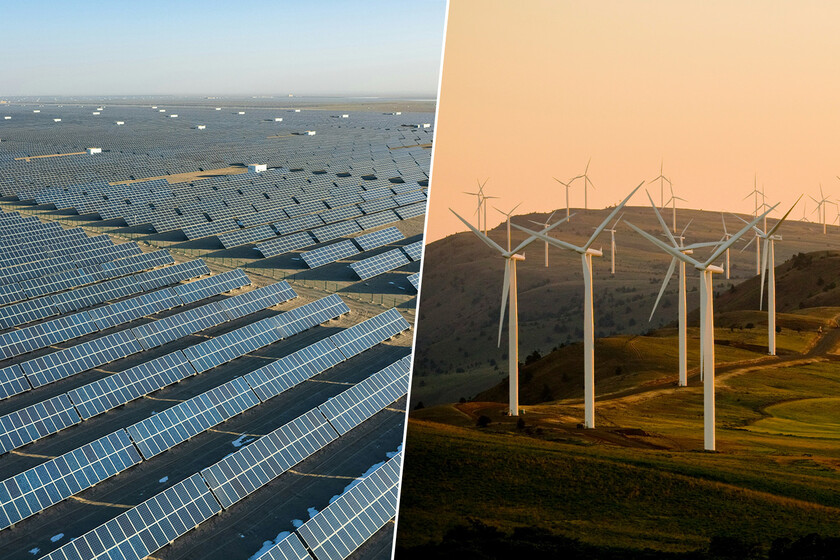
For years, the European energy transition advanced without completely displacing fossil fuels. Last year marked that turning point. According to the report European Electricity Review 2026wind and solar generated 30% of EU electricity in 2025, surpassing coal, gas and oil combined for the first time, which fell to 29%.
As Ember’s Dr. Petrovich explains, we are looking at record growth. It is not normal to go from a 20% to 30% quota in just five years, but the numbers are there. The energy map is changing: there are now 14 EU countries where wind and sun generate more than gas or coal. In this scenario, Spain, Greece or Hungary already play in the league of solar powers.
Beyond statistics. The milestone does not imply that Europe has left fossil fuels behind or that gas has disappeared from the system, but rather that it changes the hierarchy of the electricity mix. For the first time, variable renewable energies come to occupy the center of the electricity mix, while fossils are relegated to a technical and security support role. According to Ember, renewable energies as a whole contributed 48% of the EU’s electricity in 2025, practically half of the total, a figure that remained stable even in a year marked by adverse weather conditions, with less wind and less rain than usual.
Coal, the most polluting fuel in the system, continues its withdrawal. In 2024 it fell to 9.2% of the European electricity mix, a historical minimum compared to the almost 25% it represented a decade ago. Gas, for its part, rose slightly compared to 2024, although it is still 18% below its 2019 maximum, confirming that its role in the system is increasingly residual. This rebalancing has consequences that go beyond the energy mix: dependence on imported fossil fuels continues to be the main source of Price instability and strategic vulnerability in Europe, even apart from the climate debate.
Five years that changed everything. The sorpasso – as it has begun to be called in the sector – is not the result of a mild winter or a stroke of meteorological luck. It is the consequence of sustained growth, especially in solar energy, during the last decade, accelerated very notably in the last five years.
According to the report, solar generation grew by 20.1%, this being the fourth consecutive year with increases of more than 20%, an unprecedented growth rate in European energy history. In absolute terms, solar reached 369 terawatt hours (TWh), more than double that of 2020, and the annual increase in 2025 alone is equivalent to the electrical production of three French nuclear reactors.
A dizzying growth. This expansion responds mainly to installed capacity. In 2025, 65.1 GW of new solar power was added in the EU, distributed almost equally between large plants and self-consumption on rooftops. All EU countries increased their solar production, and in several of them – Hungary, Cyprus, Greece, Spain and the Netherlands – the sun already provides more than 20% of national electricity.
As for wind power, although more affected by the weather conditions at the beginning of the year, it remains the second largest electricity source in the EU, with 17% of the total, above gas. The system, therefore, begins to rely structurally on variable renewables, something unthinkable just a decade ago.
The reverse of success: when gas continues to set the price. Despite the historic advance of wind and solar, 2025 made it clear that gas continues to have a disproportionate weight in the European electricity system, especially in price formation. According to the think tank, gas-fired electricity generation increased by 8% in the EU, mainly to compensate for the drop in hydroelectric energy caused by the drought, and this greater use of gas raised the electricity sector’s import bill to 32 billion euros, 16% more than the previous year.
The impact was especially visible in the electricity markets. Ember detects that price spikes are concentrated in the hours with the highest gas use, while the hours with an abundance of solar and wind tend to make electricity cheaper. In 21 European countries, wholesale prices rose in 2025, driven almost exclusively by these fossil time slots. This is where the paradox of the current system comes in: although gas no longer dominates by volume, it continues to set the marginal price of the market at critical moments. In other words, despite the oversupply, the price structure continues to be conditioned by fossil fuel when there is a lack of wind or sun.
The new energy frontier. Ember’s report devotes an entire chapter to what it sees as the next big front of the transition: storage and system flexibility. Without these pieces, he warns, the sorpasso runs the risk of remaining a statistical victory. This was one of the great deficits of the European transition: investing massively in generation without doing so at the same pace in networks and storage. Batteries are now emerging as the piece that connects renewable success with stable prices and security of supply.
Last year, the EU exceeded 10 GW of large-scale batteries in operation for the first time, more than double that of 2023. In addition, there is a portfolio of projects that could raise that figure above 40 GW if fully implemented. The first signs are already visible in countries like Italy, where batteries have begun to cover part of the demand during peak gas hours, reducing prices and displacing fossil generation.
Physical bottlenecks: European infrastructure. It is not just a question of how much energy is generated, but where it enters and how it circulates within the continent. Europe has reduced its direct dependence on Russian gas, but continues to face physical limitations in terminals, transport networks and cross-border connections. This substitution of Russian gas has been slowed by the slowness in the construction of critical facilities, such as regasification terminals and high-capacity networks, and by the insufficient interconnection between national electrical systems.
This bottleneck explains why countries with abundant renewable production, like Spain, often cannot easily export that surplus, or why the European system as a whole still depends on fossil reserves to guarantee stability in the face of demand peaks.
Sweeping home. According to Ember, wind and solar generated 42% of Spanish electricity in 2025, ten points above the community average. However, Spain was also one of the countries where the use of gas increased the most. Gas generation grew by 19%, not due to lack of renewables, but due to technical needs of the system.
After the blackout in April 2025, Red Eléctrica chose to reinforce the stability of the network by maintaining gas plants in preventive operation. Spain produced more clean energy than ever, but paid as if that were not the case. The system burned more gas than necessary, let renewable electricity escape and closed 2025 as the third most expensive year for consumers, a paradox that is difficult to explain to the average citizen.
The root of the problem is not in generation, but in bottlenecks: eight out of ten nodes in the network are saturated, storage is lagging and connections with Europe are still not up to par. Spain produces clean energy in abundance, but it cannot always use or export it.
Looking to 2026: consolidation or bottleneck? Looking ahead to 2026, Ember is clear: the path to bypass is open, but not guaranteed. If the EU does not accelerate the deployment of batteries, networks and demand flexibility mechanisms, gas will remain the silent arbiter of the electricity system.
In Spain, the regulatory changes approved in 2025 should allow renewables and storage to assume functions that until now fell exclusively to gas. In addition, new pressure factors are now added: the massive arrival of data centers, the rise in electricity tolls and the growing territorial tension on the network.
UA milestone that is not the end. Europe has shown that it is capable of producing more clean electricity than fossil electricity. It is a historical, technical and political achievement. However, what is clear is that generating is not enough.
The true success of the transition will not be measured only in percentages of wind and solar, but in whether that abundance translates into low prices, system stability and less external dependence. He overtaking marks a point of no return. Now the most complex phase begins: converting renewable leadership into economic well-being and energy security for European citizens.
Image | Unsplash and Unsplash
WorldOfSoftware | The water from the Tagus is going to stay in Castilla-La Mancha. So Alicante and Murcia already have a plan B: set up desalination plants