If you’ve followed my coverage over the years, you know I’m usually the first person to tell you to be wary of Intel Arc GPUs. While I’ve always appreciated how “Team Blue” tried to break up Nvidia and AMD’s grip on the GPU market, the driver issues and inconsistent performance of the first wave of Intel Arc GPUs (the Alchemist era) made it a hard sell for anyone who just wanted their games to work.
But the world has changed. Unless you’ve been living under a rock, you know we’re in the middle of a full-blown RAM price crisis that has sent the cost of VRAM-heavy cards into the stratosphere. While Nvidia is (unofficially) hiking prices and even allegedly discontinuing some mid-range cards, Intel is doing the unthinkable: they’re actually making their budget card better.
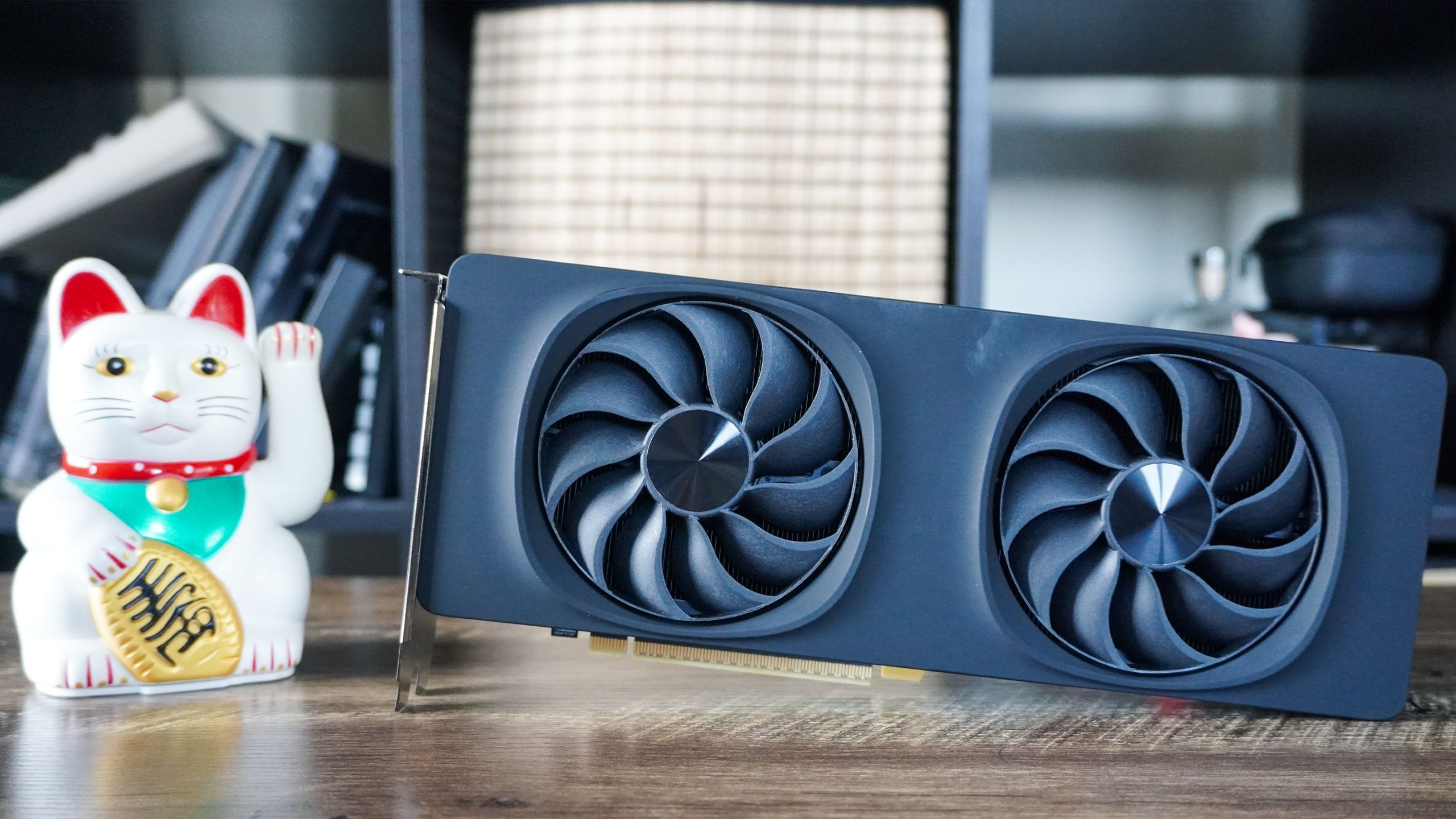
Intel has confirmed to Tom’s Guide via email that the Intel Arc B580 is officially getting XeSS 3 with Multi-Frame Generation (MFG) next month. My colleague Jason England reviewed this card last summer, and between his testing and this new confirmation, the verdict is clear: this is the best budget GPU you can buy. I’ll explain why.
Why the B580 is the sane choice in 2026
I normally wouldn’t recommend a $300 Intel card when you could save up for a GeForce or Radeon equivalent. But in 2026, desperate times call for desperate measures. Being less hyperbolic, if you know you’re getting ripped off by inflated prices, it makes sense to look for alternatives, and the Arc B580 is a legitimately solid choice.
The RAM crisis has tripled the cost of memory, leading to some truly obscene MSRPs from Nvidia, with the once $750 Nvidia GeForce RTX 5070 Ti now costing nearly, or more than, $1,000. Meanwhile, the Arc B580 currently costs $300. Yes, that’s $50 more than its original $249 asking price, but it’s still a great value — especially thanks to its generous 12GB of VRAM.
In Jason’s testing, he found that the 12GB of VRAM and 192-bit bandwidth allowed the B580 to punch above its weight class. We’re talking 1440p performance that actually holds its own. Here are some of the results Jason saw in his testing:
Compare that to an RTX 5060, which Jason notes has significantly less VRAM and lower power. Beyond the “DLSS trickery,” you need raw memory to load complex textures, and Intel gives you that future-proofing for hundreds of dollars less than the competition now that the B580 is getting XeSS 3.
XeSS 3 is the secret sauce

As I stated in the intro, Intel confirmed to Tom’s Guide that XeSS 3 MFG is arriving next month for the Arc B580. Jason has already seen what this tech can do on the Asus Zenbook Du0 (2026), using AI to generate frames, turning a 40 fps slog into a buttery-smooth 120 fps experience.
Then there’s compatibility. Through what Intel calls a “Frame Generation Override” in the Intel Graphics software, you can force-enable this on titles that already support XeSS 2. I got Cyberpunk 2077 to top out at 65 fps with default settings (1800p/Ray Tracing Low/XeSS on) on the Samsung Galaxy Book6 Pro, so I can only imagine how the game will run now that XeSS 3 is live.
A (slight) caveat

While the Arc B580 certainly has its strengths, it has one major drawback. If you like ray tracing in games, you’re going to be disappointed. Jason’s review highlights that RT is the B580’s Achilles’ heel. In Alan Wake 2, performance drops to 45 FPS at 1440p High. While that’s still playable, it’s not as smooth as 60 fps.
Also, if you use your rig for productivity or AI work, the B580 gets smoked by Nvidia’s CUDA cores. In the Procyon AI benchmark, the RTX 5060 still holds a noticeable lead. But for pure gaming? The B580 is the value king.
Bottom line
I never thought I’d see the day when an Intel GPU was my go-to recommendation. But thanks to “RAMageddon” sending prices through the proverbial roof and Nvidia seemingly content to let mid-range gamers deal with 8GB cards (a truly horrific scenario), the Arc B580 is the only card that doesn’t feel like a total rip-off. Right now, it’s a GPU seriously worth considering.

Follow Tom’s Guide on Google News and add us as a preferred source to get our up-to-date news, analysis, and reviews in your feeds.