During the first quarter 2026 earnings conference call, CC Wei, CEO of TSMC qualified Intel of ” formidable competitor » , somewhat departing from the usual communication of the Taiwanese company.
This statement comes as the semiconductor industry shifts into the era ofagentic artificial intelligencewhere each nanometer and each packaging innovation (boxing of components) is worth billions of dollars.
TSMC still dominates the global market with $35.9 billion in revenue in the first quarter of 2026, but recognizes that Intel Foundry is now its main challenger.
Why does TSMC consider Intel a serious threat?
Intel Foundry has become a threat because it is one of the rare players, with Samsung, to have the financial and technical power to compete in cutting-edge engraving.
With revenue of $4.5 billion in the fourth quarter of 2025, Intel rose to the rank of second founder in the world. Acceleration of its processes Intel 18A (1.8 nm equivalent) and 14A (1.4 nm equivalent) shows that the American is no longer content with manufacturing its own chips but actively hunts on the lands of TSMC.
Technology PowerVia (Rear Power Distribution Network) gives Intel a temporary head start on thermal management. TSMC will not offer an equivalent solution, called Super Power Railonly at the end of 2026 with its node A16.
TSMC congratulates Intel for its progress but also reminds that customer trust cannot be bought in a day. There chip manufacturing requires operational excellence that TSMC has spent decades building.
What technologies are shaking the Taiwanese giant?
The appeal of technology EMIB (integrated multi-chip interconnection bridge) and RibbonFET of Intel forces TSMC to react. The Hsinchu giant recognizes that Intel’s solutions are “ attractive » for customers seeking flexibility in designing massive processors for AI.
If TSMC maintains the volume advantage with its node N2 (2nm) already in mass production, it is closely monitoring the adoption of the technology Intel by major players like Nvidia or Tesla.
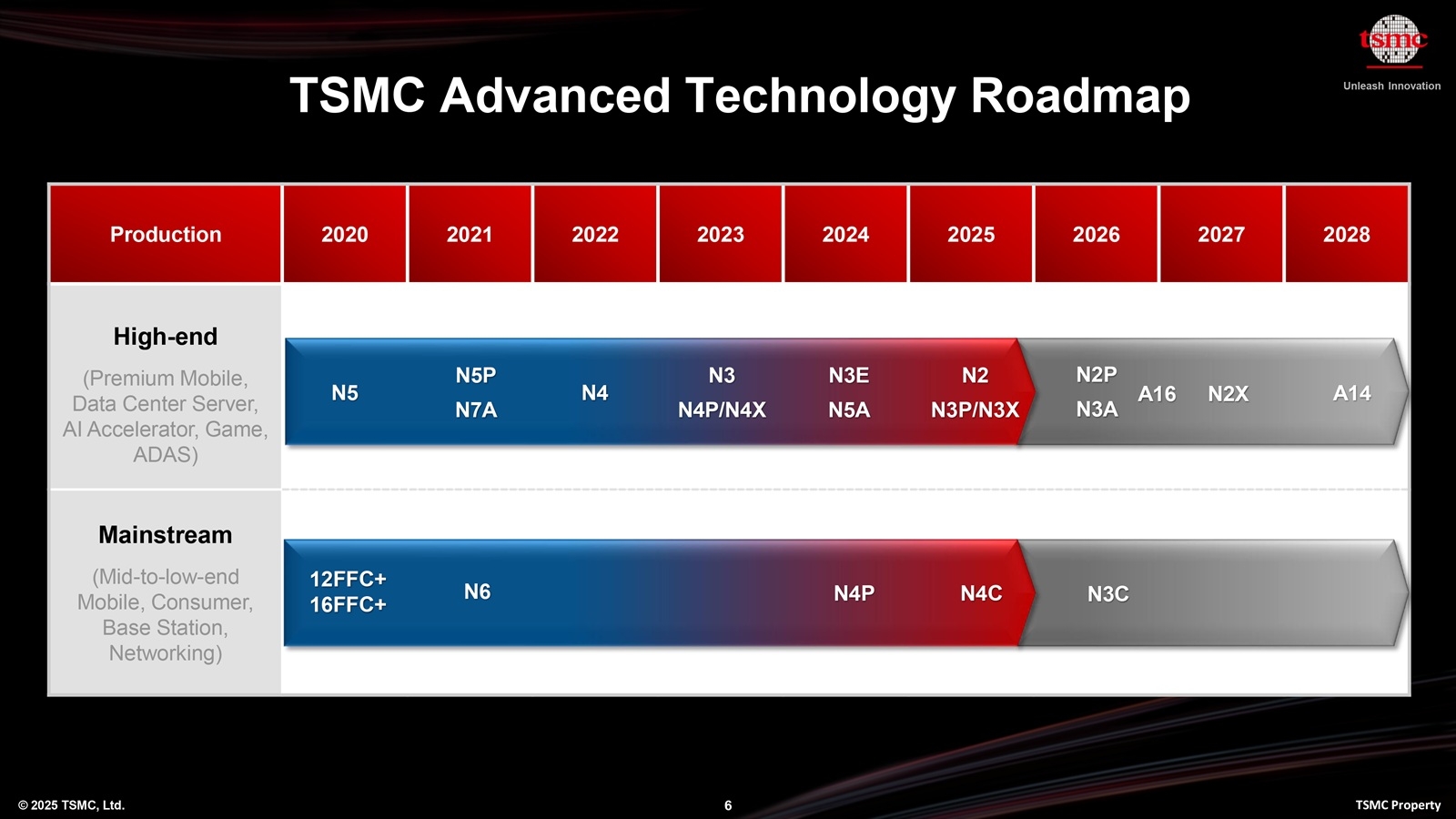
The schedule is tight. TSMC plans its A14 node for 2028, promising chip density increased by 20% and consumption reduced by 30%.
But building a factory takes three years, and ramping it up two more. Nothing happens with the snap of a finger. This physical inertia is TSMC’s best defense.
However, the emergence of Terafab project of Elon Musk shows that the industrial landscape could fragment faster than expected under the pressure of sovereign computing needs.
How does TSMC plan to maintain its technological lead?
TSMC relies on a strategy of continuity and incremental improvement of its node families N2, N2P and A16 to lock in the market. By relying on architectures June 6 of AMD or future Apple products, the founder guarantees massive volumes which ensure its margins.
The Taiwanese firm plays the experience card: there is “no no shortcuts » in this profession, recalls CC Wei. There chip manufacturing on a large scale remains an art of logistics as much as physics.
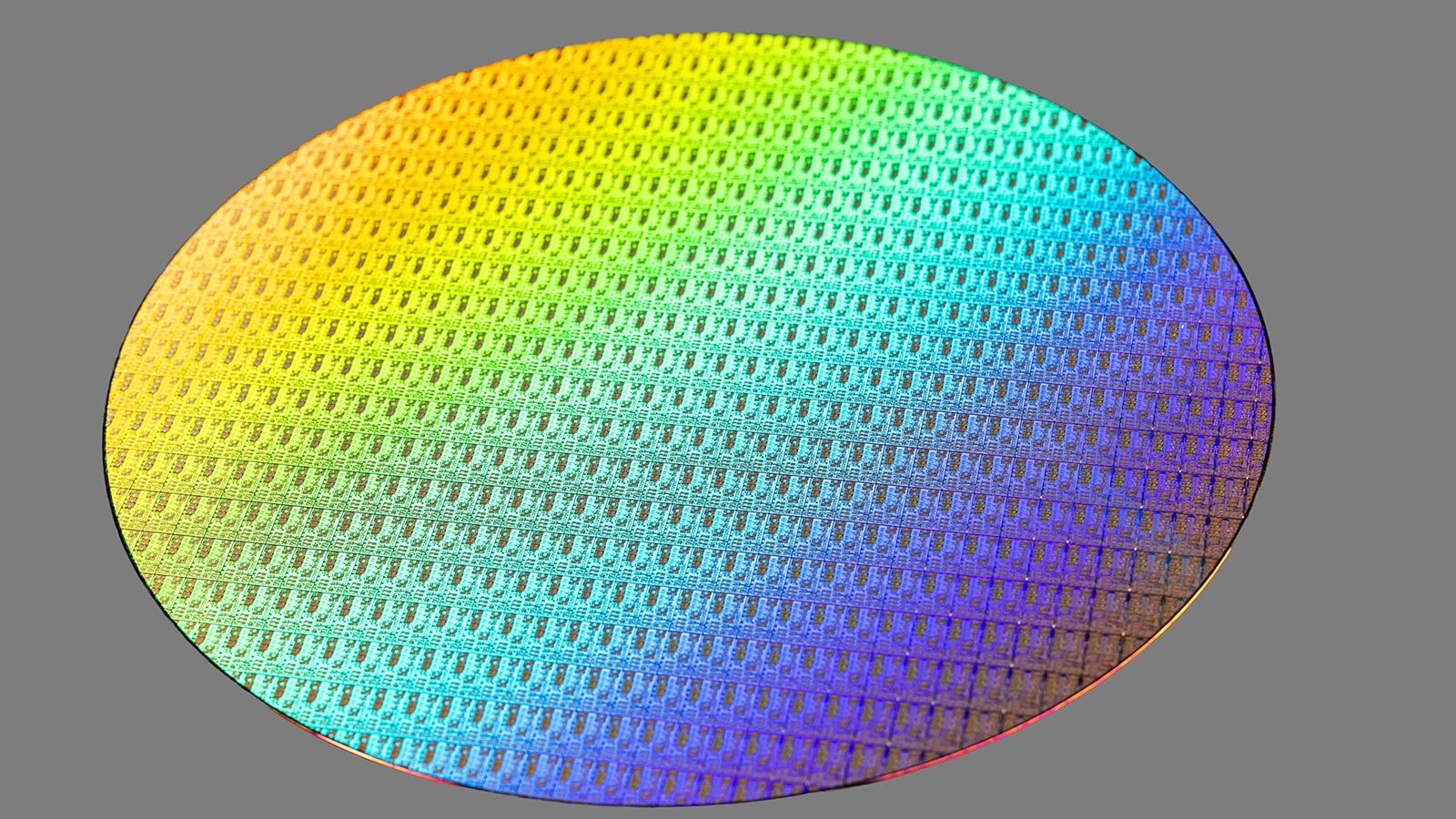
Panther Lake chip wafer in Intel 18A process
Despite geopolitical tensions which disrupt the supply of rare gases such as LPG, TSMC secures its stocks to maintain its lines active. Resilience is the key word.
The founder is banking on its expertise in 2.5D packaging to counter EMIB. We are witnessing an escalation of technical superlatives which masks a simpler reality: the first to stumble on its yields (rate of functional chips per wafer) will leave the field open to the other. For now, TSMC keeps control, but for how long?
Will the Intel-TSMC duel redefine the price of our devices?
Head-on competition between these two titans could stabilize production costs, but the explosion in demand for AI is pushing prices upwards. If Intel manages to attract the big names in tech with its foundry prices, TSMC may have to adjust its historically very high margins.
This would directly influence the final price of smartphones and high-performance servers (HPC) that we consume daily. The market can only rejoice to see a third champion, alongside Samsung, capable of producing at the highest level.
The diversity of sources is insurance against global shortages. But be careful: the complexity of the new A14 and 14A nodes makes every error along the way fatal.