
Ford has just auctioned a car so special and unique that, in fact, it was not built for customers, but for the engineers who were working on the development of the second-generation Ford GT to celebrate the 50th anniversary of Ford’s Le Mans triplet in 1966. So much so that the car was auctioned with a bare, unpainted body.
However, it is such an exclusive supercar that Ford has made sure to keep it away from prying eyes, so even though its engine works perfectly, no one will be able to show it off in public. Above all, its owner.
First prototype, second legend
The Ford GT Mk II, which has just been auctioned on the Barrett-Jackson portal, was designed at the end of 2015 as a mechanical test mule for the new engine that would be mounted in the second generation of the Ford GT that was presented in 2017.
Engineers used this car in the early testing phases of the project to collect real-world data on the dynamic behavior of the design, its aerodynamic stability and the response of the suspension under extreme conditions. So it was the intermediate step between the designs on paper and the model that would finally hit the market two years later.
Being an early design means that the car still retains the essence of the original designs, before aerodynamics or technical requirements forced certain profiles of its body to be polished. However, its usefulness as a test mule meant that technical usefulness was prioritized over aesthetics.

It was a laboratory tool on wheels, not a rolling showcase, and this was taken to the extreme that the engineers did not even consider painting the carbon fiber body, sensing that sooner rather than later it would need touch-ups.
Only five prototypes were built, so this unit spent years stored in the Ford Heritage Fleet collection, an internal collection with which the brand protects its most valuable prototypes and vehicles with historical pedigree, until it was time to bring it to light. Its recent sale makes it a unique case: it goes from being a corporate secret to becoming a private trophy.
Driving in public is prohibited
However, the brand had a hidden ace up its sleeve. The purchase of this unique supercar was linked to a very restrictive clause: the explicit and absolute prohibition of registering it, insuring it as a vehicle or driving it on any public road. That is, its owner will never be able to wear it in public, except to use it on a private circuit.
In this way, the first prototype of the 2017 Ford GT becomes a sculpture with an engine that can only be admired in the collection of the buyer who has paid $467,500 for this unique example due to its technical and historical pedigree.
Being the first Ford GT prototype to break the confidentiality of Ford garages classifies it as an exclusive collector’s item, especially for those who already have a street GT in their collection.
Under that rough and rough untreated carbon fiber body there is still the 3.5 EcoBoost V6 biturbo engine that it shares with the final GT, a brutal engine with a twin turbocharger that delivers its power through a seven-speed dual-clutch automatic transmission, optimized for pure rear-wheel drive.
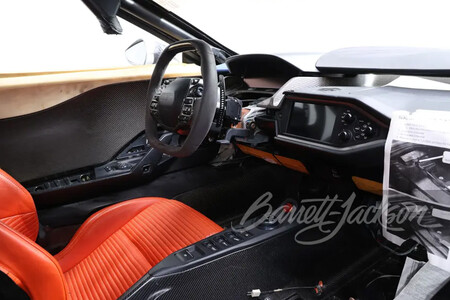
When you open its doors upwards, you are greeted by an interior as austere and practical as its exterior, designed to give your all on the track, but without the fine Alcantara finishes that you expect to find in a car for which you have paid almost $500,000.
It features a single fixed bucket seat molded in carbon fiber for the test driver, position-adjustable pedals to adapt to different drivers, and a flattened Formula 1-style steering wheel with integrated buttons. No sign of the passenger seat, which underlines its single-seater work role, whose objective was to push the performance of its engine and body to the limit. An untamed beast…that no one can legally drive on a road.
In WorldOfSoftware | In 1982 someone became unhealthy obsessed with a Mercedes-Benz 500 SL: in 43 years he has not driven it even a single kilometer.
Imagen | Barret&Jackson