

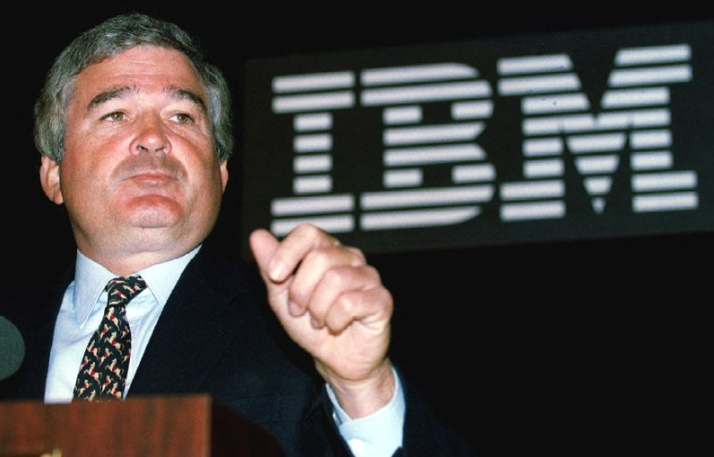
Louis Gerstner, the former chief executive officer credited with saving IBM Corp. from bankruptcy, has died aged 83, the company revealed today.
Gerstner (pictured) served as chairman and CEO of IBM from 1993 to 2002, taking over during one of the darkest periods in the company’s history, when it was rapidly losing relevance in the face of stiff competition from Microsoft Corp. and Sun Microsystems Inc.
IBM’s current Chairman and CEO Arvind Krishna announced Gerstner’s passing in an email to employees, but did not provide a cause of death. He wrote that one of first and most decisive actions was to abandon a plan to split the company, known as “Big Blue,” into a number of “Baby Blues” that would have focused on specific products, such as personal computers, software and semiconductors. According to Krishna, this decision was key to the company’s survival and later revival. “Lou understood that clients didn’t want fragmented technology, they wanted integrated solutions,” he wrote.
IBM became one of the most dominant names of the nascent technology industry in the 1960s and 1970s thanks to its mainframe computers. But after developing the IBM PC in 1981, the company lost ground in that market as competitors launched more affordable and user-friendly machines that were powered by Intel Corp.’s processors and ran software such as Microsoft’s MS-DOS and Windows operating systems.
“Lou arrived at IBM at a moment when the company’s future was genuinely uncertain,” Krishna said. “The industry was changing rapidly, our business was under pressure, and there was serious debate about whether IBM should even remain whole. His leadership during that period reshaped the company. Not by looking backward, but by focusing relentlessly on what our clients would need next.”
Gerstner took over the hot seat at IBM after serving as the CEO of the now-defunct conglomerate R. J. Reynolds Nabisco Inc., becoming the first outsider to lead the company. Prior to that, he had held senior executive roles at American Express Co. and the consultancy firm Mckinsey Co. He stunned reporters during one of his first interviews after taking over the then-loss making company, saying that “the last thing IBM needs right now is a vision”.
Instead, Gerstner insisted that the top priority was to return the company to profitability and serve existing customers better.
During his nine years at the helm of the company, he was credited with leading its pivot to business services, a move that kickstarted its profit engines and staved off bankruptcy. He also introduced radical changes to IBM’s culture, while focusing on slashing expenses, selling off unprofitable assets such as its PC making division, and repurchasing stock. Another key decision led to IBM abandoning its OS/2 operating system, which was designed as a rival to Microsoft’s Windows. Toward the end of his rein at the company, he successfully helped steer it through the dot-com crisis that engulfed the tech industry.
Gerstner was also passionate about introducing technology to transform public education. He authored the book “Reinventing Education: Entrepreneurship in America’s Public Schools,” and later launched an initiative that saw IBM’s technology become widely used for learning in American classrooms.
By the time Gerstner retired in 2002, IBM’s stock was more than 800% higher than it had been when he first took over the company. He later served as Chairman of Carlyle Group Inc., before retiring in 2008 to focus on philanthropy, supporting causes such as biomedical research and helping to establish social services organizations in Boston, New York City and Palm Beach County, Florida.
Krishna said Gerstner was a “direct leader” who challenged assumptions.
“I have my own memory of Lou from the mid-1990s, at a small town hall with a few hundred people,” he told employees. “What stood out was his intensity and focus. He had an ability to hold the short term and the long term in his head at the same time. He pushed hard on delivery, but he was equally focused on innovation, doing work that clients would remember, not just consume.”
Photo: IBM
Support our mission to keep content open and free by engaging with theCUBE community. Join theCUBE’s Alumni Trust Network, where technology leaders connect, share intelligence and create opportunities.
- 15M+ viewers of theCUBE videos, powering conversations across AI, cloud, cybersecurity and more
- 11.4k+ theCUBE alumni — Connect with more than 11,400 tech and business leaders shaping the future through a unique trusted-based network.
About News Media
Founded by tech visionaries John Furrier and Dave Vellante, News Media has built a dynamic ecosystem of industry-leading digital media brands that reach 15+ million elite tech professionals. Our new proprietary theCUBE AI Video Cloud is breaking ground in audience interaction, leveraging theCUBEai.com neural network to help technology companies make data-driven decisions and stay at the forefront of industry conversations.


