By using this site, you agree to the Privacy Policy and Terms of Use.
Accept
World of SoftwareWorld of SoftwareWorld of Software
  • News
  • Software
  • Mobile
  • Computing
  • Gaming
  • Videos
  • More
    • Gadget
    • Web Stories
    • Trending
    • Press Release
Search
  • Privacy
  • Terms
  • Advertise
  • Contact
Copyright © All Rights Reserved. World of Software.
Reading: Google DeepMind Introduces ATLAS Scaling Laws for Multilingual Language Models
Share
Sign In
Notification Show More
Font ResizerAa
World of SoftwareWorld of Software
Font ResizerAa
  • Software
  • Mobile
  • Computing
  • Gadget
  • Gaming
  • Videos
Search
  • News
  • Software
  • Mobile
  • Computing
  • Gaming
  • Videos
  • More
    • Gadget
    • Web Stories
    • Trending
    • Press Release
Have an existing account? Sign In
Follow US
  • Privacy
  • Terms
  • Advertise
  • Contact
Copyright © All Rights Reserved. World of Software.
World of Software > News > Google DeepMind Introduces ATLAS Scaling Laws for Multilingual Language Models
News

Google DeepMind Introduces ATLAS Scaling Laws for Multilingual Language Models

News Room
Last updated: 2026/01/29 at 2:05 AM
News Room Published 29 January 2026
Share
Google DeepMind Introduces ATLAS Scaling Laws for Multilingual Language Models
SHARE

Google DeepMind researchers have introduced ATLAS, a set of scaling laws for multilingual language models that formalize how model size, training data volume, and language mixtures interact as the number of supported languages increases. The work is based on 774 controlled training runs across models ranging from 10 million to 8 billion parameters, using multilingual data covering more than 400 languages, and evaluates performance across 48 target languages.

Most existing scaling laws are derived from English-only or single-language training regimes. As a result, they provide limited guidance for models trained on multiple languages. ATLAS extends prior work by explicitly modeling cross-lingual transfer and the efficiency trade-offs introduced by multilingual training. Instead of assuming a uniform impact from adding languages, the framework estimates how individual languages contribute to or interfere with performance in others during training.

At the core of ATLAS is a cross-lingual transfer matrix that measures how training on one language affects performance in another. This analysis shows that positive transfer is strongly correlated with shared scripts and language families. For example, Scandinavian languages exhibit mutual benefits, while Malay and Indonesian form a high-transfer pair. English, French, and Spanish emerge as broadly helpful source languages, likely due to data scale and diversity, though transfer effects are not symmetric.


Source: Google DeepMind Blog

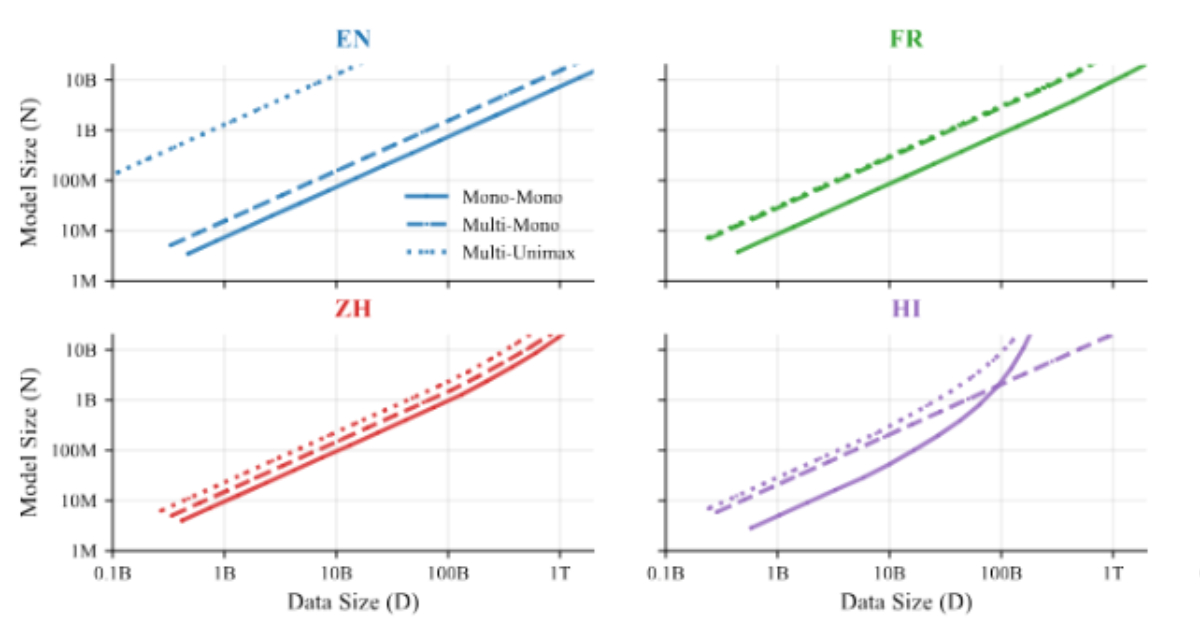
ATLAS extends scaling laws by explicitly modeling the number of training languages alongside model size and data volume. It quantifies the “curse of multilinguality,” where per-language performance declines as more languages are added to a fixed-capacity model. Empirical results show that doubling the number of languages while maintaining performance requires increasing model size by roughly 1.18× and total training data by 1.66×, with positive cross-lingual transfer partially offsetting the reduced data per language.

The study also examines when it is more effective to pre-train a multilingual model from scratch versus fine-tuning an existing multilingual checkpoint. Results show that fine-tuning is more compute-efficient at lower token budgets, while pre-training becomes advantageous once training data and compute exceed a language-dependent threshold. For 2B-parameter models, this crossover typically occurs between about 144B and 283B tokens, providing a practical guideline for selecting an approach based on available resources.

The release has started a discussion about alternative model architectures. One X user commented:

Rather than an enormous model that is trained on redundant data from every language, how large would a purely translation model need to be, and how much smaller would it make the base model?

While ATLAS does not directly answer this question, its transfer measurements and scaling rules offer a quantitative foundation for exploring modular or specialized multilingual designs.


Sign Up For Daily Newsletter

Be keep up! Get the latest breaking news delivered straight to your inbox.
By signing up, you agree to our Terms of Use and acknowledge the data practices in our Privacy Policy. You may unsubscribe at any time.
Share This Article
Facebook Twitter Email Print
Share
What do you think?
Love0
Sad0
Happy0
Sleepy0
Angry0
Dead0
Wink0
Previous Article 8 Best Sleep Headphones of 2026 8 Best Sleep Headphones of 2026
Next Article ServiceNow’s stock slides on iffy subscription revenue forecast –  News ServiceNow’s stock slides on iffy subscription revenue forecast – News
Leave a comment

Leave a Reply Cancel reply

Your email address will not be published. Required fields are marked *

Stay Connected

248.1k Like
69.1k Follow
134k Pin
54.3k Follow

Latest News

Cache vs. Database: Comparing Memcached and ScyllaDB | HackerNoon
Computing
Google DeepMind open-sources AlphaGenome medical research model –  News
Google DeepMind open-sources AlphaGenome medical research model – News
News
Building Software Organisations Where People Can Thrive
News
Google is bolstering Android theft protection with these key new features
Gadget

You Might also Like

Google DeepMind open-sources AlphaGenome medical research model –  News
News

Google DeepMind open-sources AlphaGenome medical research model – News

5 Min Read
Building Software Organisations Where People Can Thrive
News

Building Software Organisations Where People Can Thrive

6 Min Read
Expert Advice: Follow These 4 Rules for Perfect Espresso Every Time
News

Expert Advice: Follow These 4 Rules for Perfect Espresso Every Time

11 Min Read
Technological innovation is a team sport – UKTN
News

Technological innovation is a team sport – UKTN

5 Min Read
//

World of Software is your one-stop website for the latest tech news and updates, follow us now to get the news that matters to you.

Quick Link

  • Privacy Policy
  • Terms of use
  • Advertise
  • Contact

Topics

  • Computing
  • Software
  • Press Release
  • Trending

Sign Up for Our Newsletter

Subscribe to our newsletter to get our newest articles instantly!

World of SoftwareWorld of Software
Follow US
Copyright © All Rights Reserved. World of Software.
Welcome Back!

Sign in to your account

Lost your password?