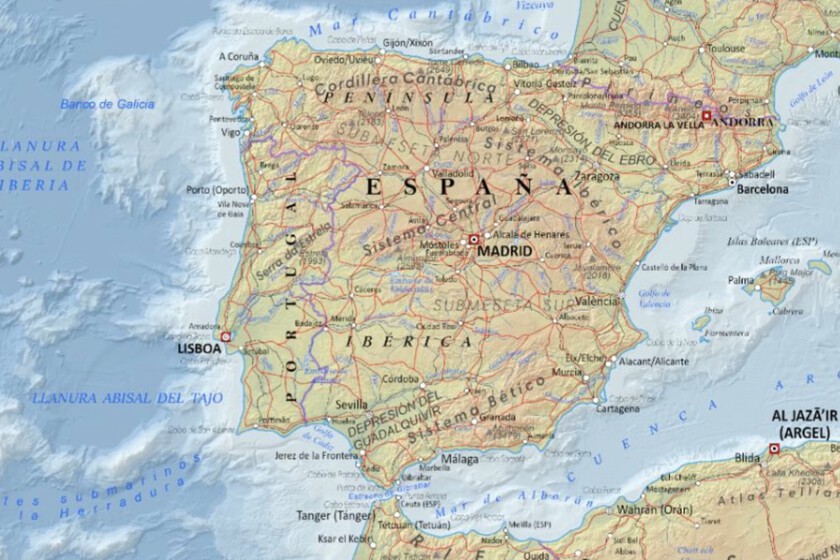
Looking back to see what the maps of yesteryear looked like can be fascinating because, well, you may find that in the Roman Empire they had a whole tangle of highways, but there is no need to go that far: the road infrastructure of the Spanish state has changed enormously in recent decades. You can ask your grandfather, but you can also see it in the latest and ambitious project of the National Geographic Institute.
Spain in the 1950s was eminently rural, but agrarian modernization, industrialization and poverty led to the exodus of a significant part of the population from the towns to the cities. Throughout those 70 years, a dense and complex network of infrastructure and urban centers has been developed that did not exist before. Towns, cultivated areas and fields have been left along the way.
For this ‘Google Maps of Spain from the 50s to today‘The IGN relies on Telespazio Ibérica, a geographic information company with satellite services. Its objective for nine months will be to launch the Historical Information System on Land Occupation in Spain (SIOSE).
The new Historical Information System on Land Occupation in Spain (SIOSE) will be the most complete, precise and exhaustive tool to analyze the effects of climate change on the state’s ecosystem, the changes in territorial planning and land use in recent decades. As the director of cartography at Telespazio Ibérica, Óscar Muñoz, explains:
“The Historical SIOSE will not only include a complete database, but also a statistical and visual validation report that will guarantee the reliability of the results for scientific, urban and environmental uses. Thanks to this we will be able to see, objectively, how the Spanish ecosystem has changed and know which green areas have been lost, which urban areas have grown and how our landscape has evolved in the last 70 years.”
The idea is to capture how its territory and landscape have evolved that period of time painstakingly rebuilding cities and towns, forests, crops, roads and buildings, among others. This Information System on Land Occupation in Historical Spain will be made up of 572 sheets of the National Topographic Map, ranging from the first complete aerial record of the territory (the American flight of ’56) and cartography generated later, both at the regional and state levels.
In addition, Telespazio Ibérica is based on a pilot developed for the IGN and will have to refine it with a more precise and functional land coverage. To do this, they will use both digitization and automated image analysis and AI algorithms, which guarantee reproducibility throughout the entire territory.
In WorldOfSoftware | Castilla-La Mancha is about to shrink 2,000 hectares in favor of Aragon. All because of a 19th century dispute
In WorldOfSoftware | Who owns the maps in the world?