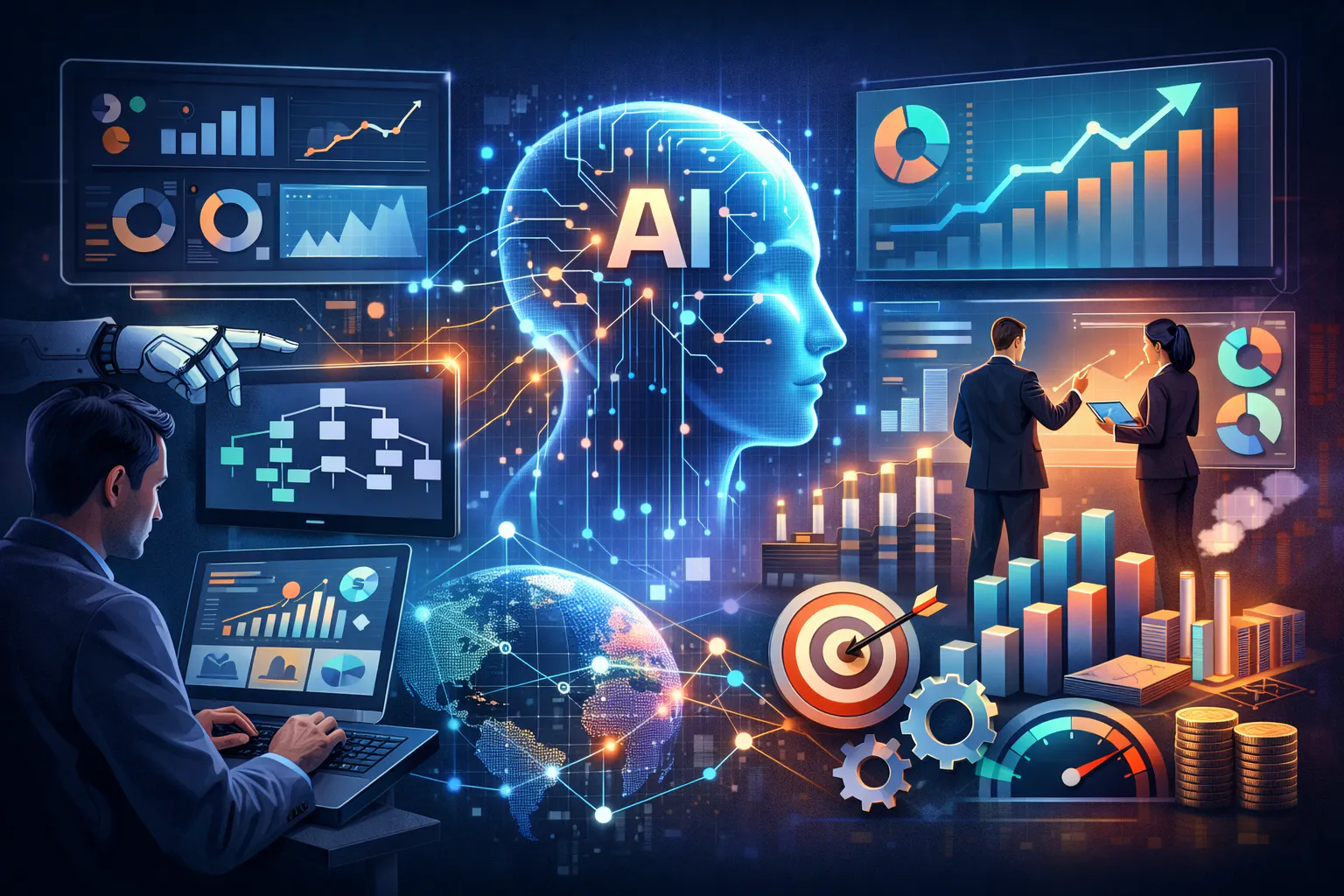
Traditionally, performance management of enterprises has been characterized by the use of fixed models, aggressive spreadsheets, and post-factum analysis. Although these methods have been used in organizations over the decades, they find it hard to match the pace, complexity, and uncertainty of modern business environments. Today, decision intelligence is starting to revolutionize the way organizations plan, predict, and respond to change by using the power of artificial intelligence and advanced analytics.
After successfully completing some enterprise-level EPM projects, I have come to realize that effectual change cannot be accomplished by merely introducing AI capabilities into the systems the company already has. The redressing of planning architectures results in a product in which data, automation, and human judgment all relate to each other in a disciplined and scalable manner.
From Retrospective Planning to Forward-Looking Intelligence
The conventional scheme of planning was rather reactive. Forecast revision was cumbersome, the assumptions were made initially, and finance departments took a lot of time to ensure that the data fitted instead of being analysed. The situation was already transformed before the realization trickled down to the leadership.
This model is converted to progressive and future-oriented planning that is AI-enabled in decision intelligence. The EPM systems available today are capable of receiving both operational and financial data and providing predictions and forecasts in response to new data. As it is executed correctly, it will make companies forget about their annual plans and rely on rolling forecasts that reflect actual business trends.
The quality of such capabilities, however, is very reliant on the quality of data and model design. Predictive outputs could be used to reinforce errors already present instead of lowering them unless there is a strong governing body. Practically, effective implementations are based on clean data pipelines, clear assumptions, accountability, and high-level analytics.
Breaking Down Functional Silos Through Integrated Planning
The resources available in decision intelligence in EPM include one of the most positive advantages: the ability to align the planning of financial, operating, and commercial teams. In the past, the roles had their own models and measures, which gave rise to conflicting assumptions and slow decision-making processes.
The combination of an intelligence-driven planning environment facilitates teamwork against a common database. Common drivers and scenarios can interconnect sales, supply chain planning, and finance planning, thereby eliminating the additional work needed for reconciliation and boosting alignment in the organization. Enterprise planning discourses that have taken this approach do not focus on the discourse of numbers as an argument but on the analysis of strategic decisions.
This evolution does not involve the role of human judgment being pushed to another level but rather sets it on a different stage. It will help leaders in the finance and operations departments to expect change and dedicate a greater amount of time to trade-off evaluation by cutting short the time spent arranging data manually.
Automation That Enables, Rather Than Obscures, Insight
Other important features of modern EPM are guideline and harmony, which are, in most cases, referred to as cost-saving options. Synthesis of information, validation, and reconciliation will be automated, there will be no chance of human error, and it offers a good foundation for further sophisticated analytics.
This importance of this history is particularly noticed where there is application of scenario modeling. Decision intelligence helps organizations generate simulations of virtual and actual conditions in comparison with known, predetermined situations that are often known as what-if analysis. Rather than reacting to occurrence, leaders will anticipate the hypothesized cost of supply disruption, alteration of demand, or decrease in cost.
Such capabilities are not a quarterly planning activity but a continuous decision-making process regarding the most optimal implementations. This brings about architectural close that enables performance scaling, transparency, and auditability.
Smarter Forecasting Through Continuous Learning
Prediction has always been very uncertain, and decision intelligence allows predictions to improve each time new information becomes available. Machine learning models can also optimize projections based on new trends, seasonal patterns, as well as other behavioral indicators, which are hard to model manually.
That being said, it does not solely use algorithms to make accurate predictions. Dimensional models, business logic consistency, and the scope and determinacy of drivers are also vital. As a matter of fact, the most successful outcomes are achieved when machine learning is applied alongside finance-use AI to elicit information and preserve the necessary control of assumptions and conclusions by human beings.
Empowering Decision-Making Across the Organization
Access to insight is also no longer confined to special teams, as decision intelligence is infiltrating EPM platforms. It has characteristics such as role-based dashboards, easy-to-use visualizations, and natural-language query systems that may enable organizational leaders at various levels to engage in a direct relationship with planning data.
This sort of democratization of wisdom is what determines how organizations are run. They are better educated, make decisions faster, and are more confident of downstream effects. The opportunities for predictability and business orientation in the decision-making process appear to exist, as users are confident about the information and even about the system.
A More Agile and Disciplined Future for EPM
The multiplication of technologies and the re-invention of performance management in organizations are decision intelligence and AI, respectively. In the successful tier of change, the majority of EPM changes provide a trade-off between innovation and discipline, advanced analytics and data management, and architectural acuity and business focus.
Decision intelligence will be more in demand as businesses turn turbulent and complex in their quest to make responsible, informed, and timely decisions. Those companies that make moderate investments in capabilities developed around realistic functional requirements rather than hype will be better suited to adapt, compete, and evolve.